





 이미지 확대보기
Despite strong results in refining and lubricants, earnings are expected to decline next year. The company also faces the task of proving the profitability of the petrochemical project Shaheen, in which it has invested more than KRW 9 trillion, amid concerns over oversupply.
S-Oil reported third-quarter revenue of KRW 11.9687 trillion and operating profit of KRW 1.4067 trillion. Operating profit surged 514% from a year earlier and beat the market consensus by about 18%. Cumulative operating profit for the first three quarters came to KRW 3.6027 trillion, a turnaround from an operating loss of KRW 136.3 billion in the same period last year.
The segment accounted for more than half of total operating profit, with an operating margin of 48.1%. Supply of Group III base oil, a premium lubricant base oil, tightened because of production disruptions and logistics constraints in the Middle East, which widened product spreads.
Refining operating profit climbed 29.7% from the previous quarter to KRW 690.4 billion. Rising international oil prices amid the prolonged war in the Middle East generated inventory-related gains, and refining margins also improved.
관련기사
A Shrimp Between Two Whales: Korea Petrochemical Caught Between S-Oil and China'Expansion' S-OIL vs. 'Caution' GS Caltex [KFT Topic]GS Stock Hits Record High, Yet Still Trades at Half Its Book ValueLG Chem Swings to Petrochemical Loss, Warns Shaheen Start-up Will Deepen OversupplyFuel Prices Surge to Three-Year High amid Iran Crisis... Oil Refiners Expected to Post Earnings Surprise
Shares move against earnings
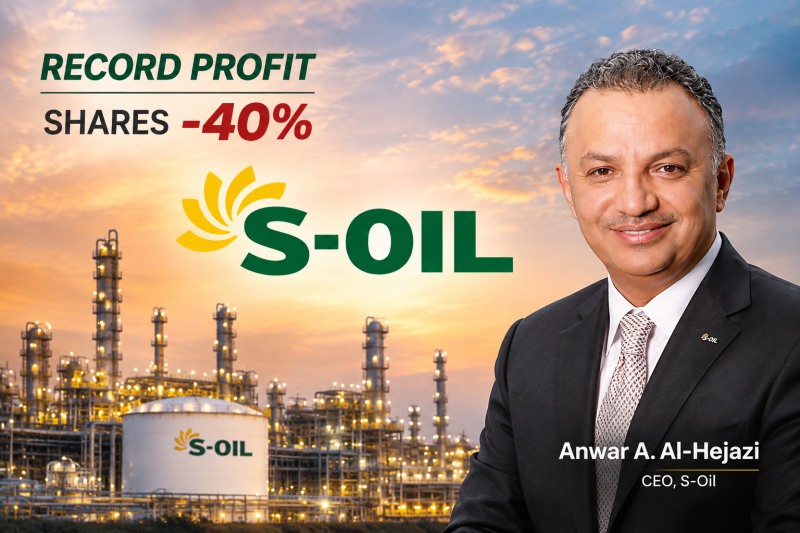
The stock moved in the opposite direction of earnings. S-Oil shares hit KRW 170,600 on Oct. 7, a 15-year high, before turning lower. On Nov. 11, they slid to KRW 103,900, down about 39% from the peak in a little over a month.The market is focusing less on current earnings than on the likelihood of a profit decline next year. Brokerages forecast this year’s operating profit at KRW 4.5 trillion to KRW 4.8 trillion, but expect it to fall to the range of KRW 3.5 trillion to KRW 3.9 trillion in 2027.
The inventory gains from higher oil prices that supported this year’s refining profit could vanish next year. If oil prices fall, the company could face a reverse lagging effect, and lubricant base oil margins, which were inflated by Middle East supply disruptions, may normalize. Fourth-quarter margin adjustments in refining and lubricants, as well as uncertainty over the settlement of loss compensation under the government’s price cap on domestic petroleum products, are additional burdens.
Shaheen: a new variable for earnings
The new variable for future earnings is the Shaheen Project, which has absorbed more than KRW 9 trillion. S-Oil has completed mechanical construction of the main facilities and is conducting test runs. It plans to start up units one by one from January next year and reach normal operating levels within two to three months.Shaheen’s core strengths are TC2C (Thermal Crude to Chemical) technology, to be commercialized for the first time in the world, and a feedstock sourcing structure that leverages existing refining facilities. TC2C is a process that converts crude oil and low-value heavy oil directly into petrochemical feedstock.
The company says it can source 83% of total feedstock internally, using naphtha produced at its existing refineries and off-gas, a byproduct of refining.
Unlike conventional naphtha crackers (NCC), which rely mainly on purchased naphtha, this structure lowers feedstock costs, which is a key differentiator. The company says it can cut capital and operating costs by 30% to 40% compared with existing processes and achieve energy efficiency 10% higher than the world’s best facilities.
Once completed, the complex is expected to produce 1.8 million tons of ethylene and 770,000 tons of propylene annually.
The petrochemical market, however, remains weak. Korean petrochemical companies are scaling back facilities and restructuring their businesses in response to accumulated losses at general-purpose NCCs and oversupply.
Brokerages likewise expect S-Oil’s petrochemical losses to widen next year, reflecting the cost burden of Shaheen’s early operations and the industry downturn. The implication is that even with cost competitiveness, it will be difficult to make money from the early stage of the investment unless product demand and prices provide support.
LG Chem said as much during its earnings conference call on Nov. 5. It projected that new capacity additions in Northeast Asia will far outpace closures. By 2031, about 8 million tons of capacity is expected to be shut down, while new additions are expected to reach about 29 million tons.
LG Chem voiced particular concern, saying, “We expect oversupply of some basic petrochemicals and PE products to worsen further in Korea next year as the Shaheen Project begins operation.”
Shareholder returns hinge on Shaheen
Shaheen’s profitability is also directly tied to the scale of future shareholder returns.S-Oil currently maintains a policy of paying out 20% of net profit as dividends. In 2017, it recorded dividends per share of KRW 5,900, a payout ratio of 55% and a dividend yield on common shares of 4.7%. In 2025, those figures fell to KRW 330, 22% and 0.3%, respectively. Dividends per share have fallen to about one-twentieth of the 2017 level.
With the Shaheen investment nearing completion, attention is turning to whether dividends will increase. Industry observers expect the payout ratio to rise to 30% or higher, on the assumption that Shaheen will contribute to earnings.
S-Oil plans to present new shareholder return guidelines in early 2027. Ultimately, whether Shaheen can recoup its massive investment and generate stable profit is likely to be the precondition for any expansion of shareholder returns.
Gwak Horyung (horr@fntimes.com)
데일리 금융경제뉴스 Copyright ⓒ 한국금융신문 & FNTIMES.com
저작권법에 의거 상업적 목적의 무단 전재, 복사, 배포 금지

가장 핫한 경제 소식! 한국금융신문의 ‘추천뉴스’를 받아보세요~