



 이미지 확대보기
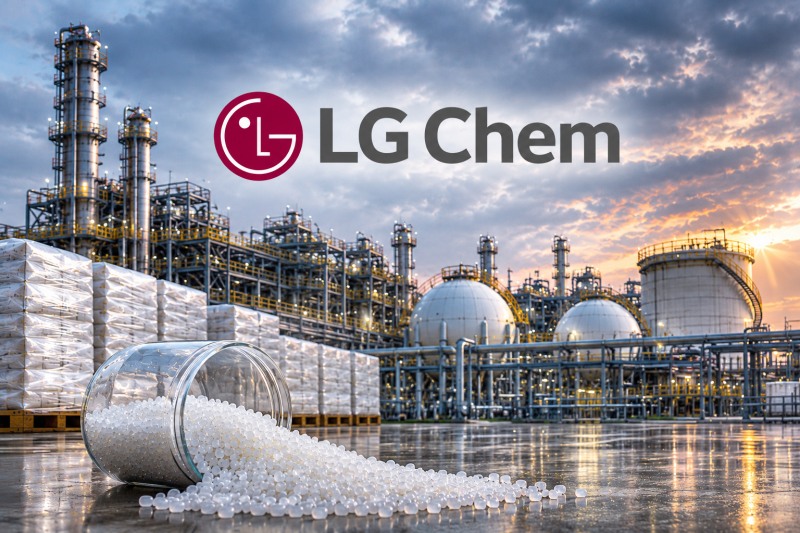
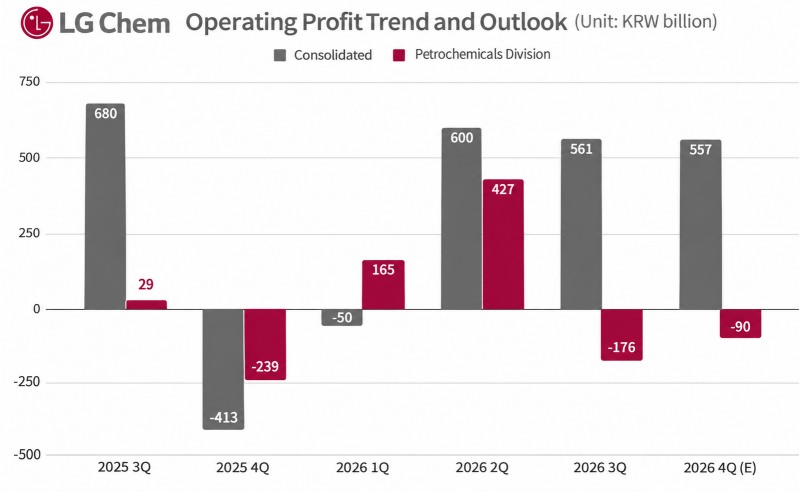
LG Chem announced on the 5th that it posted consolidated revenue of KRW 15.496 trillion and operating profit of KRW 561.2 billion for the third quarter of this year. Revenue rose 34% from a year earlier, while operating profit fell 17.4%. In the same period, operating profit at LG Energy Solution came to KRW 756 billion, exceeding the consolidated figure. A simple subtraction puts the operating result of the remaining businesses, excluding LG Energy Solution, at a loss of about KRW 194.8 billion.
The petrochemical business, its core operation, swung to an operating loss of KRW 175.6 billion on revenue of KRW 4.7547 trillion. Spreads on major products narrowed because of a “negative lagging effect,” in which declines in raw material prices are reflected in product prices with a delay. Higher freight costs and a decline in the exchange rate added to the pressure.
This means that with new capacity far outstripping closures, the start-up of a large domestic facility could add to the supply burden. LG Chem plans to focus on expanding high-value-added products rather than counting on a structural improvement in supply and demand. “Rather than expecting a structural improvement in supply and demand, we will run the business with a focus on profitability, such as by expanding differentiated high-value-added products, and thereby minimize the impact on earnings,” the company said.
 이미지 확대보기
The Advanced Materials division posted revenue of KRW 1.0726 trillion and operating profit of KRW 39.7 billion. Results improved from the previous quarter on higher shipments of battery materials and one-off gains, but profit remained limited. In electronic materials, the company began supplying semiconductor substrate materials for non-memory applications, and customers are evaluating its materials for next-generation glass substrates.
관련기사
LG’s Koo to Weigh AI Execution, Profit Recovery in Year-End ReshuffleLG Chem Petrochemicals Face Losses Despite NCC Restart; Advanced Materials RecoveringA Shrimp Between Two Whales: Korea Petrochemical Caught Between S-Oil and ChinaAs Ambitions Grow, LG Chem's Financial Health Quietly Erodes[Petrochemicals: A Shifting Landscape] Korea's Petrochemical Restructuring Accelerates as Middle East Crisis Bites
The Life Sciences division posted revenue of KRW 337.3 billion and operating profit of KRW 23.2 billion, with profitability lower than in the previous quarter.
The weakness in its main business is also feeding into financial strain. The debt-to-equity ratio at the end of the third quarter was 134.4%, up 4.8 percentage points from the end of the previous quarter. Borrowings fell from KRW 40.3 trillion to KRW 35.5 trillion, but equity declined by a larger margin, from KRW 48.9 trillion to KRW 43.6 trillion. Cash and cash equivalents stood at KRW 9.202 trillion, down by more than KRW 3 trillion from the end of the previous quarter.
Against this backdrop, attention has focused on how LG Chem will use the proceeds from the monetization of its LG Energy Solution stake, which it had promised. The key question is whether it can strengthen financial soundness while also expanding shareholder returns. During the conference call, the company said, “The company’s cash generation capacity is currently extremely deteriorated.” It also reaffirmed its principle of using the proceeds in a balanced way for strengthening financial soundness, investing in future growth and returning value to shareholders.
On Oct. 28, LG Chem announced a KRW 2.5 trillion price return swap (PRS) contract using its LG Energy Solution shares. About 20% of the after-tax cash inflow, or KRW 400 billion, is allocated to shareholder returns, of which KRW 300 billion will go to share buybacks and cancellation. The remainder will be used to fund this year’s year-end dividend.
The transaction is also part of a medium- to long-term plan to monetize its stake. LG Chem plans to lower its stake in LG Energy Solution from the current 79.38% to about 76.6% after this deal, and then gradually to around 70% over the next five years. The company intends to use the funds to ease its borrowing burden while pursuing growth investment and shareholder returns in parallel.
This is the first time LG Chem is returning value to shareholders through share buybacks and cancellation in addition to dividends. Explaining this approach, the company said, “We judged that the shares are considerably undervalued relative to their intrinsic value,” adding, “we judged that, apart from minimum dividends, share repurchases are a more effective way to enhance shareholder value.”
Gwak Horyung (horr@fntimes.com)
데일리 금융경제뉴스 Copyright ⓒ 한국금융신문 & FNTIMES.com
저작권법에 의거 상업적 목적의 무단 전재, 복사, 배포 금지

가장 핫한 경제 소식! 한국금융신문의 ‘추천뉴스’를 받아보세요~