





 이미지 확대보기
A Hyundai Motor Group official said this on the 4th at the World Hydrogen Expo 2026 (WHE 2026), which opened at KINTEX Exhibition Hall 2.
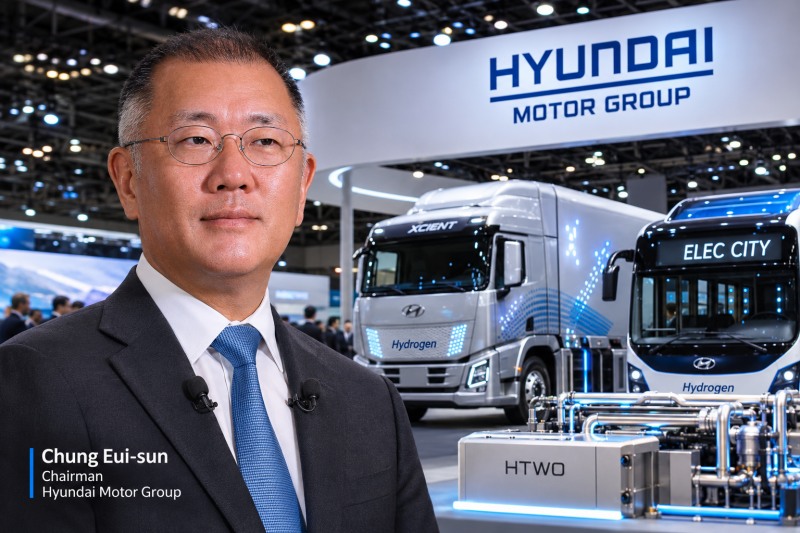
Despite market skepticism stemming from weak domestic sales of the Nexo hydrogen fuel cell passenger car and delays in rolling out charging infrastructure, the cards Hyundai Motor Group brought to this expo were clear: a commercial-vehicle-only fuel cell system with improved durability, the Xcient hydrogen fuel cell truck, and the Elec City hydrogen fuel cell low-floor intercity bus. The group signaled its intention to shift the center of gravity of hydrogen mobility from passenger cars to commercial vehicles and to expand its business scope to hydrogen production and charging infrastructure.
 이미지 확대보기
Hydrogen’s Competitiveness Found in Commercial Vehicles
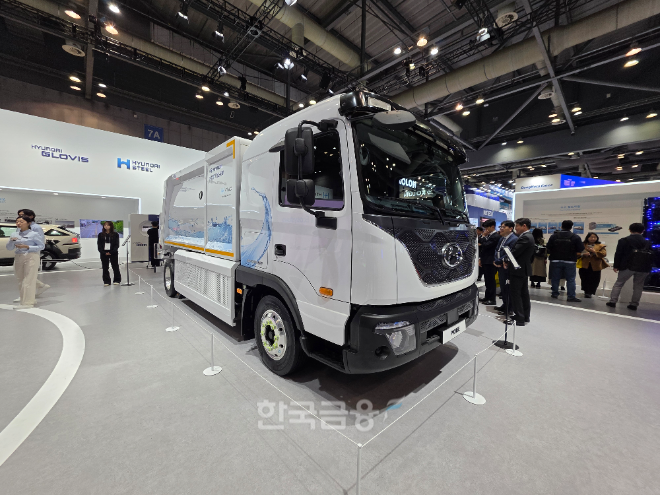
Hyundai Motor Group’s booth at WHE 2026 looked like a giant hydrogen forward base. At the center of the exhibition hall, a demonstration of the Automatic Charging Robot for hydrogen vehicles (ACR-H), which automatically connects a charging nozzle to a hydrogen fuel cell cleaning truck, drew the attention of visitors. The robot recognizes the vehicle’s charging port on its own, opens the protective cap and attaches the connector.The market Hyundai Motor Group is targeting first in its hydrogen business is commercial vehicles. While EVs have established competitiveness in the urban passenger car market, battery weight and charging time remain unresolved challenges in the heavy commercial vehicle market.
관련기사
Global Top 3 Reached, Hyundai Chairman Chung Now Faces Test of Turning Future Bets Into ProfitThe Three Women Steering Chung Eui-sun's Hyundai FutureHyundai Steps Up U.S. Robot Lobbying as China Race Heats UpInefficient Capital Allocation Holds Back Hyundai Motor's Stock Despite Record ProfitHyundai Motor Group Chairman Mulls Deepening Boston Dynamics IPO Dilemma
Large trucks that carry dozens of tons of cargo over long distances must be equipped with large-capacity batteries to secure driving range. As battery capacity increases, the vehicle’s own weight rises, which can reduce cargo capacity. For logistics operators, not only a vehicle’s driving range but also how much cargo it can carry at a time is an important economic criterion.
Charging time is also a variable. For commercial vehicles that operate for long hours, the longer they must stop to charge, the lower their utilization rate. Hydrogen fuel cell vehicles, by contrast, can typically resume operation after about five to 10 minutes of refueling, leaving room to secure competitiveness in long-distance, heavy-load transport. The fact that no additional large-capacity batteries are needed is also an advantage in terms of loading efficiency.
This is the background to Hyundai Motor Group’s first public unveiling of a commercial-vehicle-only fuel cell system at the expo. Its key feature is improved durability, designed with the characteristics of commercial vehicles, which are often operated for long hours and long distances, in mind. Because operators suffer large losses when vehicles stop running, the durability and stability of the fuel cell system determine a vehicle’s competitiveness.
The group also displayed the Xcient hydrogen fuel cell truck, the Universe hydrogen fuel cell bus and the Elec City hydrogen fuel cell low-floor intercity bus. It also introduced “Blue Link Uptime Care,” an integrated control system that monitors operating status and the condition of key components in real time, in addition to supplying vehicles. Charging automation through the automatic charging robot is likewise a technology aimed at the commercial vehicle market. The strategy is to lower the operating burden of hydrogen commercial vehicles by linking not only vehicles and fuel cells but also operation, maintenance and charging.
 이미지 확대보기
From Automaker to Energy Supplier
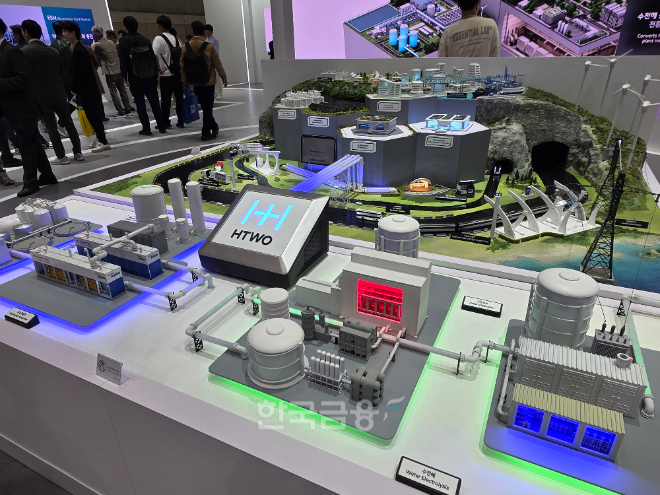
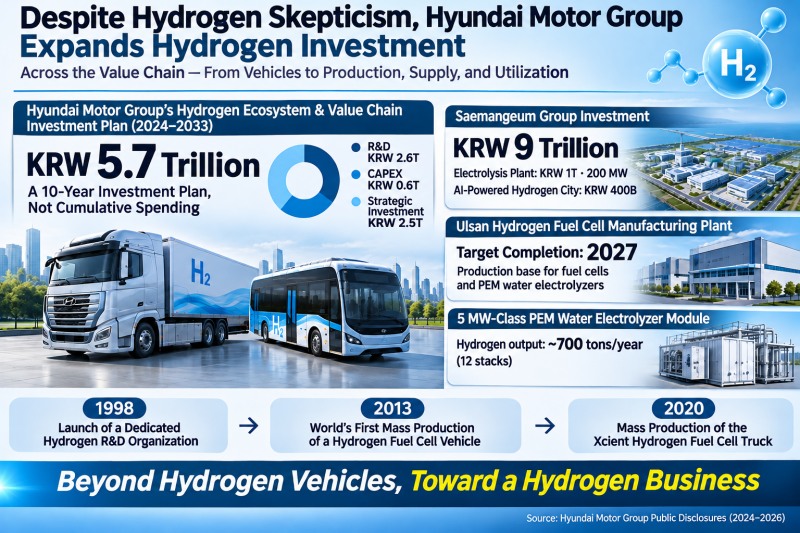
Hyundai Motor Group’s hydrogen business does not stop at manufacturing vehicles. The second thing that caught the eye at this exhibition was its hydrogen production infrastructure. Centered on HTWO, the group’s hydrogen business brand, it presented an integrated hydrogen solution linking production, transport and utilization.A representative technology is the proton exchange membrane (PEM) water electrolysis system. At the event, the group unveiled for the first time a 5 MW-class Electrolyzer Stack Module (ESM) that integrates 12 existing electrolysis stacks. Each module can produce about 700 tons of hydrogen a year, and placing multiple modules in parallel allows expansion into a water electrolysis plant of several hundred MW.
The group also displayed W2H (Waste-to-Hydrogen), a hydrogen production model that uses waste resources. It is a resource-circulating business model that extracts hydrogen from waste such as food waste and waste plastics and uses it locally. The aim is to diversify hydrogen production methods according to the availability of regional renewable energy and waste resources.
The reason Hyundai Motor Group seeks to secure even hydrogen production technology is that leadership in the future mobility market may not be limited to vehicle manufacturing. Even if hydrogen vehicles are sold, market expansion will be limited without production facilities, transport networks and charging infrastructure to supply fuel reliably.
Conversely, if the group links hydrogen production, vehicle supply, charging and operation, it can build a business model that provides infrastructure and operating solutions together, going beyond finished-vehicle sales.
The Saemangeum AI Valley initiative is also an extension of this strategy. Hyundai Motor Group presented a future industrial city model that uses electricity and hydrogen produced from renewable energy for key industrial infrastructure such as AI data centers and robot manufacturing plants. The idea is to use hydrogen not only as a vehicle fuel but as an energy source that powers industries and cities.
 이미지 확대보기
Chung Eui-sun’s Long-Term Investment… Securing Leadership in Future Energy
Chairman Chung Eui-sun’s long-term investment strategy also underlies Hyundai Motor Group’s continued commitment to the hydrogen business. Since taking office, Chung has nurtured hydrogen as a core future business of the group. In 2019, Hyundai Motor presented a mid- to long-term goal under “FCEV Vision 2030” of building a production system for 500,000 hydrogen fuel cell electric vehicles a year by 2030. The idea was to secure production and technological competitiveness before the hydrogen vehicle market began to grow in earnest.In addition, through its mid- to long-term strategy “Hyundai Way,” announced in 2024, Hyundai Motor said it would invest KRW 5.7 trillion over the 10 years from 2024 to 2033 to strengthen its hydrogen energy technology and business capabilities. The funds are intended to build an ecosystem that goes beyond developing hydrogen fuel cell vehicles to cover hydrogen production, storage, transport and charging.
Investment in production infrastructure is also becoming concrete. Hyundai Motor is investing KRW 930 billion to build a hydrogen fuel cell plant in Ulsan. Targeted for completion in 2027, the plant is being built at a scale capable of producing 30,000 fuel cell units a year. In addition to next-generation hydrogen fuel cells, it will serve as Korea’s first production base for PEM water electrolysis systems. Water electrolysis is a technology that uses electricity generated from renewable energy and other sources to split water into hydrogen and oxygen.
The group is also laying the groundwork for hydrogen production in Saemangeum. In February this year, Hyundai Motor Group announced a total investment plan of KRW 9 trillion to build a future mobility innovation hub centered on AI, robotics and hydrogen in Saemangeum. Of this, KRW 1 trillion will go toward building a 200 MW-class water electrolysis plant. The plan is to produce clean hydrogen in connection with solar power infrastructure and to build a hydrogen charging and supply chain. The group also set a goal of expanding Korea’s total water electrolysis capacity to 1 GW.
In addition, Hyundai Motor Group’s hydrogen business carries the meaning of a portfolio strategy to prepare for uncertainty in the transition to electrification. Depending on global eco-friendly policies and shifts in EV demand, the pace of market growth may vary. Hyundai Motor Group maintains competitiveness by powertrain type, developing battery EVs, hybrids and hydrogen fuel cell vehicles together. Rather than concentrating its business capabilities on a specific technology, the approach is to claim the markets where each powertrain can excel.
A Hyundai Motor Group official said, “The destination of the group’s hydrogen business is not simply to ‘build and sell good hydrogen cars,’” adding, “The plan is to make a soft landing as an ‘energy supplier’ spanning every stage of production, transport and utilization, so that we do not lose leadership in the future vehicle market to battery makers or power infrastructure companies.”
Kim JaeHun (rlqm93@fntimes.com)
데일리 금융경제뉴스 Copyright ⓒ 한국금융신문 & FNTIMES.com
저작권법에 의거 상업적 목적의 무단 전재, 복사, 배포 금지

가장 핫한 경제 소식! 한국금융신문의 ‘추천뉴스’를 받아보세요~