






 이미지 확대보기
Expanding production beyond Korea, into China and Vietnam
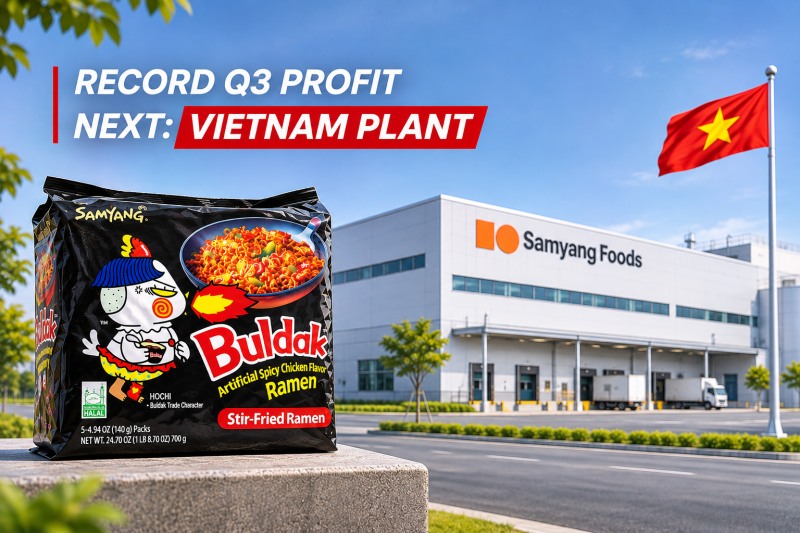
According to a filing with the Financial Supervisory Service on the 12th, Samyang Foods held a board meeting on the 11th and approved the establishment of a Vietnamese production subsidiary and a local plant. The aim is to strengthen its ability to respond to global demand and thereby raise corporate value and business competitiveness. The new Vietnamese subsidiary will build a plant in the Thuan Thanh area, large enough to accommodate a total of eight production lines.The estimated investment is about KRW 218.6 billion. This covers land acquisition, plant construction and equipment for one non-fried noodle production line. The company plans to finalize additional lines in stages going forward. It plans to complete the investment by January 31, 2029.
Overseas business was the main growth driver. Overseas revenue in the third quarter rose 29.4% from a year earlier to KRW 660.8 billion. The upward trend continued after the Buldak brand, its flagship, surpassed 10 billion cumulative units sold in the second quarter.
By region, the U.S. subsidiary posted revenue of KRW 212.5 billion in the third quarter, up 36.6% from the same period last year, driven by growth in mainstream channels such as Walmart. The Chinese subsidiary also grew 13.2% to KRW 208.9 billion in revenue, as its sales base in snack channels widened. In Europe, where product demand has risen sharply, revenue reached KRW 86.9 billion, up 65.5% from a year earlier.
관련기사
Cash-Rich but Inefficient: OTOKI's Japan Push Aims to Wake Dormant CapitalNongshim Pursues Global Push After Losing Profit Lead to SamyangRamen to Ice Cream: Korean Food Makers Push Into MexicoBeyond "Future Businesses" to "One Lotte": Shin Yu-yeol's Succession Training Enters Act TwoHanmi Pharm Hit by Shareholder Feud, Rights Return; Next Obesity Drug Key to Rebound
The Jiaxing plant in Zhejiang Province, China, Samyang Foods’ first overseas production facility, is scheduled to start operations ahead of the new Vietnamese plant. The Jiaxing plant, which is set to begin production as early as next month, has received about KRW 207.2 billion in investment. It is equipped with a total of eight production lines, six for packaged noodles and two for cup noodles, and has a maximum annual production capacity of 1.13 billion units of ramen. All of its output will be supplied to the Chinese domestic market.
Before expanding overseas production facilities, Samyang Foods had been increasing its domestic export production base step by step. After completing Miryang Plant 1 in 2022, it completed Miryang Plant 2, an export-only production base, in June last year. Having added domestic capacity and now securing local production bases in China and Vietnam, the company appears to be building a production system that can respond to overseas demand in a systematic way.
Supply shortage to ease; “high-margin” Europe in focus
Brokerages expect the capacity expansion to support Samyang Foods’ mid- to long-term growth. In particular, they noted that the new Vietnamese plant will allow the company to increase supply to markets such as Europe, where the average selling price (ASP) is relatively high.Han Yu-jung, a researcher at Hanwha Investment & Securities, said, “While the Jiaxing plant in China is aimed at serving Chinese domestic demand, the Vietnamese plant is aimed at serving European demand.” She added, “If the new production volume is allocated to regions with higher ASPs such as Europe, the same increase in sales volume can translate into a larger increase in revenue.”
NH Investment & Securities expects the risk of supply shortages to ease as production capacity expands. Joo Young-hoon, a researcher at NH Investment & Securities, said, “Production facilities have been a weakness relative to the strong demand for Buldak Ramen, to the point that people say it is ‘sold out as soon as it is stocked,’ so we expect the expansion to resolve that risk.”
Ultimately, how reliably the company can respond to rising overseas demand is expected to determine Samyang Foods’ future growth. The company plans to sustain export growth by improving operating efficiency at its production facilities and expanding its global distribution network.
A Samyang Foods official said, “We plan to raise operating efficiency at our domestic production bases, including the Miryang plants, and systematize our global distribution infrastructure so that we can respond reliably to overseas demand.”
Yang Hyunwoo (yhw@fntimes.com)
데일리 금융경제뉴스 Copyright ⓒ 한국금융신문 & FNTIMES.com
저작권법에 의거 상업적 목적의 무단 전재, 복사, 배포 금지

가장 핫한 경제 소식! 한국금융신문의 ‘추천뉴스’를 받아보세요~