





 이미지 확대보기
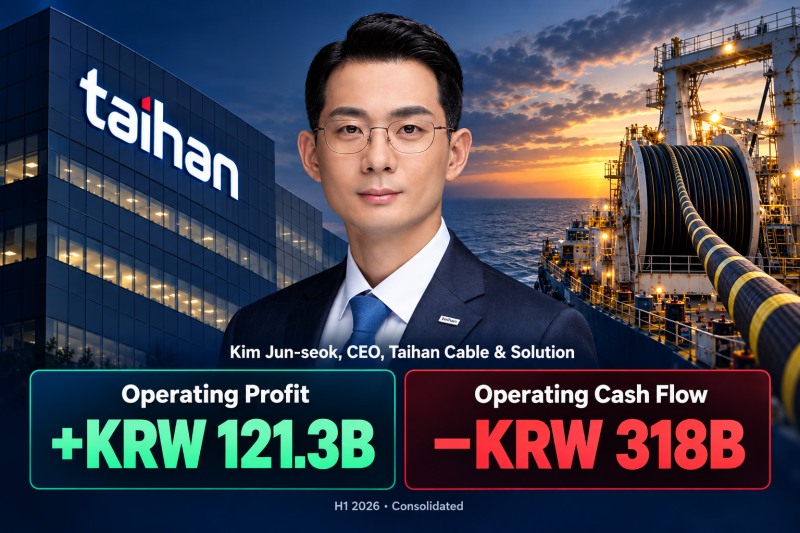
In the first half of this year, however, cash flow from operating activities recorded a net outflow of KRW 318 billion. Despite posting an operating profit, more cash flowed out of the company than came in.
With several hundred billion won more to be poured into a subsea cable plant, Kim’s first task as CEO is managing cash flow.
Hoban’s M&A Strategist Takes Helm of Taihan Cable After Five Years
Taihan Cable & Solution held a board meeting on the 21st and appointed President Kim Jun-seok as its new CEO. The appointment follows through on his nomination in Hoban Group’s executive reshuffle of its presidents on the 2nd. Song Jong-min, the former CEO, has moved to Hoban Group as senior vice chairman and CEO of Hoban Construction.Born in 1982, Kim graduated from Seoul National University with a degree in nuclear engineering and worked at Korea Hydro & Nuclear Power before joining Hoban Group in 2010. He served as head of the strategic planning team from 2018 and head of the strategic planning office in 2022, handling the group’s mergers and acquisitions (M&A).
His signature achievement is the 2021 acquisition of Taihan Cable & Solution. At that time, Hoban Industry bought a 40% stake in the company from private equity firm IMM PE for KRW 251.8 billion. Kim led the practical work on the deal.
관련기사
Kim was named CEO in this reshuffle in recognition of that work. The person who led the acquisition has now taken charge at the front of the company after five years. He will also continue to serve as head of Hoban Group’s strategy division (president).
Kim delivered his inaugural message through the company’s internal groupware without holding a separate inauguration ceremony. “Small differences add up to a company’s competitiveness,” he said, urging the company to improve technology and quality and to strengthen cost competitiveness. He also set out a direction of quickly reading market changes and focusing the business through selection and concentration to secure real competitiveness.
He also stressed that the company and its employees must grow together. “The lives of about 10,000 people, including employees of our domestic and overseas affiliates and their families, are tied to Taihan Cable & Solution,” he said, adding, “We will make sure the company’s growth leads to better lives for employees and their families.”
Scale Expands After Hoban Acquisition; Net Loss Driven by CB Valuation Loss
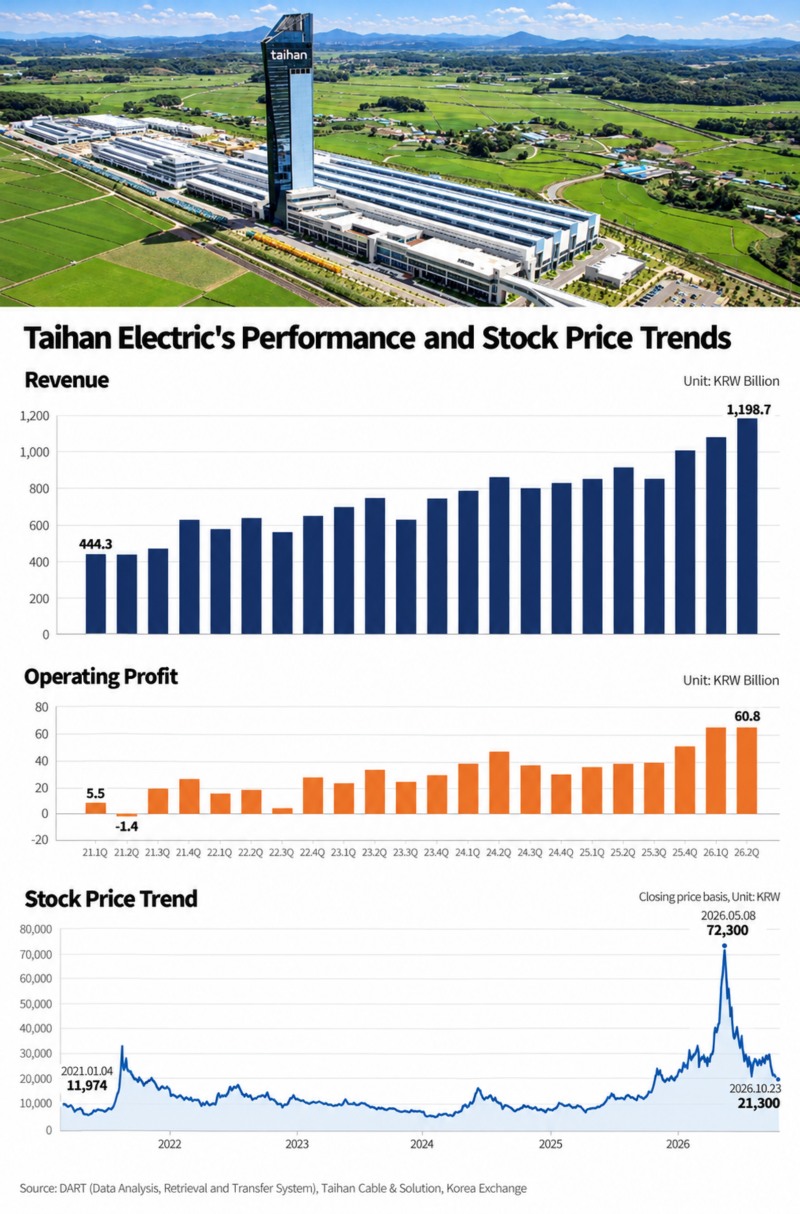
Taihan Cable & Solution has grown in scale since Hoban acquired it. On a consolidated basis, revenue rose from KRW 1.9977 trillion in 2021, the year of the acquisition, to KRW 3.636 trillion last year. Over the same period, operating profit grew about 3.3-fold, from KRW 39.5 billion to KRW 128.6 billion. The order backlog rose from KRW 1.0655 trillion at the end of 2021 to KRW 4.0629 trillion at the end of June this year.First-half operating profit this year was KRW 121.3 billion. In six months, the company earned 94% of the operating profit it made over all of last year.
The company nonetheless posted a consolidated net loss of KRW 95 billion for the first half. Losses arising from the accounting treatment of convertible bonds (CBs) accounted for a large share of this.
A CB is a bond that can be converted into company shares under predetermined terms. The CBs issued by Taihan Cable & Solution carried a condition under which the share conversion price is adjusted according to the share price. For this reason, the conversion right (the right to exchange the bond for shares) was separated from the bond and accounted for as a liability.
When the share price rises, the value of this conversion right increases, and a corresponding valuation loss is recorded on the books. As Taihan Cable & Solution’s share price rose in the first half of this year, a valuation loss of KRW 171.2 billion on the conversion rights was incurred. Excluding this, pre-tax profit was KRW 82.6 billion, up from KRW 49.2 billion a year earlier. The full KRW 110 billion of these CBs was converted into shares in April.
 이미지 확대보기
Working Capital Burden Drains Cash, but Debt Ratio Declines
The increased profit did not translate directly into accumulated cash. Cash flow from operating activities in the first half recorded a net outflow of KRW 318 billion, more than four times the KRW 68 billion outflow in the same period a year earlier.The cash outflow reflects a heavier working capital burden. An increase in inventories consumed KRW 265.1 billion in cash in the first half. In addition, KRW 130.9 billion went toward trade payables, and trade receivables rose by KRW 62.2 billion.
Over the same period, KRW 320.3 billion came in from financing activities, a result of increased borrowing, including short-term loans of KRW 747.4 billion from financial institutions against repayments of KRW 471.3 billion. Net debt, or borrowings minus cash holdings, rose from KRW 466.6 billion at the end of last year to KRW 741.3 billion at the end of June.
The debt ratio fell from 114.0% to 109.6% over the same period, as debt decreased and equity increased following the CB conversion.
KRW 720 Billion to Go Into Subsea Plant No. 2; Investment Payback in 2034
As the cash burden grows, a large-scale investment is also entering its initial phase. Taihan Cable & Solution is building Subsea Plant No. 2 in Dangjin, South Chungcheong Province, to produce high-voltage direct current (HVDC) subsea cables.The company previously invested about KRW 220 billion in Plant No. 1, which makes subsea cables for offshore wind power. Plant No. 1 reached full completion in June last year and is now in operation.
A total of about KRW 720 billion is to be invested in Plant No. 2 going forward. Of this, the company plans to spend KRW 497.2 billion in the first phase, with operations targeted to begin in 2027. In March, the Export-Import Bank of Korea said it plans to provide KRW 450 billion in financing for the Plant No. 2 construction project.
A large portion of first-phase funding was raised through a paid-in capital increase in 2024. Of the KRW 462.5 billion raised at that time, the company plans to use KRW 412.5 billion for the first phase of Plant No. 2. Taihan Cable & Solution has put the expected payback period for its subsea cable investment at 2034. As recovering the investment will take time, converting orders won after the plant begins operating into actual revenue and cash flow is expected to become important.
“The company is currently at the stage of building up capabilities,” said Jang Jae-hyuk, a researcher at Meritz Securities. “A process is needed to prove, step by step, whether it wins orders for Subsea Plant No. 2 and turnkey orders for large HVDC projects,” he said.
Jung Jina (urzinnie@fntimes.com)
데일리 금융경제뉴스 Copyright ⓒ 한국금융신문 & FNTIMES.com
저작권법에 의거 상업적 목적의 무단 전재, 복사, 배포 금지

가장 핫한 경제 소식! 한국금융신문의 ‘추천뉴스’를 받아보세요~