





 이미지 확대보기
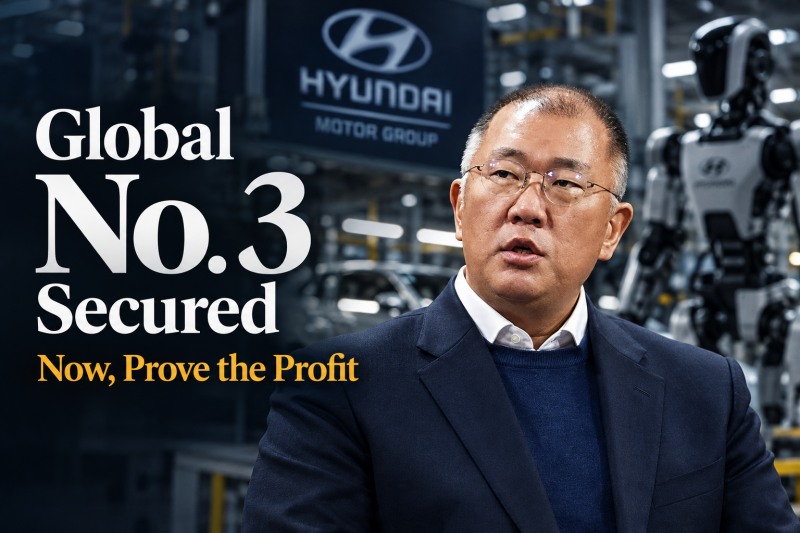
The task now facing Chairman Chung is proving the next stage of growth. While maintaining the competitiveness of its existing automotive business, the group must convert future businesses, including robotics, software-defined vehicles (SDVs), autonomous driving and artificial intelligence (AI), into actual revenue and profit. If the past six years were a period of transforming the group’s size and business makeup, the next six will be a period of proving whether the capital poured into future technologies can return as a new growth engine.
Settling Into the Global Big Three, Rising as a ‘Brand That Commands Full Price’
The most visible achievement since Chairman Chung took office on October 14, 2020, is the change in the group’s standing in the global market. Hyundai Motor and Kia ranked third in global automobile sales in 2022 and have held that position for four consecutive years through last year. Their combined global sales last year totaled about 7.27 million units.Behind this growth lie changes in product competitiveness and brand strategy. A representative case is Genesis. Launched as a standalone brand in 2015, Genesis was a strategy pursued before Chairman Chung became head of the group. After he took office, the group intensified its push into the luxury segment, and Genesis grew into a pillar reshaping Hyundai Motor Group’s earnings structure. Genesis annual sales rose almost threefold, from 77,135 units in 2019 to 221,482 units last year, and cumulative sales surpassed 1.5 million units last year.
Kia’s brand overhaul and its product lineup centered on recreational vehicles (RVs) are also cited as factors that raised the group’s product competitiveness. During his time as Kia’s head, Chairman Chung shifted the business structure away from an image as a mass-market brand built on price competitiveness, toward securing higher selling prices based on product quality, design and brand value.
관련기사
The Three Women Steering Chung Eui-sun's Hyundai FutureEven If It Clears the Governance Overhang, Hyundai Mobis Faces a New Mountain: China's Robotics RivalsHyundai Steps Up U.S. Robot Lobbying as China Race Heats UpKia's Three Growth Engines Fuel Its Historic Charge Toward No. 1Inefficient Capital Allocation Holds Back Hyundai Motor's Stock Despite Record Profit
The group was also quick to respond to the era of electrification that took off after he took office. Its electrification strategy was diversified to address demand in each market rather than focusing on a single technology. While building EV competitiveness on its dedicated EV platform, E-GMP, it expanded hybrid supply as EV demand growth slowed.
A production system that can run internal combustion, hybrid and electric vehicles together has become a means for Hyundai Motor Group to respond to regional demand and policy changes. Hyundai Motor and Kia sold about 1.76 million eco-friendly vehicles last year, and their combined hybrid sales in the first half of this year totaled 679,000 units.
These results have provided the financial foundation for investing in future businesses. Whether growth in the existing business will continue at the same pace, however, is a separate question. Uncertainties remain, including slowing growth in the global automobile market, price competition from Chinese automakers, shifts in EV demand and the trade environment in key markets. That is why the group must generate profit from its existing automotive business while building the next growth pillar.
 이미지 확대보기
Atlas, SDV, Autonomous Driving… Monetization Is the Key for Future Businesses
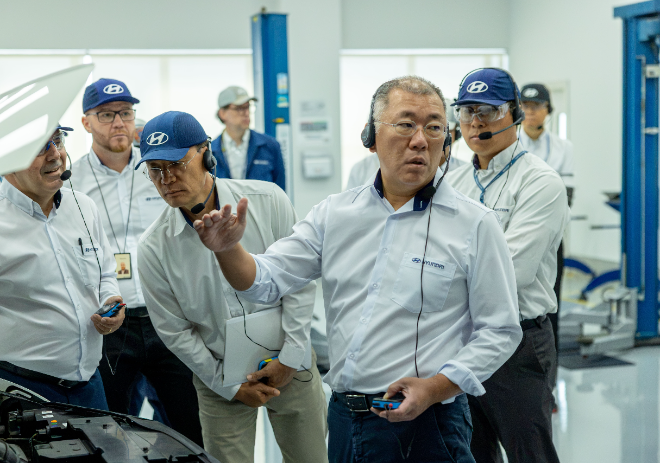
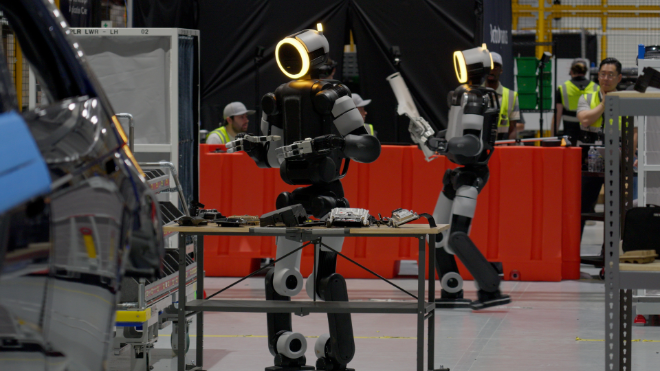
The next growth direction laid out by Chairman Chung is to break down the boundaries of automobile manufacturing. This year, Hyundai Motor Group has begun pushing in earnest to link autonomous driving, robotics and AI-based manufacturing, aiming to transform into a so-called “physical AI” company. The idea is to apply AI not only in digital environments but also to have it operate in real-world physical settings such as vehicles, robots and factories, thereby raising efficiency across manufacturing, mobility and logistics.A flagship project is “Atlas,” the humanoid robot from Boston Dynamics. Hyundai Motor Group plans to deploy Atlas at Hyundai Motor Group Metaplant America (HMGMA) in the United States in 2028. It will first be applied to tasks such as parts sorting and sequencing, and the group is pursuing plans to expand its use across manufacturing sites over time.
Because the group can pursue both external sales of robots and a strategy of deploying them in its own factories to raise productivity, synergy with its automotive manufacturing capabilities is expected.
However, the competitiveness of a robotics business cannot be proven by technology demonstrations alone. It must show that the robots operate reliably on actual production lines and by how much they can raise productivity compared with existing automation equipment.
It must also be verified that the business makes economic sense even after accounting for initial adoption costs and maintenance costs. Cutting production costs by deploying robots in its own plants must be distinguished from securing profit for the robotics business itself by selling to outside customers.
Boston Dynamics’ earnings illustrate these challenges. Boston Dynamics has pushed to commercialize robotics technology since its acquisition by Hyundai Motor Group, but according to foreign media reports, its cumulative losses from 2021 to 2025 amount to about KRW 1.7 trillion. Even taking into account the nature of an industry that requires upfront investment in technology development and building a production base, what matters is whether future increases in production scale and the securing of customers translate into actual improvements in profitability. Securing robot production capacity alone makes it difficult to judge the return on investment.
SDV and autonomous driving face the same test. At its 2026 CEO Investor Day, Hyundai Motor presented a plan to apply Level 2+ autonomous driving technology to mass-produced SDVs in 2028. It also outlined plans to strengthen its autonomous driving and software capabilities through cooperation with NVIDIA on building an AI data center and a technology partnership.
The aim is to create new customer value not merely by selling vehicle hardware, but by continuously improving software and providing data-based services.
The key is narrowing the gap between technology investment and revenue models. Software development and data infrastructure require spending, and recovering it requires services and a scope of application that customers are willing to pay for.
The safety of autonomous driving technology, regulatory compliance and service operating costs will also affect profitability. Beyond developing the technology and applying it to vehicles, the group must make concrete which services it will provide to which customers and how much profit they will generate.
 이미지 확대보기
Balancing Core Business Profitability and Investment Recovery
The pace of commercializing future businesses leads to questions of investment scale and capital allocation. Starting this year, Hyundai Motor Group announced a plan to invest KRW 125.2 trillion in South Korea over five years. The group intends to expand future businesses and R&D in areas such as AI, SDV, robotics and hydrogen, and strengthen its domestic production and technology base. Plans including the Saemangeum AI Valley and investment in the Yeongnam region are also part of a strategy to build up industrial foundations in manufacturing, AI and energy.Large-scale investment is the foundation for securing future competitiveness, but the size of the investment itself does not mean results. Even after robot production facilities and AI infrastructure are built, it may take time before actual revenue is generated.
If profitability in the existing automotive business weakens or the commercialization of new businesses is delayed beyond expectations, the investment burden could grow. The higher the expectations for future businesses, the more the market will inevitably demand clarity on investment purposes, commercialization timelines, expected revenue sources and break-even points.
At its 2026 CEO Investor Day, Hyundai Motor raised its 2030 consolidated operating margin target to above 9%. The company cited an expanded hybrid lineup, cost reductions across all models and expanded local production as the main means of improving profitability.
First-half revenue came to KRW 95.2 trillion, with an operating margin of 5.6%. This means that maintaining profitability in the existing automotive business remains important to secure the capacity to invest in future businesses.
Transformation of production sites and organizations is another variable. Deploying humanoid robots in factories can be expected to automate repetitive tasks and raise productivity, but it may also change work methods and job composition. Uncertainty in the field adoption process can be reduced only if worker safety, retraining, job transitions and labor-management consultation systems are put in place alongside the pace of technology adoption. Labor-management cooperation is separate from the intrinsic revenue model of future businesses, but it is important as an execution condition for getting the technology established on the actual production floor.
“Chairman Chung Eui-sun’s six years in office were a period in which Hyundai Motor Group widened its footing in the global automobile market and raised its brand and product competitiveness,” said an industry official. “In the next stage, it must connect the manufacturing capabilities, capital and supply chain accumulated in the automotive business to competitiveness in robotics and AI and software businesses.”
The official added, “The key is not to stop at securing new-business technologies but to win actual customers and markets and generate sustainable profit. Whether the group can keep a balance between the profitability of its existing business and investment recovery in that process will be Chairman Chung’s next test in managing the group.”
Kim JaeHun (rlqm93@fntimes.com)
데일리 금융경제뉴스 Copyright ⓒ 한국금융신문 & FNTIMES.com
저작권법에 의거 상업적 목적의 무단 전재, 복사, 배포 금지

가장 핫한 경제 소식! 한국금융신문의 ‘추천뉴스’를 받아보세요~