





 이미지 확대보기
The appointment comes as the FLNG business shifts from one-off projects, in which a single unit is built at a time, to a series business in which units of the same specifications are built repeatedly. The move is read as an effort to cement an "FLNG mass-production system" by putting forward someone who started in design and went on to cover project management and production.
30 years with the company… the design specialist who led the Petronas project
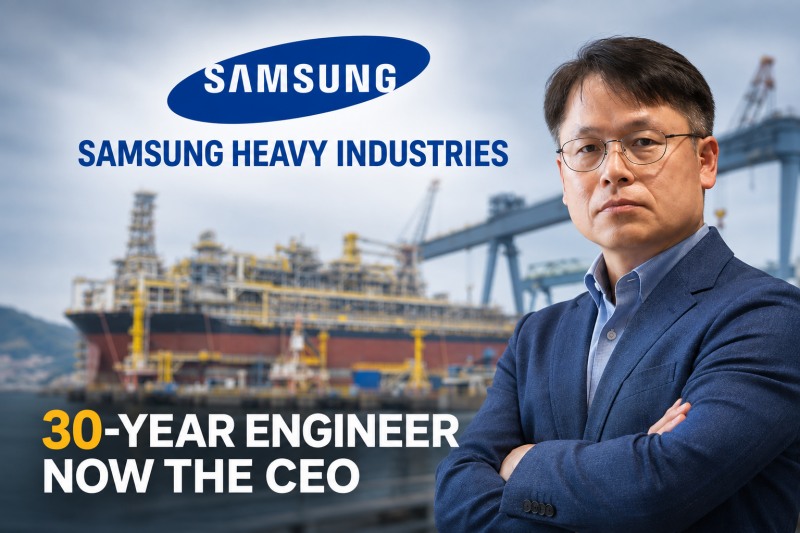
On the 23rd, Samsung Heavy named Lee Wang-geun, chief operating officer (COO) and head of the shipbuilding and offshore division (executive vice president), as its nominee for president and CEO. Lee is to be formally appointed after the shareholders' meeting and board procedures. Choi Sung-an, vice chairman and CEO, will serve as chairman of the board until the regular shareholders' meeting in March next year, then step down.From June 2016 to December 2018, he served as project director for the Malaysian state-owned energy company Petronas project. At the time, Samsung Heavy was building DUA, Petronas' second FLNG unit. The facility, ordered in February 2014, had a final contract value of KRW 1.7037 trillion and left the Geoje shipyard in February 2020.
He then successively headed offshore design, offshore business and production, and from December 2023, for two years, oversaw the production site as head of the shipyard and chief safety officer (CSO). He was appointed an inside director in March 2024.
관련기사
Why Hyundai Won’t Give Up on Hydrogen: From Carmaker to Energy SupplierFrom Rescuer to Growth Driver: Doosan Enerbility’s New Vice Chairman Must Turn KRW 26 Trillion Backlog Into CashKAI’s Cash, Orders and Margins Dry Up Despite Defense Export BoomRiding the U.S. Power Supercycle, Hyosung Heavy Industries Eyes Global Top 3 by 2031
Offshore orders, FLNG standardization… design and production experience carries weight
Samsung Heavy introduced Lee as a technical expert who built his career in design and who has held key posts across business management and production. As the challenges facing the company are concentrated in the offshore segment, Lee's offshore background is expected to be a strength.This year, Samsung Heavy's commercial vessel orders reached US$8.3 billion, exceeding the annual target of US$5.7 billion by 46%. The offshore segment, by contrast, secured only US$4.4 billion of its annual target of US$8.2 billion. The company is in talks to win orders for the second FLNG unit of the Delfin project in the U.S. and for the Western LNG FLNG project in Canada.
The business model is also changing. The Delfin project in the U.S., ordered in June, adopted a "multiple FLNG" approach, in which several FLNG units of identical specifications are deployed in sequence instead of a large onshore plant. The developer plans to order three units in total. At the signing of the contract for the first Delfin unit, Samsung Heavy said it would "secure cost and quality competitiveness through optimized design and solutions and lead the era of FLNG mass production."
For the Coral Norte FLNG in Mozambique, which was converted to a full contract in the same month, the company applied a "Lessons Learned system." Samsung Heavy explained that this made it the first in the world to standardize the entire project process, from design to commissioning.
Three large FLNG units are currently under simultaneous construction at the Geoje shipyard: Petronas' ZLNG in Malaysia, Eni's Coral Norte, and Cedar in Canada. The contract for the first Delfin unit took effect in June.
If design is the starting point of repeat construction and standardization, production capability is what supports a system that builds several units at once. This is why attention is on Lee's career, which began in offshore basic design and passed through production and the shipyard head's post.
 이미지 확대보기
A design specialist inheriting the FLNG business built by a former Samsung E&A CEO
The path to naming a new CEO began a year ago. In December last year, Samsung Heavy appointed Lee as COO and head of the shipbuilding and offshore division. While Lee oversaw both the commercial vessel and offshore businesses for a year, Executive Vice President Namgung Geum-seong took over as shipyard head and CSO.The latest appointment connects to the selection of Vice Chairman Choi four years ago. In 2014, Samsung Heavy and Samsung E&A (then Samsung Engineering) pursued a merger, aiming to combine offshore and onshore plant capabilities and leap forward as a comprehensive plant company. The deal collapsed after dissenting shareholders' stock buyback claims exceeded the contractual limit.
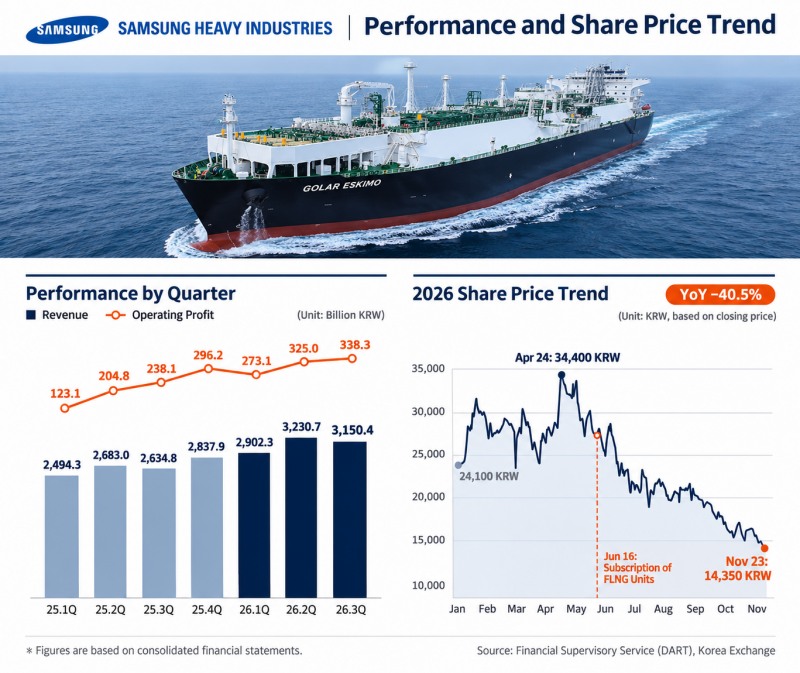
Eight years later, in December 2022, Choi, then CEO of Samsung E&A, moved to Samsung Heavy as vice chairman and CEO. He is a plant expert who joined Samsung E&A in 1989 and built his career in chemical engineering and plants. Under Choi, Samsung Heavy posted an operating profit of KRW 233.3 billion in 2023, returning to full-year profitability for the first time in nine years.
The FLNG business has also gotten on track. In June this year, Samsung Heavy won the Delfin project, the first FLNG project in the U.S., for US$2.9 billion (KRW 4.3301 trillion), and the Coral Norte FLNG in Mozambique was converted to a full contract worth about KRW 3.7 trillion in total construction costs. Samsung Heavy has won seven of the 11 newbuild FLNG units ordered worldwide so far, a market share of 64%.
At the Coral Norte launching ceremony in January, Choi said, "Considering our shipbuilding capacity, we plan to secure one to two FLNG units every year." At the March shareholders' meeting, he said regarding FLNG, "We will develop a global standardization model through structural innovation." If the plant expert laid the foundation for orders and set the direction for standardization, the task of realizing it through repeat construction now falls to a CEO from offshore design.
Must lead FDC new business… offshore orders a 'challenge'
The new business Lee will lead is also a facility that floats at sea. In April this year, Samsung Heavy received concept design certification for a 50 MW floating data center (FDC) from the American Bureau of Shipping (ABS) and the UK's Lloyd's Register (LR). The model is a barge-type facility that operates a data center with self-generated power fueled by liquefied natural gas (LNG). Samsung Heavy also became the first Korean shipbuilder to set a commercial service date for an FDC, the second quarter of 2028.The core of offshore structures is the technology of transferring onshore facilities onto limited space at sea. This is the background for how floating-structure design and construction experience from FLNG could extend to the new business.
The immediate challenge, however, is offshore orders. Total orders this year came to US$12.7 billion, 91% of the annual target of US$13.9 billion, and the shortfall against the target came from the offshore segment. Samsung Heavy also plans to finalize and announce its regular 2027 executive reshuffle for vice president level and below soon.
A Samsung Heavy official said, "We expect him to lead efforts to strengthen the core competitiveness of the shipbuilding and offshore business and secure future growth drivers through new businesses."
Jung Jina (urzinnie@fntimes.com)
데일리 금융경제뉴스 Copyright ⓒ 한국금융신문 & FNTIMES.com
저작권법에 의거 상업적 목적의 무단 전재, 복사, 배포 금지

가장 핫한 경제 소식! 한국금융신문의 ‘추천뉴스’를 받아보세요~