





 이미지 확대보기
Back Together After 13 Years: Shifting to an 'Operating Holding Company'
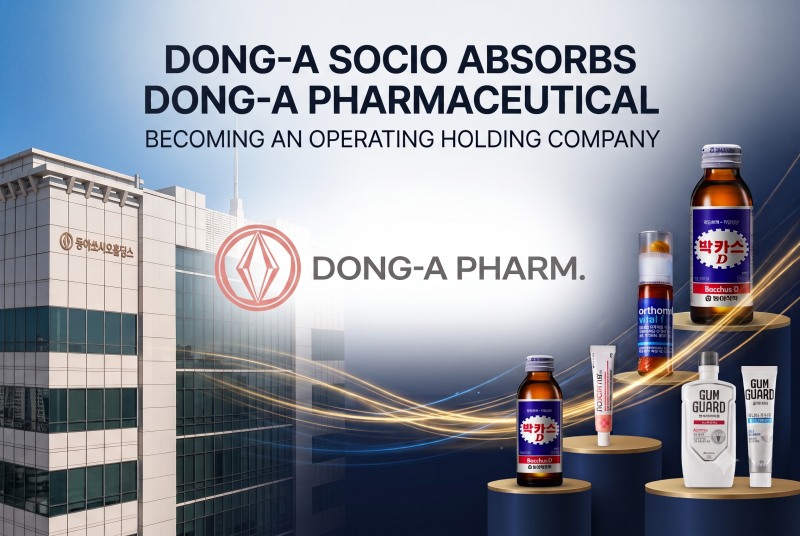
According to industry sources on Oct. 1, Dong-A Socio Holdings completed its small-scale merger with Dong-A Pharmaceutical that day. It is now operating as an operating holding company under the new name of the merged entity, "Dong-A Pharmaceutical."The surviving legal entity is Dong-A Socio Holdings, but the merged company's name changes to Dong-A Pharmaceutical through an amendment to its articles of incorporation. The amendment, which changes the company name and adds business purposes, took effect after an extraordinary shareholders' meeting on Sept. 22.
However, a pure holding company structure has the drawback that the holding company's own earnings become more volatile depending on its subsidiaries' business performance and dividend payout ratios. Its capacity to generate capital through its own operations is also limited, which has drawn criticism that capital allocation is inefficient when making large investments such as finding new growth drivers or acquiring promising biotech ventures.
The launch of the merged company is seen as a move to confront these structural constraints head-on. As Dong-A Pharmaceutical's operating assets and earnings base are absorbed directly into the holding company, the holding company itself becomes an operating holding company with stable operating cash flow. Dong-A Socio Holdings already owned 100% of Dong-A Pharmaceutical before the merger, so there is no change in aggregate group results on a consolidated basis. However, the merger is expected to raise revenue and operating profit in the holding company's standalone financial statements.
관련기사
SK Biopharmaceuticals Doubles Down: $795M Bet on Second Blockbuster Epilepsy DrugCelltrion Fires on All Cylinders with Profitability and Shareholder Returns, but Stock Price LagsSolid Finances, Underwhelming Returns: Yuhan Corporation's Capital Efficiency ChallengeKolmar Group Joins South Korea's Large Business Tier After 36 Years — HK inno.N at the Core
Q3 Results Tailwind Reflects Solid Cash-Generating Power
The Q3 earnings outlook for Dong-A Socio Holdings, due out soon and timed to the merged company's official launch, is also positive. According to the current brokerage consensus (market average forecast), Q3 consolidated revenue is projected at KRW 423.7 billion, up 10.74% year-on-year, and operating profit at KRW 35.6 billion, up 6.89%.The biggest contributor to these results is Dong-A Pharmaceutical, the absorbed company. Its OTC lineup of well-known products, including Bacchus, Panpyrin, Champ and Noscarna, along with growth in health functional foods such as the premium vitamin Orthomol, has demonstrated solid cash-generating ability year after year.
Dong-A Pharmaceutical's standalone operating cash flow was KRW 97.6 billion in 2023, KRW 44.5 billion in 2024 and KRW 130.7 billion in 2025. Its standalone annual revenue last year also exceeded KRW 700 billion. With this profitable cash pipeline now integrated into the holding company, its financial strength as an operating holding company is expected to improve further.
No New Shares Issued, Preserving Shareholder Value
The market sees the merger as more than a simple reallocation of resources. It regards it as a catalyst for revaluation, chiefly because of how the merger was structured and how directly asset value now flows into the parent.Dong-A Socio Holdings absorbed Dong-A Pharmaceutical through a small-scale merger at a 1-to-0 ratio, with no new shares issued. Because no new shares are issued, there is no risk of diluting existing shareholders' stake value.
On the Korean stock market, holding company discounts have recurred, in which the real value generated by a profitable unlisted subsidiary is not properly reflected in the holding company's share price, or the company is undervalued over concerns about double listing. The no-new-share merger, however, creates a structure in which the operating value and assets of Dong-A Pharmaceutical, once fenced in as an unlisted subsidiary, are reflected directly in the listed holding company's financial statements.
This is expected to help improve the holding company's capital allocation efficiency. The internalized cash flow can be used to fund future growth drivers such as new drug development and the bio business within the group. It creates a virtuous cycle of capital between the healthcare and OTC businesses, which generate profits in the short term, and the bio research and development (R&D) business, which needs longer-term results.
"When a pure holding company converts into an operating holding company, standalone revenue and operating profit increase dramatically," said an official in the investment banking (IB) industry. "This leads to a higher credit standing for the holding company itself and greater borrowing capacity, giving the entire group financial flexibility."
Jeong Chaeyun (chaeyun@fntimes.com)
데일리 금융경제뉴스 Copyright ⓒ 한국금융신문 & FNTIMES.com
저작권법에 의거 상업적 목적의 무단 전재, 복사, 배포 금지

가장 핫한 경제 소식! 한국금융신문의 ‘추천뉴스’를 받아보세요~