





 이미지 확대보기
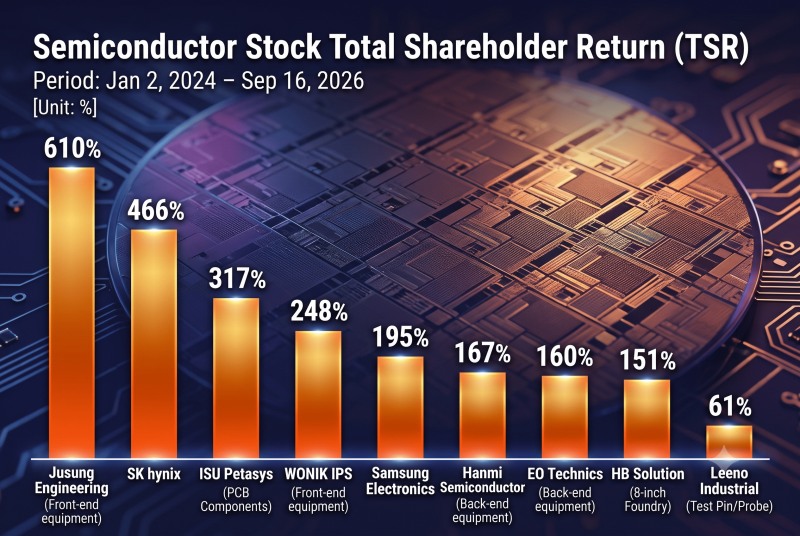
Korea Financial Times used the corporate data platform DeepSearch to calculate cumulative total shareholder return (TSR) for semiconductor and chip equipment companies from Jan. 2, 2024, to Sept. 16, 2026. Excluding Samsung Electronics, SK hynix and companies linked to them, Jusung Engineering (610%) posted the highest return among companies with a market capitalization of KRW 5 trillion or more. It was followed by ISU Petasys (317%), WONIK IPS (248%), Hanmi Semiconductor (167%), EO Technics (160%), DB HiTek (151%) and Leeno Industrial (61%).
TSR is the total shareholder return, combining share price changes and dividends. Over the same period, Samsung Electronics and SK hynix posted TSRs of 195% and 466%, respectively. Jusung Engineering was the only company to outperform SK hynix.
Jusung Engineering is a front-end semiconductor equipment maker specializing in deposition equipment. Its high-k atomic layer deposition (ALD) technology is cited as a next-generation technology that can address the shift to finer process nodes and vertically stacked transistor structures. Analysts say the share price reflects not only demand for existing deposition equipment but also the potential for new equipment adoption as process structures change.
An earnings recovery this year has also supported the share price. Jusung Engineering reported revenue of KRW 52.3 billion and an operating loss of KRW 12.6 billion in the fourth quarter of last year, and another operating loss of KRW 7 billion in the first quarter of this year. It returned to profit in the second quarter. The turnaround after consecutive quarters of losses raised expectations that earnings have bottomed out.
관련기사
Even If It Clears the Governance Overhang, Hyundai Mobis Faces a New Mountain: China's Robotics RivalsSame Earnings Growth, Opposite Shareholder Returns: APR Up, LG H&H and Amorepacific DownCoway's Profits Keep Rising — So Why Aren't Shareholders Smiling?Why Is Kia's Stock Lagging Despite Beating Hyundai on Earnings?Hyosung Saved Its Chemical Unit, But TNC Shares Have Been Cut in Half
ISU Petasys produces high-layer-count printed circuit boards (PCBs) used in AI servers and network equipment. Its customers include global Big Tech companies such as Google, Nvidia, Microsoft and Amazon. Its TSR rebounded from -8% in 2024 to 335% in 2025 but slumped again to -10% this year through Sept. 16.
Last year, the share price reflected expectations that expanded investment in AI accelerators and data centers would boost demand for high-end PCBs. High-value-added PCBs are technically demanding and have a limited number of suppliers, so they were regarded as direct beneficiaries of AI infrastructure investment. Sentiment has shifted this year. Because expectations of AI investment growth were priced in quickly last year, market attention has moved to the company's growth potential after its capacity expansion and the pace of its customers' investment. The negative TSR this year is interpreted as a result of expectations being adjusted after last year's surge.
WONIK IPS supplies deposition and etching equipment needed for front-end semiconductor processes. Its TSR jumped from -36% in 2024 to 208% in 2025 and stands at a relatively healthy 76% this year. Its share price has moved in tandem with Samsung Electronics. Samsung Electronics accounts for more than half of its sales, so the recovery in Samsung's memory cycle and the resumption of its capital spending have directly affected WONIK IPS's share price.
When Samsung Electronics expands investment centered on AI memory and leading-edge processes, demand for WONIK IPS's front-end equipment also grows. Jusung Engineering drew expectations for next-generation deposition technology, while expectations of a recovery in Samsung Electronics' investment cycle were at the center of WONIK IPS's share price gains.
Hanmi Semiconductor, a back-end equipment maker, supplies thermal compression (TC) bonders used to stack high-bandwidth memory (HBM).
Its TSR was 34% in 2024, 55% in 2025 and 77% this year, marking three consecutive years of positive returns and a steady upward trend. Hanmi Semiconductor is a representative stock whose share price moves in sync with SK hynix. When SK hynix moves to expand HBM production capacity, expectations for Hanmi's equipment demand rise. Conversely, when concerns grow over the pace of HBM investment or customer diversification, its share price also wobbles.
EO Technics is a back-end equipment maker that uses lasers to process semiconductors with precision. Its TSR rebounded from -9% in 2024 to 96% in 2025 and has stayed positive at 72% this year. The share price reflects an outlook that the range of applications for laser equipment could widen as HBM production expands and foundry processes advance. Expectations for related equipment demand have grown in particular because back-end process upgrades are expected to continue through the transition to HBM4 and the expansion of its production.
DB HiTek is a legacy foundry that produces power semiconductors, image sensors and display driver ICs (DDIs) on 8-inch wafers. Its TSR improved sharply from -42% in 2024 to 108% in 2025 and 85% this year. In the early phase of AI chip investment, attention centered on HBM and high-performance chips, leaving DB HiTek relatively overlooked. Sentiment changed after large foundries such as TSMC and Samsung Electronics expanded investment in leading-edge processes to address AI chips, which reduced 8-inch production capacity.
Because DB HiTek specializes in 8-inch processes, it is cited as a possible beneficiary of the supply reduction. Some observers say foundry prices could rise if demand for 8-inch processes holds while capacity shrinks. For DB HiTek, the restructuring of investment by large players is instead leading to an improved supply-demand environment.
Leeno Industrial recorded the lowest TSR among the surveyed companies. It supplies sockets and pins used in semiconductor testing. Its TSR rose from -5% in 2024 to 57% in 2025 but came to just 9% this year. Analysts say that despite growing test demand for high-performance, highly integrated chips, the sale of the largest shareholder's stake emerged as the main share price variable this year.
In April, Leeno Industrial CEO Lee Chae-yoon disclosed plans to sell 9.18% of his holdings through an after-hours block trade. As a result, his stake fell from 34.66% to 25.48%. The market is watching for the possibility of further stake sales, amid overhang concerns that shares held by the largest shareholder could return to the market.
The decline in the largest shareholder's stake also appears to weigh on the share price, as it could raise the possibility of mergers and acquisitions or a change in management control. Expectations persist that demand for test components will grow as chips become more advanced. However, the supply-demand burden from the major shareholder's stake sale and the governance uncertainty are seen as having capped share price gains.
Gwak Horyung (horr@fntimes.com)
데일리 금융경제뉴스 Copyright ⓒ 한국금융신문 & FNTIMES.com
저작권법에 의거 상업적 목적의 무단 전재, 복사, 배포 금지

가장 핫한 경제 소식! 한국금융신문의 ‘추천뉴스’를 받아보세요~