





 이미지 확대보기
As signs emerge that the electric vehicle chasm — the temporary slowdown in EV demand — is easing, South Korea's two leading battery makers, LG Energy Solution and Samsung SDI, are tracing diverging paths on the Altman Z-score, a measure of corporate financial risk.
Both companies remain in the "distress zone," below the 1.8 threshold that signals default risk. But while LG Energy Solution has continued to decline, sinking deeper into that zone, Samsung SDI has rebounded this year, moving closer to the "gray zone." The divergence is attributed to differences in the two companies' capital-raising strategies and asset efficiency.
Z-Scores Diverge on Profitability
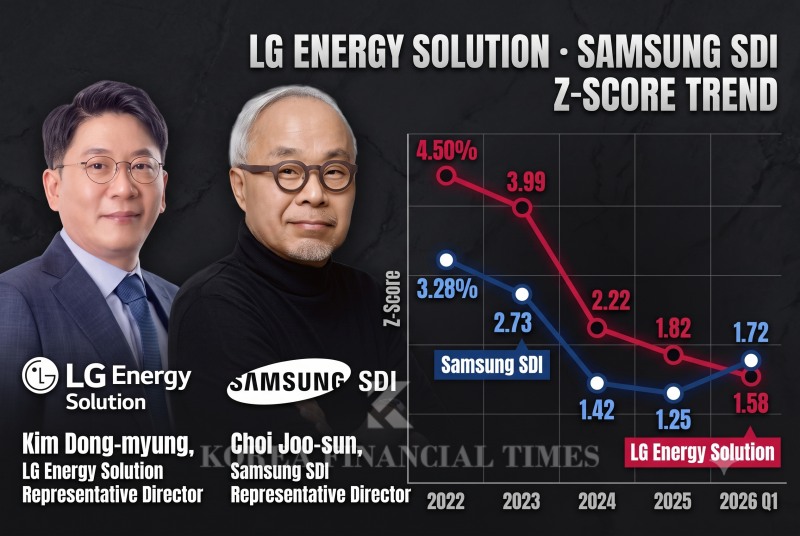
According to THE COMPASS, the AI-based corporate analysis platform built in-house by Korea Financial Times, LG Energy Solution's Z-score stood at 1.58 as of the end of the second quarter this year, down 0.24 points from 1.82 a year earlier, pushing it into the distress zone. Samsung SDI's Z-score, by contrast, rose 0.47 points year-on-year to 1.72 in the second quarter, up from 1.25.
The Z-score is a model for predicting the likelihood of corporate default, calculated from financial statement items: X1 (working capital/total assets) + X2 (retained earnings/total assets) + X3 (operating income/total assets) + X4 (market capitalization/total liabilities) + X5 (sales/total assets). For manufacturers, a score of 3 or above is considered safe, while a score below 1.8 signals distress.
관련기사
De-Risking From China: LG Energy Solution Secures US Lithium Supply Through 2039"Turned to a Millstone by the Chasm": SK's EV Trio — When Will Normalization Come?LG Energy Solution's Subsidy-Driven Profit Masks a KRW 6 Trillion Inventory ProblemSamsung SDI's Returns Run Six Times That of LG Energy Solution… But Why?'U.S. Subsidy Effect Fades'… LG Energy Solution Scrapes Together Every Penny
The trajectories of both companies' Z-scores mirror the boom and bust of the battery business. Both peaked in 2022, when the battery industry was thriving, before declining continuously through last year amid the EV chasm.
However, in the first half of this year, the two companies' Z-score trends diverged on the profitability component, which carries the heaviest weighting in the formula.
LG Energy Solution's Z-score moved as follows: 4.5 (safe zone) in 2022, 3.99 (safe zone) in 2023, 2.22 (gray zone) in 2024, 1.82 (distress zone) in 2025, and 1.58 (distress zone) as of the end of the second quarter of 2026 — a decline of 2.92 points from its 2022 peak. In effect, the company fell two tiers, from the safe zone to the distress zone, in four years.
LG Energy Solution's earnings trajectory backs this up. During 2022-2023, when demand for EV batteries peaked, X3 — operating income relative to total assets — came in at 0.0317 and 0.0476, respectively, lifting the overall Z-score.
But profitability sharply deteriorated from 2024 onward, as the EV chasm reached its peak, with X3 falling to 0.0049 as of the end of the second quarter of 2026.
LG Energy Solution posted an operating loss of KRW 207.8 billion in the first quarter of this year, before swinging to an operating profit of KRW 113.3 billion in the second quarter, helped by U.S. subsidies. Even including the full benefit of those subsidies, however, the company remains in the red by a cumulative KRW 94.4 billion for the first half of the year.
Samsung SDI's Z-score also declined through 2025 — 3.28 (safe zone) in 2022, 2.73 (gray zone) in 2023, 1.42 (distress zone) in 2024, and 1.25 (distress zone) in 2025 — before rising to 1.72 (distress zone) as of the end of the second quarter of 2026. The trajectory shows that Samsung SDI's decline actually began a full year earlier than LG Energy Solution's.
In terms of earnings, Samsung SDI posted an operating loss of roughly KRW 1.7 trillion in 2025, driving X3 to a low of -0.0408.
Samsung SDI returned to profit in the second quarter of this year, posting operating income of KRW 203.8 billion — its first profitable quarter in seven quarters. Notably, even excluding KRW 107.7 billion in U.S. subsidies, the company still posted operating income of KRW 96.1 billion, demonstrating underlying strength. Cumulative operating profit for the first half of this year came to KRW 48.2 billion.
Samsung SDI's X3 stood at -0.0177 as of the end of the second quarter — still negative, but improved from its low point. Rising earnings and expectations for the commercialization of all-solid-state batteries also pushed the company's market capitalization up roughly 50% from the start of the year, contributing to the rebound in its Z-score.
What Happens to Credit Ratings Next?
Why did profitability diverge between LG Energy Solution and Samsung SDI even as both benefited from the same easing of the EV chasm?
The answer lies in fundamental differences between the two companies' financing and investment strategies, both in their early growth phase and today. Given that the battery industry requires massive capital investment in facilities, how a company raises funds shapes its financial resilience.
LG Energy Solution pursued aggressive, debt-driven fundraising and investment in order to achieve economies of scale early.
Its debt-to-equity ratio, which stood at a low of 85.9% in 2022, rose to 129.0% by 2025. With the ratio climbing further to 149.6% by the end of the second quarter this year, the combination of depreciation costs from large-scale capacity expansion and rising interest expenses has weighed on profitability.
X2 (retained earnings/total assets), a measure of cumulative profitability, also turned negative for LG Energy Solution, coming in at -0.0093 as retained earnings swung to -KRW 723.4 billion at the end of the second quarter this year.
This indicates that even the profit base the company had built up over time has now been depleted.
X1 (working capital/total assets), a measure of short-term liquidity, improved slightly to 0.0529 from 0.0242 a year earlier, but X5 (sales/total assets), an asset turnover measure, stood at 0.3625 — nearly half the level of 0.6684 recorded in 2022.
As profitability declined, LG Energy Solution's return on invested capital (ROIC) also fell — from 4.2% in 2022 to 5.7% in 2023, 1.3% in 2024, and 0.6% in 2025 — before turning negative at -0.02% as of the end of the second quarter this year. ROIC, a key indicator of capital efficiency, measures after-tax operating profit generated relative to capital deployed in business operations.
A representative example of LG Energy Solution's situation is its factory utilization rate, which fell every year — from 73.6% in 2022 to 69.3% in 2023, 57.8% in 2024, and 47.6% in 2025 — before rebounding to 52.8% in the first half of this year, helped by the shift toward energy storage system (ESS) batteries.
The analysis suggests that while LG Energy Solution built out production capacity through large early-stage investments, production has not kept pace, driving up the burden of fixed costs.
Samsung SDI, by contrast, has stuck to equity-driven, selective investment based on rigorous profit-and-loss vetting, rather than pursuing scale expansion. This is likely also influenced by the broader Samsung Group financial philosophy, which places heavy emphasis on staying debt-free.
Samsung SDI's debt-to-equity ratio — 75.7% in 2022, 70.9% in 2023, 88.2% in 2024, and 79.2% in 2025 — shows it has been managed markedly differently from its rival. The ratio stood at 77.4% as of the end of the second quarter this year.
Samsung SDI's ROIC fell from 7.0% in 2022 to 5.6% in 2023, 1.1% in 2024, and -3.4% in 2025, before rebounding to 0.2% as of the end of the second quarter this year. The company has also built a financial buffer by improving capital liquidity through asset efficiency measures, including the sale of its stake in Samsung Display.
Samsung SDI's factory utilization rate declined more gradually — from roughly 84% in 2022 to 77% in 2023, 65% in 2024, and 55% in 2025 — before rebounding to about 73% in the first half of this year.
Overall, Samsung SDI's financial and investment strategy appears to have managed risk more effectively than LG Energy Solution's.
LG Energy Solution's debt-driven management approach is now translating into both financial strain and the threat of a credit rating downgrade. A ratings downgrade would not only raise the cost of raising funds, including through public bond issuances, but could also hurt the company's prospects in future order-winning, as clients tend to weigh financial soundness heavily in awarding contracts.
Indeed, S&P Global Ratings, one of the world's three major credit rating agencies, downgraded its outlook on both LG Chem and LG Energy Solution from "stable" to "negative" in March.
Korea Ratings has also recently warned that LG Energy Solution's net debt/adjusted EBITDA ratio has exceeded 3.5 times — the downgrade trigger level — since 2025, driven by rising borrowings. As of the second quarter this year, the company's net debt/adjusted EBITDA ratio surpassed 4.5 times.
"The indicator for net debt repayment capacity has deteriorated to the point where the conditions for a rating downgrade have been met," Korea Ratings said. "A review of the credit rating is unavoidable, and the company has not been able to escape the risk of a downgrade."
Samsung SDI's net debt/adjusted EBITDA ratio, meanwhile, stands at approximately 3.4 times, close to its own downgrade trigger. However, given the company's relatively sound financial position, maintained through a conservative investment stance, the pressure from rating agencies has been comparatively limited. Its credit rating has remained unchanged since its regular review in 2025.
Kim JaeHun (rlqm93@fntimes.com)
데일리 금융경제뉴스 Copyright ⓒ 한국금융신문 & FNTIMES.com
저작권법에 의거 상업적 목적의 무단 전재, 복사, 배포 금지
가장 핫한 경제 소식! 한국금융신문의 ‘추천뉴스’를 받아보세요~