




 이미지 확대보기
Beyond Cosmetics ODM: Into Pharmaceuticals and Biotech
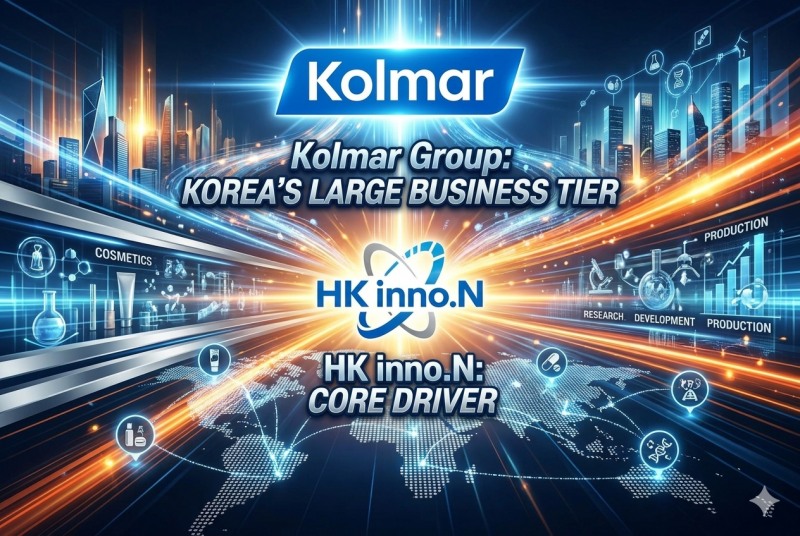
According to industry sources on April 30, Kolmar Group has been included in the KFTC's "2026 Publicly Designated Large Business Group" (a regulatory designation applied to conglomerates with total assets of KRW 5 trillion or more, subject to enhanced disclosure and anti-tunneling regulations).
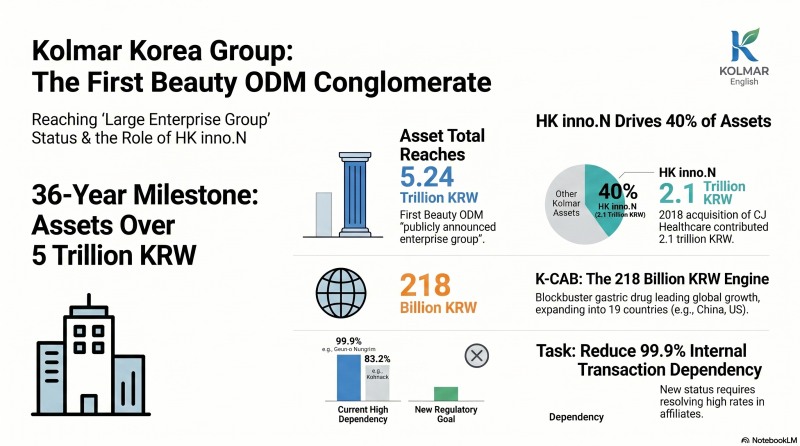
The threshold for designation as a large business group is total assets of KRW 5 trillion or more. As of the end of last year, Kolmar Group recorded total consolidated assets of KRW 5.2428 trillion. Of this amount, Kolmar Korea accounted for KRW 1.529 trillion, while HK inno.N, the group's core pharmaceutical and biotech affiliate, contributed KRW 2.0969 trillion.
Kolmar Group's parent company, Kolmar Korea, is a cosmetics ODM firm. This marks the first time in South Korea that a company specializing exclusively in ODM has been designated as a large business group.
Kolmar Korea achieved record-high results last year, posting consolidated revenue of KRW 2.7224 trillion and operating profit of KRW 239.6 billion. HK inno.N joined the "KRW 1 trillion revenue club" last year with revenue of KRW 1.0631 trillion and operating profit of KRW 110.9 billion in the same period. Kolmar BNH, the group's health functional food ODM affiliate, posted consolidated revenue of KRW 574.9 billion last year, down 6.6% year on year, while operating profit rose 8.2% to KRW 26.6 billion.
What stands out is that HK inno.N, a pharmaceutical and biotech affiliate, accounts for approximately 40% of Kolmar Group's total assets — even though the group built its reputation as a cosmetics ODM specialist. This is widely interpreted as validation of the group's strategy to expand beyond the cosmetics export boom into the pharmaceutical and biotech sector.
관련기사
HK inno.N, the Key Contributor, Rides High on K-CAB
The group overcame the inherent limitations of B2B contract manufacturing — with relatively thin margins dependent on client orders — by breaking into the high value-added ETC (ethical drug, i.e. prescription pharmaceutical) business. On top of that, Kolmar Holdings Vice Chairman Yoon Sang-hyun's decision in 2018 to invest KRW 1.31 trillion to acquire CJ Healthcare (now HK inno.N) is widely credited with creating "Kolmar the large enterprise."
The key product driving HK inno.N's growth is K-CAB, a novel drug for gastroesophageal reflux disease (GERD) belonging to the P-CAB (potassium-competitive acid blocker) class. K-CAB generated prescription sales of KRW 217.9 billion last year, and continued its role as a cash cow in the first quarter of this year, recording KRW 58.5 billion — a 13.9% increase year on year.
Buoyed by the strong performance of its flagship product, HK inno.N's first-quarter revenue this year rose 4.6% year on year to KRW 258.7 billion, while operating profit climbed 30.8% to KRW 33.2 billion. K-CAB has now entered 19 countries overseas, including China, Mongolia, the Philippines, Mexico, and Indonesia, accelerating its global expansion.
In January, HK inno.N submitted a New Drug Application (NDA) to the U.S. Food and Drug Administration (FDA) based on Phase 3 clinical trial results, putting it on the cusp of entering the U.S. market. Currently, the only P-CAB product available in the United States is Voquezna by Phathom Pharmaceuticals.
Voquezna demonstrated strong growth potential by posting revenue of USD 60 million (approximately KRW 88.4 billion) in its first year on the market and USD 180 million (approximately KRW 147.3 billion) in its second year, validating the commercial viability of the P-CAB category. The company expects that if K-CAB successfully enters the U.S. market, it will boost profitability not only for HK inno.N but for the group as a whole.
 이미지 확대보기
Intra-Group Transactions Under Scrutiny — 99.9% Internal Dependency a Looming Challenge
As a newly designated large business group, Kolmar Group will now be subject to stricter regulatory standards, including anti-tunneling rules (regulations against funneling business to affiliates for private gain) and mandatory disclosure requirements for large-scale related-party transactions. The most pressing challenge is reducing the high ratio of intra-group transactions among affiliates.
Based on last year's audit reports for Kolmar Group's affiliates, the entity with the highest internal dependency is Geun-o Nonglim, an agricultural corporation that supplies raw materials including health functional food ingredients. Of Geun-o Nonglim's total revenue of approximately KRW 18.8 billion last year, 99.9% — or KRW 18.77214 billion — was derived from transactions with related parties such as Kolmar BNH. In effect, the company operates entirely on intra-group business with virtually no external sales.
The situation is similar at Kolmask, a mask pack manufacturer. Of its total revenue of KRW 40.2 billion last year, 83.2%, or KRW 33.4 billion, came from transactions with affiliates such as Korea Kolmar. HnG, which handles cosmetics packaging and logistics, also filled 65.2% — or KRW 66 billion — of its total revenue of KRW 101.2 billion last year through intra-group transactions with Kolmar Korea, Kolmar BNH, and other group entities. Revenue that had underpinned the group's external growth through intra-group transactions has now become subject to regulatory scrutiny following the large business group designation.
In anticipation of the designation, Kolmar Group moved to restructure its governance to defuse potential tunneling risks. In January, Kolmar BNH disposed of its entire stake in Kolmask to Kolmar Korea. Additionally, HnG transferred its cosmetics business assets and liabilities to Kolmar UX, a subsidiary of Kolmar Korea.
However, no clear governance restructuring has yet been observed for Geun-o Nonglim — whose internal transaction ratio stands at 99.9% — either before or after the large business group designation.
Earlier in March, Kolmar Holdings, the group's holding company, announced plans to establish an "Internal Transaction Committee" within its board of directors as part of a corporate value enhancement initiative. This is interpreted as a commitment to proactively preventing large-scale intra-group transactions and building a transparent decision-making system.
A Kolmar Holdings representative stated: "We will strengthen global competitiveness on the foundation of responsible management and transparent governance befitting our expanded scale," adding, "Through AI-driven research and development and production innovation, we will simultaneously enhance the growth potential and profitability of our entire business portfolio to continuously increase corporate value."
Yang Hyunwoo (yhw@fntimes.com)
데일리 금융경제뉴스 Copyright ⓒ 한국금융신문 & FNTIMES.com
저작권법에 의거 상업적 목적의 무단 전재, 복사, 배포 금지

가장 핫한 경제 소식! 한국금융신문의 ‘추천뉴스’를 받아보세요~