





 이미지 확대보기
Australia is a critically important country for POSCO Group. Since beginning long-term iron ore purchases in 1971, the group has imported more than 1.5 billion tons of Australian raw materials, and in 2010 it took part from the early stages in developing the Roy Hill iron ore mine.
With Australia supplying roughly 70% of the group's overall raw-material procurement, the meeting served to reaffirm the key partner in its resource supply chain.
KRW 29.1 Trillion Over Three Years
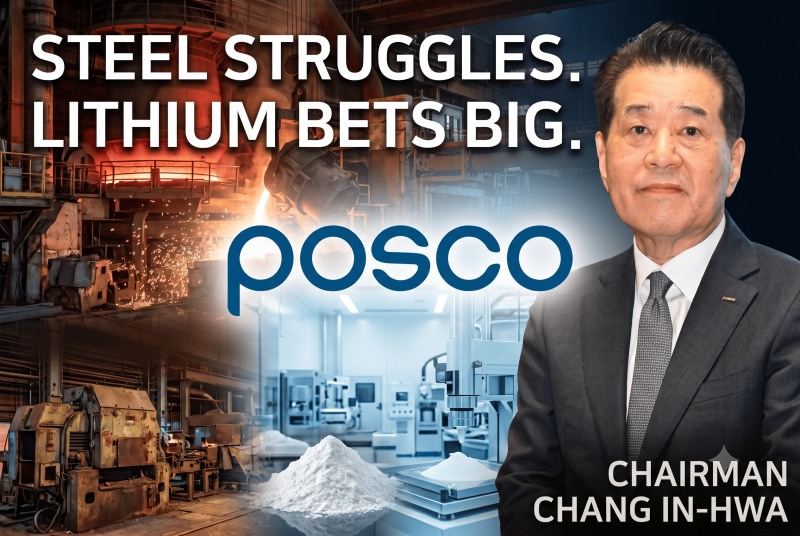
Chairman Chang In-hwa is putting his 'Triple Core' strategy front and center. With his term set to end in six months, he needs clear results to show for it. Lithium, one of the three core pillars, is a growth engine Chang himself identified back when he headed POSCO's new business division.His recent trip to Australia is also part of the 'Triple Core' strategy POSCO Group unveiled on July 2. At the time, the group named steel (industrial resources), lithium (strategic resources) and energy (energy resources) as its core business pillars and pledged to invest a total of KRW 29.1 trillion over three years, from this year through 2028.
관련기사
POSCO Group Expands Rare Gas Business From Semiconductors to Aerospace and DefenseRebounding from a Plunge: Does POSCO Future M's Z-Score Signal a Revival?POSCO Holdings Stock Soars 68% in Two Months on Wings of Non-Steel BusinessPOSCO Holdings Finds New Revenue Engine in Energy, but Debt Shadow DeepensPOSCO Holdings Completes 6% Share Cancellation Pledge — But Core Profit Recovery Remains the Missing Piece
Through the 'Triple Core' strategy, POSCO Group has set a target of KRW 187 trillion in combined group sales and KRW 13.1 trillion in operating profit by 2035. Last year, the group posted combined sales of KRW 69.095 trillion and operating profit of KRW 1.827 trillion — meaning the plan calls for doubling sales and boosting operating profit nearly sevenfold within a decade.
The question is where the investment funds will come from. POSCO Group plans to raise part of the capital by selling stakes in its listed subsidiaries. By the end of 2027, the group intends to reduce its holdings in blue-chip listed affiliates — POSCO International, POSCO Future M and POSCO DX — down to 50%, the minimum level needed to retain management control.
This is expected to raise roughly KRW 3.5 trillion, 10% of which will go toward share buybacks and cancellations, with the rest funding projects POSCO Holdings runs directly, including phases three and four of its Argentina lithium investment. In effect, the group is selling off stable, dividend-generating assets to bet on new businesses.
Through this strategy, POSCO Group has also set a goal of raising its return on equity (ROE) from 1.2% last year to 4.2% by 2028, and its price-to-book ratio (PBR) from 0.4x to 1.0x.
Argentina Lithium Turns Profitable
Chairman Chang In-hwa's term runs until March 20 next year — about six months from now. Given that the chairman selection process typically begins three months before a term expires, this year is effectively his last chance to build the track record that will determine whether he is reappointed.In 2023, POSCO Group abolished the "reappointment priority review" system that had given sitting chairmen preference; incumbents are now screened through the same process as new candidates.
The 'Triple Core' strategy is Chang In-hwa's bid for reappointment. The lithium project at the Salar del Hombre Muerto brine deposit in Argentina, which broke ground in 2022, spent a long period requiring capital injections with little to show for it — but this year it turned profitable, and its results are becoming visible.
By contrast, the core steel business remains sluggish. POSCO's sales in the first quarter of this year fell 0.4% year-on-year, while operating profit plunged 38%. With steel struggling, the performance of new businesses has become all the more important.
The resource strategy Chang has steadily built through organizational and personnel decisions since the start of his tenure is now translating into concrete results as his term nears its end.
Behind this bold move lies his track record of leading new businesses. Chang In-hwa graduated from Seoul National University's Department of Naval Architecture and Ocean Engineering and earned a doctorate in ocean engineering from the Massachusetts Institute of Technology (MIT).
His ties to POSCO began in 1988, when he joined the Research Institute of Industrial Science and Technology (RIST) in Pohang.
An engineer by training, he held key posts at POSCO from 2011 to 2017 — including head of the new business division and head of new business management — roles focused on identifying and managing new ventures.
Since becoming chairman, he has shifted the organization's focus toward new businesses and resources through annual reorganizations. In 2024, he created the "Chief Technology Officer" post as the group's R&D control tower; in 2025, he established the "Future Strategy Office" and set up the group's first overseas resource-focused research institute, the Australia Critical Resources Research Institute, on Australian soil. This year, he also created a "Strategic Investment Office" dedicated to overseas investments in markets such as India and the United States.
A POSCO Group official said, "Chairman Chang pursued lithium as a new business when he was in charge of new business development, and that business is now blooming. His track record as head of new business is now bearing visible fruit."
Jung Jina (urzinnie@fntimes.com)
데일리 금융경제뉴스 Copyright ⓒ 한국금융신문 & FNTIMES.com
저작권법에 의거 상업적 목적의 무단 전재, 복사, 배포 금지

가장 핫한 경제 소식! 한국금융신문의 ‘추천뉴스’를 받아보세요~