





 이미지 확대보기
Spicy flavors and K-content hit the mark… Mexican market backed by the numbers
According to industry sources on Sept. 30, major Korean food companies took part in "2026 K-Expo Mexico," held for four days from Sept. 24 to 27 at the Centro Internacional de Exposiciones y Convenciones (CIEC) of the World Trade Center Mexico City. They promoted their products and held sales negotiations with distributors.Several factors explain why the Korean food industry is focusing on Mexico among Latin American countries, including market size, geographic advantages and similarities in food culture.
The popularity of K-content on top of a local food culture accustomed to spicy flavors has also been a key factor. In a survey of Mexican consumers conducted last year by global data provider Statista, 67% and 66% of respondents said K-pop and K-dramas, respectively, were well known or popular in the country.
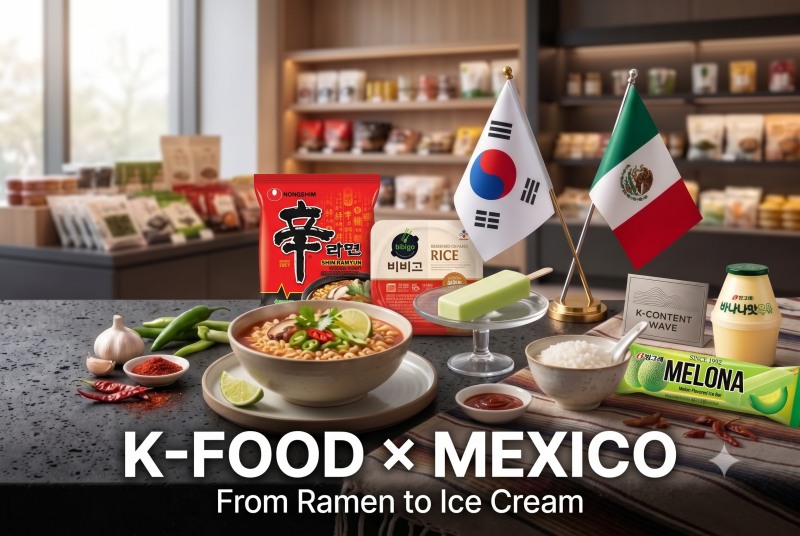
As demand for K-food rises on the back of the Korean Wave (Hallyu), the leading item, unquestionably, is ramen (instant noodles). According to Agri-Food Export Information (KATI) data, Korea's ramen exports to Mexico surged 797% in five years, from USD 2,683,000 (approx. KRW 3.6 billion) in 2020 to USD 24,069,800 (approx. KRW 32.6 billion) last year. Over the same period, export volume rose 422%, from 1,042.3 tons to 5,443.9 tons.
관련기사
Beyond "Future Businesses" to "One Lotte": Shin Yu-yeol's Succession Training Enters Act TwoCash-Rich but Inefficient: OTOKI's Japan Push Aims to Wake Dormant CapitalUnderdog No More: Cosmecca Korea Outpaces Beauty Giants Kolmar, Cosmax on Growth and MarginsKolmar Group Joins South Korea's Large Business Tier After 36 Years — HK inno.N at the Core
The power of "Shin Ramyun"… Nongshim breaks into local distribution networks
As K-food's growth is proven by the numbers, Korean companies are accelerating their push into the local market. The most notable move came from Nongshim. Nongshim, the only Korean ramen maker to take part in the expo, set up a "Shinverse" booth reflecting the brand universe of its "Shin Ramyun" and placed photo zones featuring its global ambassador, K-pop girl group aespa, across the front and sides of the booth to draw visitors' attention.In the tasting zone at the front of the booth, Nongshim installed a "Han River ramen cooker" (the automatic ramen-cooking machines found at convenience stores along the Han River, familiar to Mexican audiences from Korean dramas and variety shows). By letting visitors taste freshly boiled Shin Ramyun and "Shin Ramyun Toomba" on the spot, the company ran detailed marketing that connected the food culture seen in K-content to an actual taste experience.
The company did not stop at running a booth but delivered business results. It confirmed the listing within this year of its Shin Ramyun Big Bowl and Shin Ramyun Toomba Big Bowl products at Sam's Club, a global retailer operating about 170 stores in Mexico, and agreed to begin full-scale sales in early next year.
In addition, Nongshim will operate a dedicated Nongshim display section and run a large-scale promotion with Soriana, a major Mexican retail chain, in November to coincide with "Buen Fin," Mexico's biggest shopping season, often called the Mexican Black Friday. In early next year, it plans a large-scale launch event alongside the listing of its new "Shin Ramyun Rose," and it will continue to expand its portfolio to include a stir-fried noodle lineup, such as "Shin Ramyun Kimchi Stir-Fried Noodles," tailored to local consumers' needs.
Nongshim CEO Cho Yong-cheol said, "Shin Ramyun has firmly established itself as a cultural product representing K-culture, going beyond being just a food item." He added, "We will continue to expand distribution channels in key markets around the world more aggressively, raise the share of overseas sales to 60% or more by 2030, and be sure to achieve our targets of KRW 7.3 trillion in sales and an operating margin of 10%."
After CJ CheilJedang, Binggrae too… Bibigo and Melona win over Mexico
CJ CheilJedang likewise expanded its points of contact with young local consumers by putting its global flagship brand "Bibigo" at the forefront. Moving away from a simple product-display format, it built digital content and a theme zone using the IP of ALPHA DRIVE ONE, Bibigo's global brand ambassador, and drew a warm response from local fans.Its tasting strategy also focused on localization. The company paired Hetbahn (cooked rice; sold locally as "bibigo Sticky White Rice") with a drizzle of Bibigo gochujang sauce (sold locally as "bibigo Hot & Sweet Gochujang Sauce"), which is seen as having appealed to Mexicans, who eat rice as a staple and also enjoy spicy sauces.
The rush of K-food into Mexico is expanding into desserts such as ice cream. Through relay meetings with local distributors held during K-Expo Mexico, Binggrae secured a plan to list its flagship ice cream product, "Melona," at Soriana in November.
This is the result of local marketing that followed its participation in Expo Antad 2026, an international food fair held in Guadalajara, Mexico, in May. Binggrae currently sells its Banana Flavored Milk at large local retail channels such as Soriana and HEB. It plans to use the Melona listing as a bridgehead to place its entire K-ice cream lineup, including Bungeo-ssamanco, in the local mainstream distribution network.
An industry official said, "In the past, K-food consumption in Mexico centered on Korean marts and Asian markets, but now it is entering the main shelves of large mainstream local retail channels directly." The official added, "Since it has gone beyond simple curiosity to actual repeat purchases, companies should be able to keep adding products by using the large retail channels as a stepping stone."
Yang Hyunwoo (yhw@fntimes.com)
데일리 금융경제뉴스 Copyright ⓒ 한국금융신문 & FNTIMES.com
저작권법에 의거 상업적 목적의 무단 전재, 복사, 배포 금지

가장 핫한 경제 소식! 한국금융신문의 ‘추천뉴스’를 받아보세요~