




 이미지 확대보기
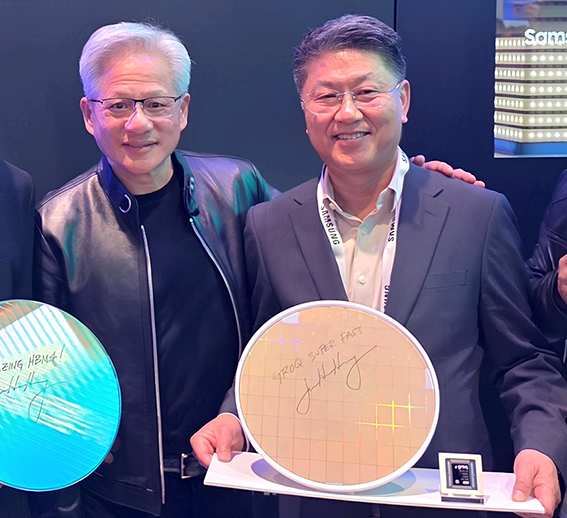
Han Jin-man, President and head of Samsung Electronics' Foundry Business Division, shared these sentiments last month at NVIDIA's technology conference "GTC 2026," held in San Jose, California.
This year marked the first time Samsung Electronics' Foundry division participated in GTC. NVIDIA plans to have Samsung Electronics Foundry produce the "Groq 3," an inference-dedicated Language Processing Unit (LPU) chip to be embedded in its next-generation AI platform, "Vera Rubin." In connection with this, NVIDIA CEO Jensen Huang reportedly exclaimed, "Thank you, Samsung!"
Back in 2019, Samsung Electronics Chairman Lee Jae-yong announced "Semiconductor Vision 2030," a plan to invest KRW 133 trillion in non-memory fields such as foundry by 2030 to achieve global No. 1 status, aiming to overcome Samsung's overdependence on memory semiconductors.
Reality, however, proved far less accommodating. Contrary to the plan, the company has been met with a sobering assessment that it remains in a difficult transitional phase in terms of market share and customer acquisition.
관련기사
Samsung Eyes Record KRW 90 Trillion Shareholder Payout as Chip Supercycle Ignites Earnings [Treasury Stock Report]Samsung Electronics and SK Hynix Engage in High-Stakes AI Chip War [KFT Topic]SK Chairman Takes Center Stage in Global AI Race on Record HBM ProfitsSamsung's 'Last Chance': Lee Jae-yong Pushes HBM4 as Make-or-Break Moment [KFT Topic]"Samsung Is Back," Chip Chief Declares, Eyeing Record Profit on HBM Recovery [KFT Topic]
According to market research firm TrendForce, TSMC's revenue market share in 2025 stood at 69.9%, up 5.5 percentage points from the previous year. Samsung Electronics ranked second with a 7.2% share, which actually declined by 2.2 percentage points. The gap with TSMC widened further, from 55 percentage points to 63 percentage points. China's SMIC, in third place with a 5.3% share, is also gaining ground rapidly.
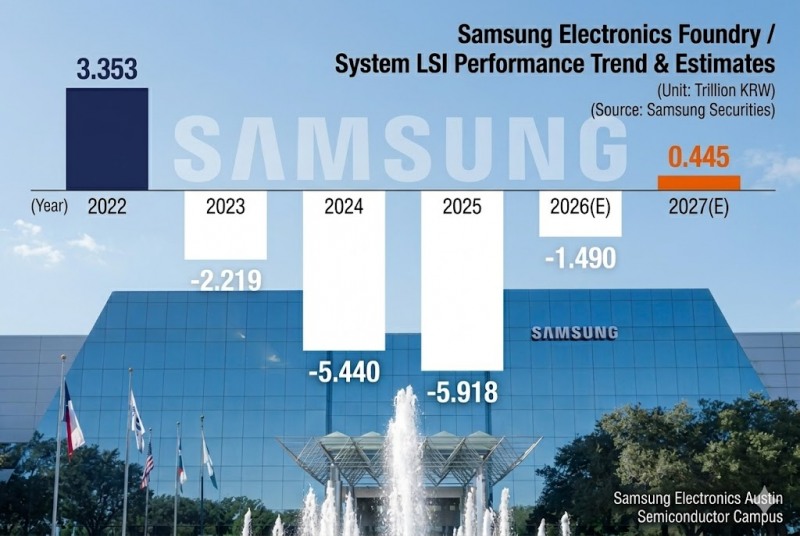
Profitability has taken a direct hit as well. Securities analysts estimate Samsung Electronics' operating losses in its non-memory segment — encompassing foundry and System LSI — at KRW 2.2 trillion in 2023, KRW 5.4 trillion in 2024, and KRW 5.9 trillion in 2025.
The perception of Samsung Electronics Foundry began to shift last year in July, when the company secured a long-term supply contract with Tesla worth USD 16.5 billion (approximately KRW 23 trillion) — the "Tesla Deal." Samsung won the contract to manufacture Tesla's next-generation AI autonomous driving chip, "AI6," using a 2-nanometer process.
Samsung Electronics Foundry also captured a portion of the "AI5" volume, which had been widely believed to be awarded entirely to TSMC. Tesla CEO Elon Musk had consistently mentioned the possibility of expanding collaboration with Samsung Electronics Foundry, and at last year's earnings call in October, he confirmed: "Both TSMC and Samsung Electronics will manufacture the AI5 chip."
 이미지 확대보기
Han Jin-man stated, "Tesla is not an ordinary foundry customer," adding, "As we enter the era of autonomous driving and robotics, we have seized an opportunity to leap to the next level through collaboration with Tesla, the frontrunner in physical AI."
In terms of near-term results, the company expects its performance this year to reflect the contribution of the "Exynos 2600," the processor powering the Galaxy S26 and Galaxy S26 Plus. The Exynos 2600 is a mobile application processor designed by System LSI and manufactured through the Foundry division's 2-nanometer process. Last year, the Exynos 2500 failed to make it into the Galaxy S25 due to early-stage issues, dealing a blow to the non-memory business.
The full-scale ramp-up of High Bandwidth Memory (HBM) 4 supply — of which Samsung Electronics was the first in the industry to mass-produce and ship — is also expected to lift foundry earnings. Unlike SK Hynix, which partners with TSMC, Samsung Electronics produces HBM4 base dies directly at its own foundry.
The base die is the chip positioned at the bottom of an HBM stack formed by layering DRAM chips. It serves not merely as memory storage, but also as a "control tower" that manages the other memory chips, requiring a high-precision foundry process that produces less heat and offers greater power efficiency.
Building on these anticipated contributions from Exynos and HBM4, projections suggest that Samsung Electronics' non-memory segment could return to quarterly profitability as early as the fourth quarter of this year.
The real battleground begins next year, when the Taylor fab (fab: semiconductor manufacturing facility) in the United States commences large-scale mass production. The Taylor plant was initially established around 4-nanometer processes, but following the success of the Tesla contract, the company plans to build out 2-nanometer production lines in order to respond swiftly to market changes.
Han Jin-man said, "Foundry is now generating real synergy with memory and System LSI," adding, "This is a business that requires a long view. Give us just one or two more years, and we will deliver strong results."
Gwak Horyung (horr@fntimes.com)
데일리 금융경제뉴스 Copyright ⓒ 한국금융신문 & FNTIMES.com
저작권법에 의거 상업적 목적의 무단 전재, 복사, 배포 금지

가장 핫한 경제 소식! 한국금융신문의 ‘추천뉴스’를 받아보세요~