





 이미지 확대보기
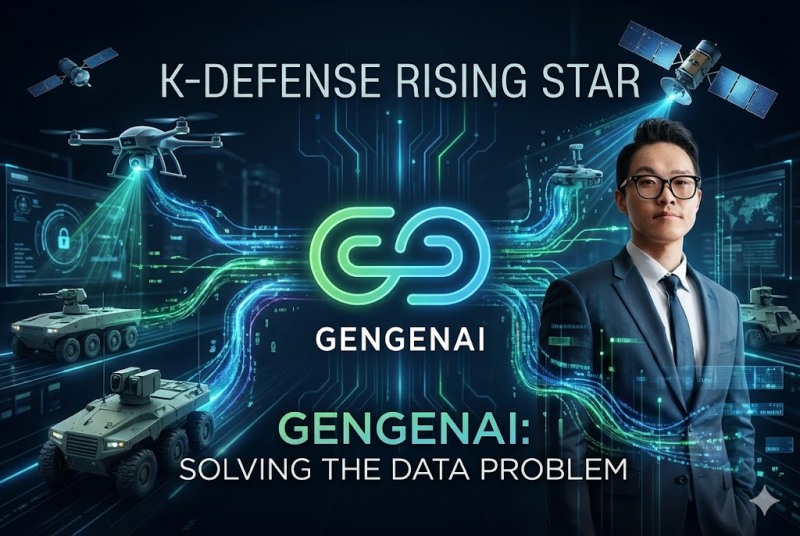
"I want to make sure no customer ever says they cannot build AI because they lack data," Cho said. "Our goal is to become the TSMC of data — a data foundry — so that the many companies developing AI can build their models using our data."
Born from an Engineer's Frustration: 'Truly Generative' AI
Cho Ho-jin, who completed his bachelor's and doctoral degrees in computer science at Pohang University of Science and Technology (POSTECH), is a veteran engineer who served as a doctoral intern on the Adobe Photoshop development team and was a founding member of StradVision, a domestic autonomous driving software company. Working firsthand on autonomous driving AI, he witnessed the inefficiency of spending tens of billions of KRW annually on data collection, refinement, and processing.So-called "edge case" data — such as animals like bears or kangaroos encountered while driving abroad, or unexpected accident scenarios — was inherently difficult to obtain even at enormous cost.
This frustration led to the founding of GenGenAI in January 2022. The reason for incorporating generative AI into the company name from the start was equally clear: the ambition was to create not merely plausible-looking images, but GENuine data that could be immediately used for training in real industrial settings.
관련기사
Breaking Through Data Limitations with Domain-Specific Technology
Synthetic data based on 3D simulation was not new. However, the persistent problem was the "domain gap" — the failure to perfectly replicate actual sensor noise and complex physical environments, causing performance to degrade when applied to real-world conditions.GenGenAI resolved this through its domain-specific generative technology. By precisely reflecting customer sensor characteristics and mission environments, the company generates data indistinguishable from real-world data.
The efficiency gains are equally transformative. There is no need to wait a full year to obtain data across all four seasons, or to take risks filming on snowy roads. Using only GPUs in an office environment, the system can freely simulate all four seasons, weather conditions, and terrain. As a result, AI development cycles that previously took 6 to 12 months have been compressed to 10 to 20 days — a reduction of more than 90%.
Leading AI-Driven Intelligence for Land, Sea, and Air Unmanned Systems
Originally targeting the automotive autonomous driving market, GenGenAI made its full entry into the defense sector in 2023, beginning with a partnership with Hanwha Systems. The defense industry — where data cannot be shared due to security restrictions and collection is inherently difficult — was precisely where GenGenAI's capabilities were most urgently needed.In the areas of unmanned systems and Intelligence, Surveillance and Reconnaissance (ISR) in particular, GenGenAI leverages generative AI to precisely replicate targets that are difficult to capture in reality, specific weather conditions, terrain changes by time of day, and hypothetical threat scenarios.
This enables the enhancement of core unmanned system functions — including object detection and classification, tracking, and situational awareness — and supports comprehensive training on rare edge cases. The company currently generates data for all unmanned platform types: ground (UGV), maritime (USV), and aerial (UAV).
Following the successful completion of a maritime environment infrared (IR) sensor data generation project with Hanwha Systems, GenGenAI has secured partnerships with leading domestic defense companies including Korea Aerospace Industries (KAI), Hanwha Aerospace, LIG Nex1, Hyundai Rotem, and the Agency for Defense Development (ADD).
In collaboration with KAI — which holds a 9.87% stake as the company's second-largest shareholder — GenGenAI is working on unmanned aerial vehicle and satellite data generation, and is expected to serve as a key data supplier for future "AI pilot" training.
Revenue Doubled in Two Years — Order Backlog Reaches KRW 2 Billion
GenGenAI's business is built on three pillars: GenGenData, which generates and supplies data; GenGenVision, which develops customized AI models; and GenGenStudio, a platform that enables customers to generate their own data and develop AI independently.GenGenStudio received an Innovation Award in the AI category at CES 2025, drawing such enthusiasm that executives from global automakers including Volkswagen and Audi visited the booth daily. Considering security and cost concerns, GenGenAI plans to launch an on-premise product targeting the military and government-funded research institutes later this year.
Revenue metrics have been trending upward. Sales grew from approximately KRW 300 million in 2023 to KRW 620 million in 2024. Also in 2024, the company signed an export contract worth approximately USD 250,000 for autonomous driving-related data supply to the United States. Last year's revenue reached KRW 680 million, and the current order backlog stands at approximately KRW 2 billion. The company projects growth of two to three times or more compared to the prior year.
Beyond Defense: Targeting Robotics and Global Expansion
Cho's attention is now turning to physical AI (robotics) and the manufacturing sector. Robot applications requiring sensor-based perception demand data of even greater sophistication than simulations can provide. Manufacturing, too, stands to benefit from AI adoption through cost reduction and productivity gains."We have only been one year into executing contracts since getting on track in the defense sector," Cho said. "This year, we will successfully deliver for our existing customers while expanding the scope of additional collaboration."
Because GenGenAI's data generation technology carries dual-use advantages — applicable to civilian industries as readily as to defense — the company plans to accelerate revenue growth outside the defense sector and rapidly build its global customer base.
The company is currently broadening its footprint across consumer electronics, manufacturing, and security industries, among other civilian sectors. It is in close discussions with major domestic large and mid-sized enterprises, and is poised to sign mass production contracts with select companies within the first half of this year.
This month, the company finalized a cooperation framework with global mobility technology firm AUMOVIO (formerly Continental Automotive), and has also successfully completed proof-of-concept (PoC) demonstrations conducted at the request of defense companies in Italy and Spain.
Internal structural improvements are also underway. The company is building a proprietary model by consolidating its accumulated technological expertise. It plans to strengthen its business model by transitioning from a simple "data generation service" to a solution product-centric structure.
As for his medium-to-long-term vision, Cho stated: "Rather than grandiose goals, I want to focus on the essence of business — generating profit. Our goal is to develop the products, technologies, and services the market demands, and to become a defense startup that achieves its annual break-even point and turns a profit."
Shin Haeju (hjs0509@fntimes.com)
데일리 금융경제뉴스 Copyright ⓒ 한국금융신문 & FNTIMES.com
저작권법에 의거 상업적 목적의 무단 전재, 복사, 배포 금지

가장 핫한 경제 소식! 한국금융신문의 ‘추천뉴스’를 받아보세요~