




 이미지 확대보기
Chairman Chey spent approximately three weeks in the United States beginning in early February, reviewing local business operations and strengthening his network with political and business leaders.
During his U.S. visit, Chey held a series of meetings with the heads of global big tech companies, including Jensen Huang, CEO of NVIDIA; Hock Tan, CEO of Broadcom; Satya Nadella, CEO of Microsoft; Mark Zuckerberg, CEO of Meta; and Sundar Pichai, CEO of Google.
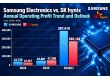
The memory shortage is, in fact, the driving force behind SK Hynix's stellar financial performance. The company posted record-breaking results last year, with revenue of KRW 97 trillion 1,467 billion and operating profit of KRW 47 trillion 2,063 billion — representing an operating margin of 49%.
HBM, the AI-critical semiconductor that Chairman Chey has called a "monster chip," carries an operating margin exceeding 60%. Conventional memory, which has suffered severe supply shortages due to being deprioritized in favor of HBM production, operates at comparatively lower margins.
관련기사
SK Telecom's Profits Plunge 41% After Hacking Crisis; Bets on AI for ComebackSamsung Electronics and SK Hynix Engage in High-Stakes AI Chip War [KFT Topic]Lee Jae-yong and Chey Tae-won, Korea's 'Semiconductor Duo,' Head to China... What's the Status of Local Operations? [KFT Topic]SK Hynix's Five-President Team Set to Usher in KRW 100 Trillion Profit Era
On this point, Chairman Chey noted: "They say the figure could go from USD 50 billion (KRW 70 trillion) in December last year to USD 70 billion (KRW 100 trillion) in January this year, and the new forecast could exceed USD 100 billion (KRW 140 trillion)."
Nevertheless, Chey cautioned against excessive optimism, saying it "could also turn into a USD 100 billion loss." The remark is widely interpreted as a reflection of the AI industry's winner-takes-all nature, where a single technological victory can determine everything.
Competition in HBM is now intensifying around the sixth-generation HBM4.
Samsung Electronics, which fell behind in last year's fifth-generation HBM3E race, has leveraged its advanced process technology to achieve what it claims is the industry's first mass production shipment of HBM4. Meanwhile, Micron has faced recurring speculation — which the company has denied — about being dropped from NVIDIA's HBM4 supply chain.
SK Hynix has also been grappling since last year with a redesign issue related to its HBM4 for NVIDIA. The company stated: "We established a mass production system for HBM4 in September last year and are currently manufacturing customer-requested volumes." However, it has yet to officially announce full-scale supply.
The outcomes of the HBM4 race are expected to come into clearer focus at GTC 2026, NVIDIA's annual AI technology conference, scheduled to be held on March 16 (local time) in California. At the event, both SK Hynix and Samsung Electronics are set to showcase the performance of their HBM4 chips to be integrated into NVIDIA's AI accelerator "Rubin."
Attention is also turning to the next generation of technology. CEO Jensen Huang has stated that he will unveil "a chip the world has never seen" at GTC 2026 — widely expected to be the AI accelerator "Feynman," equipped with eighth-generation HBM5. SK Hynix previously announced at the SK AI Summit in November last year that it plans to introduce HBM5 around 2029.
Gwak Horyung (horr@fntimes.com)
데일리 금융경제뉴스 Copyright ⓒ 한국금융신문 & FNTIMES.com
저작권법에 의거 상업적 목적의 무단 전재, 복사, 배포 금지

가장 핫한 경제 소식! 한국금융신문의 ‘추천뉴스’를 받아보세요~