





 이미지 확대보기
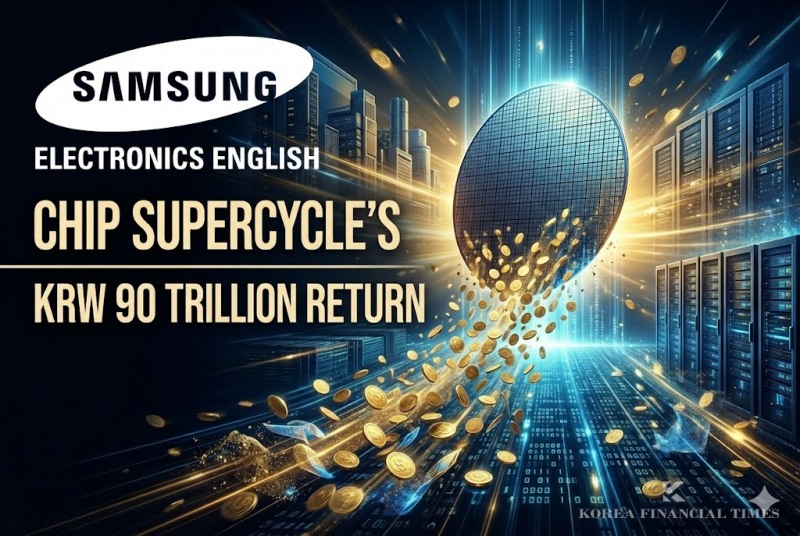
Market attention, however, is now fixed on the final outcome of the company's three-year shareholder return policy spanning 2024 to 2026. With Samsung widely expected to surpass KRW 200 trillion in operating profit this year on the back of a semiconductor supercycle, total shareholder returns through the end of the policy period in 2026 are projected to soar to an unprecedented KRW 90 trillion range.
KRW 15 Trillion Treasury Share Retirement
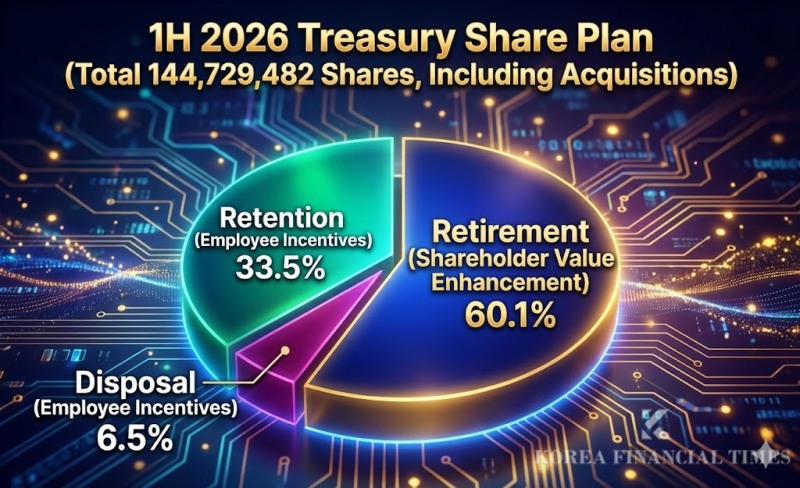
In its annual business report filed on the 10th, Samsung Electronics disclosed plans to cancel approximately 87 million shares — comprising 73,359,315 common shares and 13,603,461 preferred shares — out of its total treasury stock holdings of 105,432,448 shares (91,828,987 common shares and 13,603,461 preferred shares) by June 30 of this year. Based on the closing price on the 12th, the total assessed value of the shares to be retired amounts to KRW 15.6071 trillion.At the time, Samsung Electronics announced a total buyback of KRW 10 trillion to boost shareholder value — a surprise move signaling the company's resolve to lift its share price, which had fallen to as low as KRW 40,000 per share amid concerns over weakening competitiveness in high-bandwidth memory (HBM) and other memory semiconductor segments.
The buyback was carried out in three tranches through September last year: the first tranche (November 2024 – February 2025) totaling KRW 3.0387 trillion; the second tranche (February 2025 – May 2025) totaling KRW 3.0394 trillion; and the third tranche (July 2025 – September 2025) totaling KRW 3.9119 trillion.
관련기사
Six Years Locked Away: What Will Hyundai Steel Decide on Its Treasury Shares at This AGM?POSCO Holdings Completes 6% Share Cancellation Pledge — But Core Profit Recovery Remains the Missing PieceLG Corp. Taps Asset Sale Proceeds to Defend Dividend Amid Subsidiary SlumpSamsung Electronics and SK Hynix Engage in High-Stakes AI Chip War [KFT Topic]
Under the latest announcement, the remaining 86,962,775 shares from the KRW 7 trillion balance, net of shares reserved for employee compensation, are set to be retired by the end of the first half of this year. The assessed value has reached KRW 15.6 trillion, reflecting a nearly threefold surge in the share price since the buyback was executed at KRW 55,000–69,000 per share.
 이미지 확대보기
Performance Bonuses Paid in Stock
Samsung Electronics currently holds a total of 105,432,448 treasury shares (including 13,603,461 preferred shares), representing 1.57% of total shares outstanding. The company plans to additionally acquire 39,297,034 shares by the end of the first half of this year to fund performance-linked stock unit (PSU) awards and performance incentives including OPI (Outperformance Incentive) and LTI (Long-Term Incentive) programs. Even after the large-scale cancellation, the company intends to retain 48,423,794 shares for future employee compensation purposes.The rationale behind Samsung's substantial treasury share reserve for employee compensation is closely tied to its recently revamped incentive structure.
In October 2025, Samsung Electronics introduced a new PSU scheme. The program is seen as a supplementary compensation measure designed to partly address dissatisfaction among employees who, unlike their counterparts at rival SK Hynix, are subject to a ceiling on maximum bonus payouts.
Under the PSU plan, treasury shares are granted three years after the grant date based on the share price appreciation rate, structured as follows: below 20% appreciation, 0x; 20–40%, 0.5x; 40–60%, 1x; 60–80%, 1.3x; 80–100%, 1.7x; 100% or above, 2x. The reference share price at the time of introduction was approximately KRW 85,000, and analysts expect that sustaining the current share price trajectory alone would be sufficient to qualify for the maximum payout.
The OPI bonus — paid when annual performance targets are exceeded — has also been tied to treasury shares. Last year, the company introduced a scheme under which executives receive 50–100% of OPI payouts in the form of treasury shares, depending on their seniority. Starting this year, the policy has been extended to all employees, who may now elect to receive between 0% and 50% of their OPI in treasury shares in increments of 10%. An additional incentive of 15% in treasury shares is granted on the stock compensation amount for employees who hold the shares for at least one year.
This Year's Projected Shareholder Return Pool: KRW 92 Trillion, Fivefold Last Year's Level
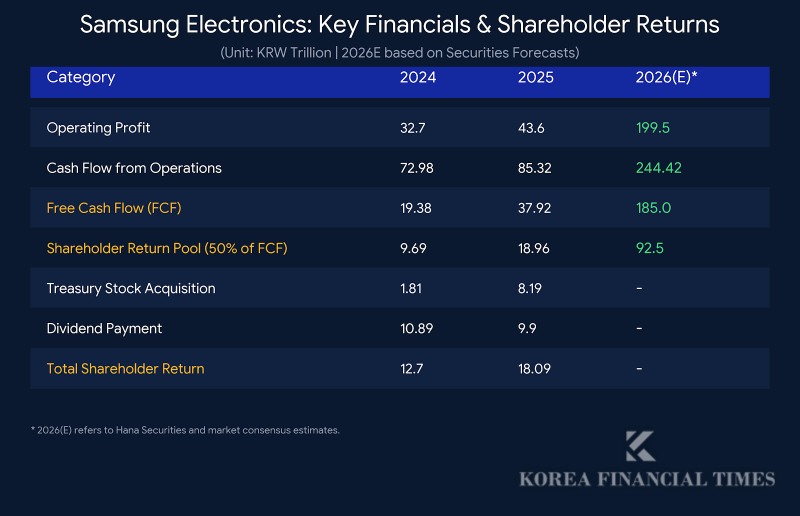
This year marks the final year of Samsung Electronics' three-year plan (2024–2026), under which the company committed to allocating 50% of cumulative free cash flow (FCF) to shareholder returns in the form of share buybacks and dividends.As Samsung Electronics enters a memory semiconductor boom cycle, attention is increasingly turning to the scale of shareholder returns this year. Major brokerage firms have recently forecast Samsung's operating profit for the year at KRW 220–240 trillion, more than five times the KRW 43,600,000,000,000 recorded last year.
Free cash flow (FCF) refers to the cash remaining after capital expenditures and other investment outlays are deducted from cash generated through operating activities.
 이미지 확대보기
According to Samsung Electronics' earnings report, the company's FCF for fiscal year 2025 stood at KRW 37.92 trillion, implying a shareholder return pool of approximately KRW 18.86 trillion — half of that figure.
Last year, Samsung Electronics deployed a total of KRW 18.09 trillion in shareholder returns: KRW 8.19 trillion in treasury share acquisitions and KRW 9.9 trillion in dividend payments. While the figures may differ slightly from actual disbursements due to fiscal year accounting conventions, they broadly align with the company's stated shareholder return commitments.
What, then, might shareholder returns look like this year, when earnings are expected to surge dramatically?
Hana Securities, which projects Samsung Electronics' operating profit at a relatively conservative KRW 199.5 trillion, estimates FCF for the year at KRW 185 trillion, implying a shareholder return allocation of KRW 92.5 trillion — equivalent to half of FCF and 4.9 times the 2025 level. Setting aside share cancellations for simplicity and expressing the figure purely in dividend terms, this translates to approximately KRW 13,618 per share.
Gwak Horyung (horr@fntimes.com)
데일리 금융경제뉴스 Copyright ⓒ 한국금융신문 & FNTIMES.com
저작권법에 의거 상업적 목적의 무단 전재, 복사, 배포 금지

가장 핫한 경제 소식! 한국금융신문의 ‘추천뉴스’를 받아보세요~