





 이미지 확대보기
Hanwha has also floated an "entrusted operation" model, in which the military remains the owner of the data while a defense company runs the facility. The idea is for the private sector to fill the gap until the government builds its own dedicated defense center.
135MW→180MW… "Expanded from the previous plan"
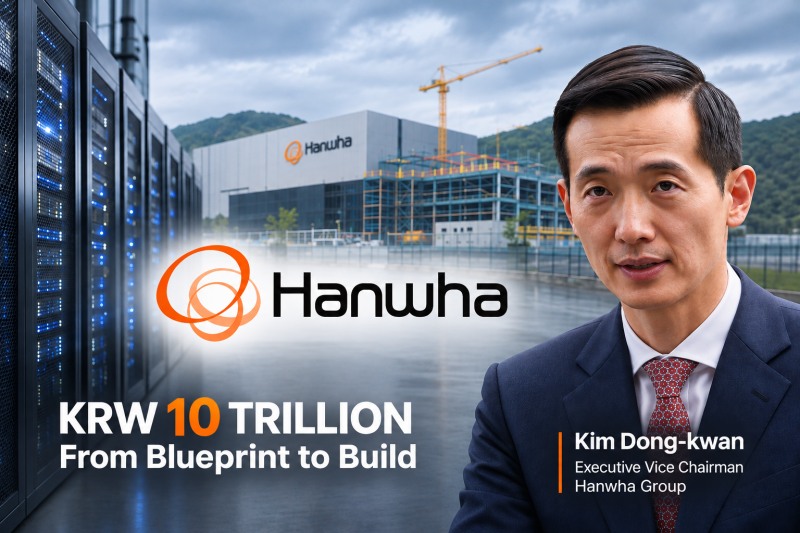
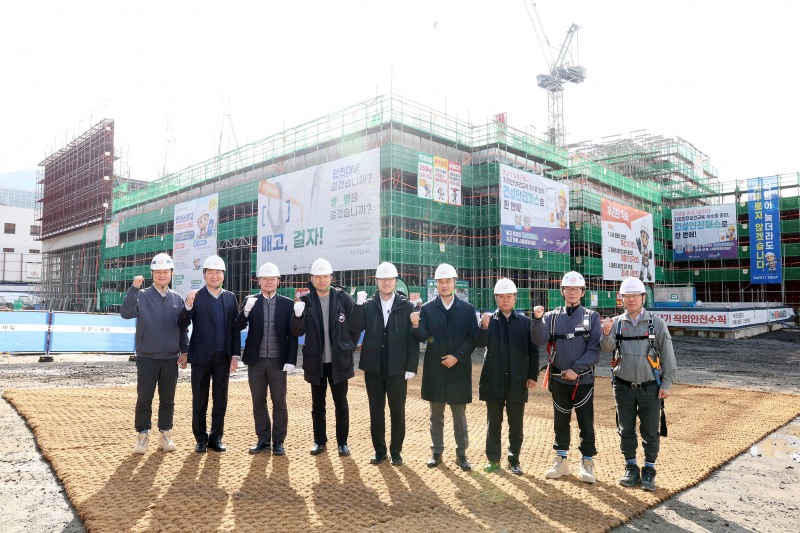
According to industry sources on the 25th, Hanwha Aerospace on the 24th briefed Ha Jung-woo, vice chairman of the National AI Strategy Committee, and officials from the committee and the Defense Acquisition Program Administration (DAPA) on its plan to build the defense AI data center. The briefing took place at the construction site of the AI data center (AIDC) in Changwon, South Gyeongsang Province. The committee and DAPA visited Changwon's defense research and development (R&D) and weapons production sites to plan the defense sector's AI transformation (AX) policy and secure the capacity to carry it out.Hanwha is building the center on a site of about 13,000 pyeong (about 43,000 square meters) near its Changwon plant. It aims to start initial services by bringing part of the facility online in July 2028, and to complete it at a final capacity of 180 megawatts (MW). The company said this is equivalent to about 13% of the capacity of one nuclear power reactor.
The Changwon center is one pillar of the KRW 55 trillion investment plan Kim announced in July at the "Yeongnam Region Advanced Industry Development Vision National Briefing" in Jinju, South Gyeongsang Province.
관련기사
Hanwha Solutions’ Pretax Profit Owes to Asset Sale, Not Core BusinessHanwha Semitech Names 37-Year-Old Strategist as Fourth CEO in Two YearsHanwha Bundles Ships and Missiles in Push for U.S. Navy BusinessHanwha Systems Raises KRW 3.4 Trillion as It Winds Down ‘Bridge’ Role in Hanwha Ocean DealHanwha’s Three Defense Units Split Roles After Reshuffle: Localization, Space·AI and North America
The earlier plan was for the Changwon center to start at 45MW this year and expand to 135MW by 2032. With the final capacity now set at 180MW, the plan has grown by 45MW, or about 33%, in four months.
Phase 1 investment is KRW 10 trillion, and further investment has been signaled. The construction of this data center is also included in that Phase 1 investment.
"The actual plan is being carried out on a larger scale than what we announced earlier," a Hanwha Aerospace official said. "We judged that the need for an AI data center has become even more important."
 이미지 확대보기
Entrusted operation added to the plan… "Bringing defense AI forward by 4–5 years"
Hanwha regards defense AI capability as an essential condition for future national security. As the military's manpower pool shrinks, manned-unmanned teaming operations, in which people and unmanned equipment fight together, and autonomous missions by unmanned equipment are growing rapidly. Dangerous missions will increasingly fall to unmanned equipment. The company said AI assistance is also needed for border surveillance and reconnaissance, and for helping commanders make decisions by assessing battlefield conditions.Defense AI, however, cannot use ordinary commercial data centers for security reasons. The network must be separated so outside forces cannot break into the data, and the facility must meet the highest level of national security. It must also keep running during disasters and emergencies.
When it announced the plan in July, Hanwha said it would make the Changwon center a "closed, high-security data center" that is managed in-house rather than relying on outside parties. It said it would operate the center together with a space data center so that operations would not be interrupted even if one of them were disabled.
This time, Hanwha has added a vision for who will operate the center and how. Under the entrusted operation model it is reviewing, the military keeps full ownership and control of the data, and a defense company handles only the operation of the facility.
The idea takes into account how long it would take the government to build its own center. For the Ministry of National Defense to secure its own AI data center, it would have to go through a feasibility study, site selection and permitting, and design and construction, which takes six to eight years.
Hanwha judged that a data center built first by the private sector can fill this gap. It expects that using the Changwon center could bring the adoption of defense AI forward by four to five years compared with a government-led approach.
Beyond Changwon to home and abroad… even "integrated package exports"
Through additional investment, Hanwha plans to expand AI data center hubs in Korea and overseas, linked to the group's power generation assets. Under the previous announcement, the Changwon center was to secure its electricity through links with Hanwha Energy's power generation assets. This time, the scope has widened to expanding data center hubs across the group. If countries that have adopted Korean weapons systems need it, Hanwha also plans to consider exporting an integrated package that includes a data center.The company said the Changwon center was built on the data center operating experience it has accumulated. Hanwha has run the Jukjeon Integrated Data Center since 2011, managing data for its defense affiliates. It is also leading the design and system integration of an AI data center in Georgia, United States (NVIDIA B300 AI Factory).
Once the Changwon center is fully operational, it is expected to help raise regional competitiveness in South Gyeongsang. More than half of Korea's defense-related companies are clustered in the region. The gains would come through talent development, job creation, and upgrades to energy and communications infrastructure. In its earlier announcement, Hanwha said it is already running industry-academia projects, scholarship programs and retraining for current employees with local universities, including Pusan National University, Changwon National University and Gyeongsang National University. It said it will broaden that cooperation by setting up undergraduate contract-based departments and operating contract-quota graduate programs.
"Building a defense AI data center is about securing defense AI as national infrastructure, on a par with roads, ports and power grids," a Hanwha Aerospace official said. "We will pour Hanwha's capabilities into driving exports of integrated AI-based weapons systems and help the government lead Korea to become one of the world's top four defense powers."
Jung Jina (urzinnie@fntimes.com)
데일리 금융경제뉴스 Copyright ⓒ 한국금융신문 & FNTIMES.com
저작권법에 의거 상업적 목적의 무단 전재, 복사, 배포 금지

가장 핫한 경제 소식! 한국금융신문의 ‘추천뉴스’를 받아보세요~