◇ MX Division Profitability Forecast to Plunge Up to 40% Next Year
◇ Dual Challenges of Weak Global Demand and Soaring Semiconductor Prices
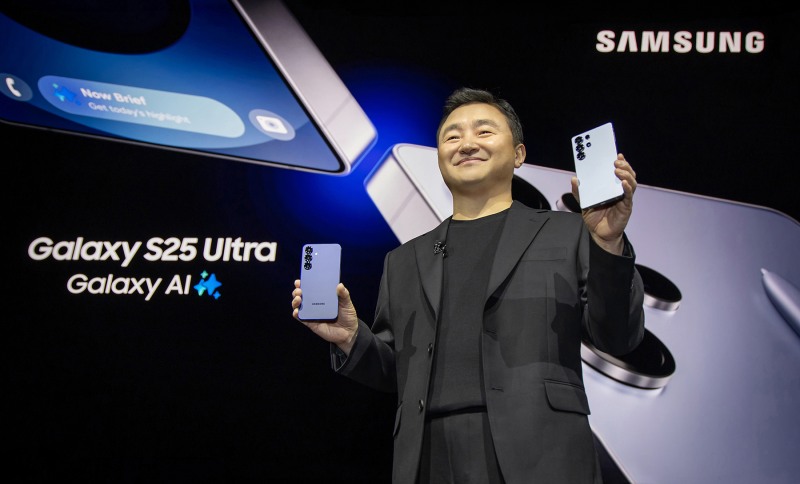
이미지 확대보기Roh Tae-moon, President and Head of Samsung Electronics' DX Division and MX Business
[Korea Financial Times, Gwak Horyung] While securities firms are raising their 2026 Samsung Electronics earnings forecasts daily following confirmation of the memory semiconductor boom, most projections for the MX division responsible for smartphones remain negative. For example, Kiwoom Securities' recent Samsung Electronics corporate brief forecasts the MX (Network) division's operating profit to decline approximately 40 percent from KRW 13.01 trillion this year (10.2 percent operating margin) to KRW 7.83 trillion next year (5.9 percent). Samsung Electronics' smartphone business has consistently generated KRW 10 trillion to KRW 15 trillion in annual operating profit even after Chinese smartphone makers launched their low-price offensive in earnest in 2015.
This backdrop stems from negative smartphone demand growth due to economic recession. While companies typically respond to stimulate demand by freezing product prices, even this is difficult for the flagship Galaxy S series. Component cost burdens are growing due to surging DRAM prices.
The Galaxy S25 released early this year was already priced identically to its predecessor. According to the industry on Dec. 22, the Galaxy S25 Ultra's component cost breakdown is estimated at: AP chip (37 percent), display (18 percent), memory (15 percent), and camera (11 percent). Though cost burden increased 20 to 30 percent compared to one to two years ago due to using Qualcomm's Snapdragon exclusively instead of the in-house Exynos for AP chips, the analysis suggests Samsung matched the launch price by reducing costs in display, memory, and camera components. At the Galaxy S25 launch event, Roh Tae-moon, President and Head of Samsung Electronics' DX Division and MX Business, said, "We made a very difficult decision (on the price freeze)."
Such aggressive pricing policy is expected to be challenging for the Galaxy S26, due around February next year.
Rising memory prices are the primary problem. DRAM prices this year have quadrupled from their February low to December based on DDR5 16Gb. The shortage of general-purpose DRAM due to High Bandwidth Memory (HBM) is expected to continue next year. According to some reports, Samsung Electronics' semiconductor (DS) division reportedly rejected the MX division's request for a one-year or longer semiconductor supply contract and decided to proceed with quarterly contracts instead.
Cost increases from camera upgrades are also anticipated. At the third-quarter earnings call in late October, Samsung Electronics stated, "The Galaxy S26 series will revolutionize user experience through new camera sensors." The Galaxy S series has made virtually no changes to camera specifications for three years since the S23. There have been consistent calls for camera upgrades to differentiate from Chinese smartphones like Xiaomi.
However, given that competitor Apple froze prices for the iPhone 17 base model released in September in the U.S., observations suggest the Galaxy S26 will have no choice but to exercise maximum price restraint.
The key is the in-house AP chip "Exynos 2600." Samsung Electronics is known to use both Exynos 2600 and Qualcomm's latest chip in parallel for the S26 series. While the specific policy has not been confirmed, they are expected to be deployed separately by model and sales region.
Exynos 2600 is designed by Samsung Electronics' System LSI and mass-produced by Samsung Foundry. It will be the first to apply the cutting-edge Gate-All-Around (GAA)-based 2-nanometer process. According to content Samsung Electronics revealed on Dec. 19, Exynos 2600 shows up to 39 percent improvement in CPU computational performance and 113 percent improvement in NPU AI processing performance compared to its predecessor.
Gwak Horyung (horr@fntimes.com)
가장 핫한 경제 소식! 한국금융신문의 ‘추천뉴스’를 받아보세요~
뉴스레터 구독을 위한 이메일 수집 및 수신에 동의하시겠습니까?
뉴스레터 수신 동의
(주)한국금융신문은 뉴스레터 구독(이메일 전송) 서비스와 당사 주관 또는 제휴·후원 행사 및 교육에 대한 안내를 위해 이메일주소를 수집합니다.
구독 서비스 신청자는 개인정보 수집·이용에 동의를 거부할 권리가 있습니다. 단, 거부 시 뉴스레터를 이메일로 수신할 수 없습니다.
뉴스레터 수신동의 해제는 뉴스레터 하단의 ‘수신거부’를 통해 해제할 수 있습니다.







 이미지 확대보기

![용산구 ‘나인원한남’ 88평, 9억 상승한 167억원에 거래 [일일 아파트 신고가]](https://cfnimage.commutil.kr/phpwas/restmb_setimgmake.php?pp=006&w=284&h=214&m=5&simg=2025071010042800278b372994c952115218260.jpg&nmt=18)