





 이미지 확대보기
The core of these partnerships is not simply adding more cathode suppliers. Their significance lies in building a stable supply chain by linking LFP, whose demand is expanding in the market now, and solid-state batteries, considered a next-generation technology, each with a domestic materials company.
Expanding LFP with POSCO Future M: Aiming at the "Present"
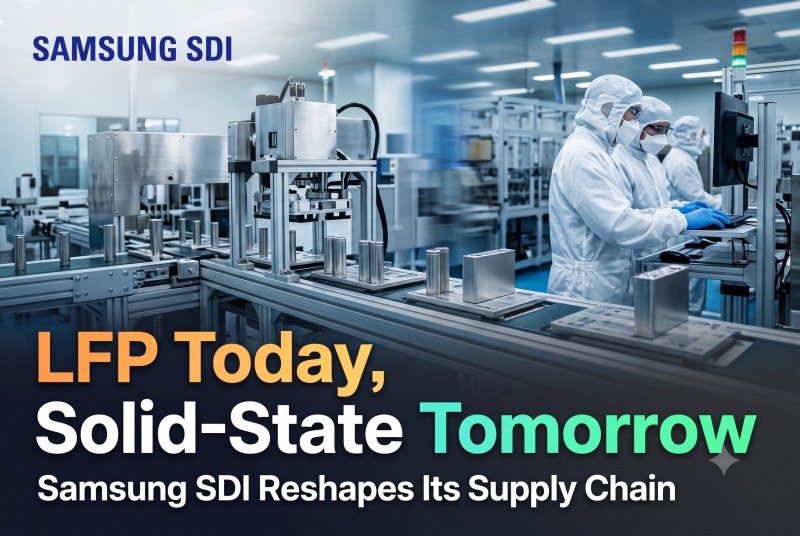
According to Samsung SDI on Oct. 7, the company signed a long-term battery materials supply contract with POSCO Future M the previous day (Oct. 6) for the "bundled supply" of secondary battery materials, including LFP cathode materials. The final contract more than doubled the volume of the large-scale, long-term LFP cathode material supply agreement reached in August, which covered 190,000 tons for the period from 2027 to 2032.LFP does not use nickel or cobalt, which gives it relatively strong price competitiveness and excellent thermal stability. High-nickel cathode materials remain competitive in premium electric vehicles (EVs), where high energy density is important. But LFP is increasingly used in markets where price and stability matter, such as ESS and mid-to-low-priced EVs.
The accelerating growth of the ESS market in particular strengthens Samsung SDI's LFP strategy. EV demand is growing more slowly than expected, while electricity demand is surging with the spread of AI data centers, making ESS an emerging source of battery demand.
관련기사
Debt vs. Equity: LG Energy Solution and Samsung SDI Take Diverging PathsSK On Builds Non-Chinese LFP Supply Chain With POSCO Future M, L&FDe-Risking From China: LG Energy Solution Secures US Lithium Supply Through 2039LG Energy Solution's Subsidy-Driven Profit Masks a KRW 6 Trillion Inventory Problem"Turned to a Millstone by the Chasm": SK's EV Trio — When Will Normalization Come?
The ESS market, where demand is rising mainly in the United States, is also seeing a stronger push to move away from China-dependent supply chains. Samsung SDI's expanded cooperation with domestic materials companies goes beyond securing stable cathode sources; it is also meant to meet the supply chain requirements of the North American market.
An industry official said, "Samsung SDI has already been pursuing LFP supply cooperation with other domestic cathode makers," adding, "Its expansion of long-term supply contracts with domestic cathode companies can be interpreted as one part of the restructuring of supply chains away from China."
 이미지 확대보기
Preparing for the Solid-State "Future" with EcoPro BM
On the same day it signed the LFP cathode supply contract with POSCO Future M, Samsung SDI also signed a cathode materials cooperation agreement with another domestic cathode maker, EcoPro BM. If the partnership with POSCO Future M is a response to the current market, the one with EcoPro BM is a move aimed at the future.Samsung SDI will jointly develop key materials for sulfide-based solid-state batteries with EcoPro BM. Beyond cathode materials, the scope of cooperation extends to cathode electrolytes and separator electrolytes, with the goal of securing development capabilities across solid-state battery materials.
A solid-state battery is a next-generation battery that uses a solid electrolyte instead of a liquid one. It can offer higher energy density and safety than existing lithium-ion batteries, and its potential expansion into new applications requiring high performance and high safety, such as robots, as well as EVs, is being discussed.
The partnership is significant because Samsung SDI sees solid-state batteries as a next-generation growth engine. The company is developing them with a target of mass production in 2027. Starting joint development with a key materials supplier now allows it to stabilize material performance and quality and to build the supply chain in time for mass production.
The industry official said, "Solid-state batteries differ from existing lithium-ion batteries in material composition and processes, so collaboration with materials companies is important at the mass-production stage." He added, "Rather than simply buying finished materials, having battery makers and materials suppliers align their technologies from the early development stage can determine mass-production competitiveness."
This is also why Samsung SDI's partnerships with POSCO Future M and EcoPro BM matter. Samsung SDI is diversifying not only its battery cell technology but also reshaping its materials supply chain to match future demand.
The partnership with POSCO Future M secures a stable supply of LFP cathode materials to respond to the current expansion of the ESS market. The partnership with EcoPro BM is a move to secure next-generation materials, such as solid-state cathode materials and electrolytes, ahead of rivals and raise mass-production competitiveness. The aim is not merely to add suppliers but to secure "present profitability" and "future growth potential" at the same time.
Going forward, Samsung SDI's competitiveness is expected to depend on more than which batteries it can make. How flexibly it can produce batteries suited to each market, from LFP to high-nickel to solid-state, and how reliably it can secure the materials supply chain behind them is emerging as a key competitive factor.
Kim JaeHun (rlqm93@fntimes.com)
데일리 금융경제뉴스 Copyright ⓒ 한국금융신문 & FNTIMES.com
저작권법에 의거 상업적 목적의 무단 전재, 복사, 배포 금지

가장 핫한 경제 소식! 한국금융신문의 ‘추천뉴스’를 받아보세요~