





 이미지 확대보기
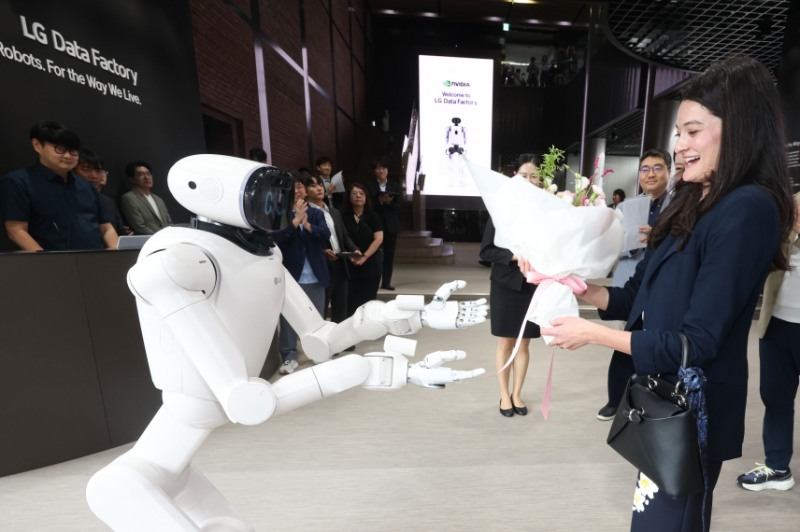
Key Nvidia officials, including Madison Huang, senior director of product marketing for Omniverse and Robotics, visited LG's Data Factory in Seocho-gu, Seoul, on the 18th at LG Electronics' invitation to review the progress of the robot Data Factory project and discuss ways to generate synergy. It was Huang's first visit to LG since April 28, when she toured LG Twin Towers — four months earlier.
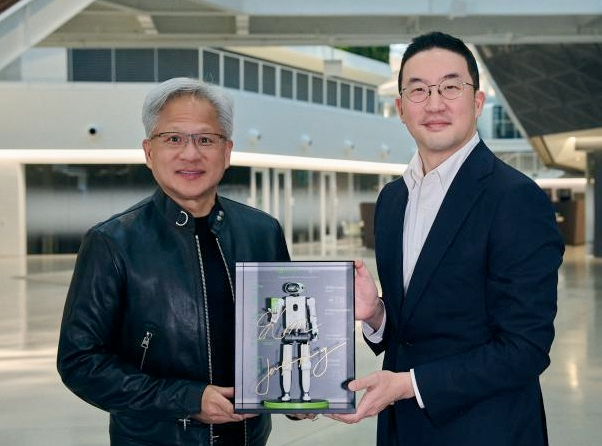
Separately, Chairman Koo Kwang-mo and Nvidia CEO Jensen Huang met in succession in June and August, fleshing out cooperation plans in key future industries such as robotics, AI factories and mobility. At a meeting held at Nvidia's headquarters on the 13th in particular, the two sides signed a memorandum of understanding (MOU) on strategic business cooperation.
 이미지 확대보기
The most notable development is the announcement of plans for a bipedal humanoid robot. The robot will run on Nvidia's next-generation onboard computing platform, Jetson Thor, and its robot foundation model, Isaac GR00T, as its "brain." These will be combined with core capabilities from across the LG group — actuators from LG Electronics, high-performance sensors from LG Innotek, and batteries from LG Energy Solution. LG is developing the robot with an unveiling targeted for the first quarter of 2027.
By contrast, the household humanoid robot CLOiD, which LG Electronics unveiled at CES 2026 in January, uses a wheeled structure. That choice was made to maximize stability and cost-competitiveness, optimized for precise movement and reduced power consumption on flat, threshold-free indoor floors and in logistics settings.
The newly pursued bipedal structure, on the other hand, offers the advantage of high versatility. It can be deployed in existing work environments without requiring any changes. It can move freely through spaces wheels cannot easily reach, such as stairs or passages with varying floor heights. It can also directly operate equipment designed for human height and eye level, and pick up items regardless of their height.
관련기사
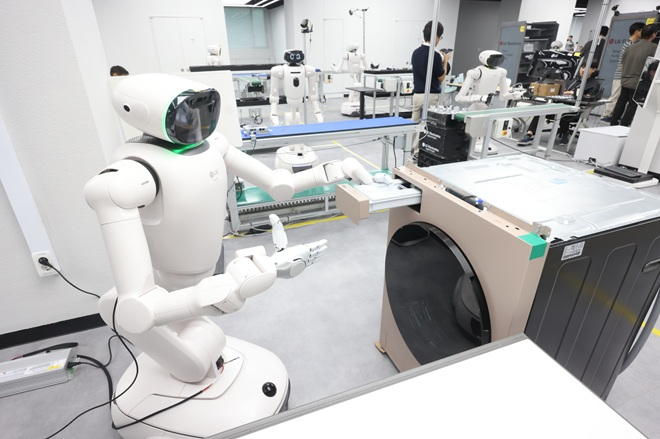
At this stage, however, the wheeled CLOiD — already deployed — remains the primary source of data collection. Using its Yangjae Data Factory in Seoul as a forward base, LG has deployed dozens of wheeled CLOiD robots to gather real-world field data. The approach combines decades of accumulated know-how data from skilled manufacturing workers with Nvidia's robotics solutions, synthesizing and amplifying it virtually. LG plans to expand its CLOiD deployment to about 300 units and secure 100,000 hours of training data by the end of the year, building a "data flywheel" system that will eventually extend to bipedal humanoid robots as well.
LG is also moving quickly in the AI factory sector. It plans to build an early test site based on Nvidia's next-generation AI platform, Vera Rubin, in the first half of 2027, followed by an expanded 80-megawatt AI factory in Cheonan, South Chungcheong Province, in the first half of 2028. The facility will serve as an internal research hub for training robot foundation models, while also functioning as a key reference site for rapidly exporting a "One LG AI Infrastructure Package" to global tech giants — made possible by a prefabricated, modular design that cuts building assembly time by more than 20%. In mobility, LG will jointly develop a next-generation high-performance computing platform for AI-defined vehicles (AIDVs) based on Nvidia's DRIVE Hyperion, expanding its existing in-vehicle infotainment (IVI) business into the autonomous driving space.
The mobility push also extends beyond simple component supply, expanding into the development of a high-performance computing platform that unifies autonomous driving and in-vehicle AI services. By leveraging Nvidia's DRIVE Hyperion, LG aims to broaden its infotainment-centered business into autonomous driving in one stroke, boosting its competitiveness in winning contracts from global automakers.
This integrated value chain across LG affiliates is expected to create unrivaled B2B negotiating power, allowing the group to move beyond supplying individual components and instead offer AI infrastructure as a complete turnkey solution.
"The partnership with Nvidia could be a turning point for LG to shed its image as a home appliance manufacturer and be re-evaluated as an AI solutions-based B2B company," an industry official said.
Gwak Horyung (horr@fntimes.com)
데일리 금융경제뉴스 Copyright ⓒ 한국금융신문 & FNTIMES.com
저작권법에 의거 상업적 목적의 무단 전재, 복사, 배포 금지

가장 핫한 경제 소식! 한국금융신문의 ‘추천뉴스’를 받아보세요~