





 이미지 확대보기
Kumho Petrochemical began focusing on enhancing shareholder value in 2021. At the time, Park Chul-wan, then a managing director and the largest individual shareholder, who is also a nephew of Chairman Park Chan-koo, challenged for management control under the banner of "expanded dividends."
In response, Kumho Petrochemical announced a shareholder return policy under which it would, in addition to its existing dividend policy (20-25% of standalone net income), carry out annual treasury share buybacks and cancellations (10-15% of standalone net income).
At Kumho Petrochemical, neither side of the dispute can secure management control with its stake alone. As of the end of June this year, the Park Chan-koo side held 18% and the Park Chul-wan side held 12%, a gap of only six percentage points. This structure makes the support of general shareholders essential.
In 2024, the company announced a new shareholder return policy that added a plan to cancel 50% of its existing treasury shares in stages. Kumho Petrochemical had acquired a large volume of treasury shares during its 2001 merger with Kumho Chemical. Just before the first cancellation, the treasury shares it held accounted for 18% of total shares outstanding. The company is currently carrying out a plan to cancel half of that amount by this year.
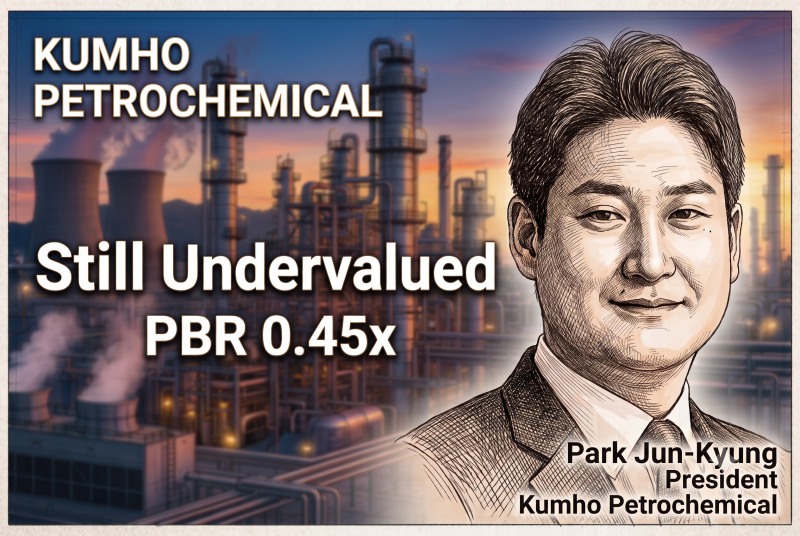
Despite these active shareholder return efforts, the stock has continued to languish. As of the end of the second quarter this year, its PBR stood at just 0.45x, down from 0.65x in 2022-2023. To be sure, petrochemical companies tend to have relatively low PBRs given their large capital base from heavy equipment investment and the earnings volatility inherent to a cyclical industry. Even accounting for this, however, some point out that the current share price is excessively undervalued.
The core reason behind the PBR undervaluation is the slowdown in the petrochemical industry. The company's net income has continued to decline, falling from KRW 1.0257 trillion in 2022 to KRW 447 billion in 2023, KRW 348.6 billion in 2024, and KRW 290.9 billion in 2025. Meanwhile, total equity has kept growing, from KRW 5.6534 trillion in 2022 to KRW 6.2465 trillion in 2025, adding to the capital burden and driving a sharp decline in return on equity (ROE).
To improve capital efficiency, a company must either increase profit or reduce capital. If the petrochemical industry downturn is unlikely to improve significantly in the short term, additional cancellation of treasury shares—a relatively straightforward option—could be called for.
Notably, Kumho Petrochemical still holds the remaining 50% of its treasury shares, for which no clear use has been identified. In its 2024 shareholder return plan, the company stated these shares were "a resource for future growth, including future business restructuring, joint venture (JV) establishment, and friendly-stake exchanges (M&A)." So far, however, no large-scale transaction for such purposes has materialized. In addition, the revised Commercial Act, which took effect this year, has placed new restrictions on the use of treasury shares. Under the revised law, existing treasury shares must in principle be cancelled, and holding or disposing of them for exceptional purposes, such as management needs, now requires shareholder approval at a general meeting.
As a result, Kumho Petrochemical is expected to clarify its stance on its remaining treasury shares through a new shareholder return policy next year.
In the process, the so-called "nephew's revolt" could flare up again. Former Managing Director Park has not submitted a shareholder proposal for two consecutive years, in 2025 and this year, and the management rights dispute has entered a lull. However, with the terms of CEO Baek Jong-hoon and independent director Lee Jung-mi set to expire in March next year, the possibility of another proxy battle between the two sides over the new shareholder return policy and board composition cannot be ruled out.
Gwak Horyung (horr@fntimes.com)
데일리 금융경제뉴스 Copyright ⓒ 한국금융신문 & FNTIMES.com
저작권법에 의거 상업적 목적의 무단 전재, 복사, 배포 금지

가장 핫한 경제 소식! 한국금융신문의 ‘추천뉴스’를 받아보세요~