KRW 800 billion project — up to KRW 4 trillion including follow-on orders HD Hyundai Heavy Industries' 'Southeast Asia track record' vs. Hanwha Ocean's 'delivery history'
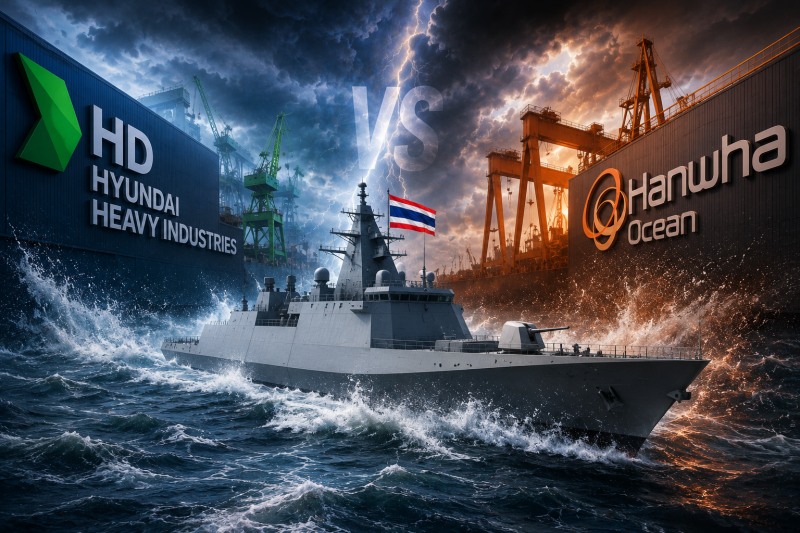
이미지 확대보기This image was created using AI to aid in understanding the article.
[Korea Financial Times, Jung Jina]
The Royal Thai Navy is set to select a preferred bidder as early as the end of this month for its 4,000-ton-class frigate acquisition program. Among domestic shipbuilders, HD Hyundai Heavy Industries and Hanwha Ocean have submitted proposals.
Up to KRW 4 trillion in scale — a bridgehead into the Thai market
The project is worth 17.5 billion baht, or roughly KRW 800 billion. The Royal Thai Navy plans to expand its frigate fleet from the current four vessels to eight by 2037. Including follow-on orders, the total scale of the project could grow to as much as KRW 4 trillion.
A defense industry source said this bidding war is expected to serve not as a one-off deal but as a bridgehead into the market, since weapons systems tend to remain in use once introduced. Because setting up new maintenance parts, manuals and crew training systems is burdensome, prior experience delivering vessels to a given country tends to give an advantage in that country's subsequent projects.
Of course, the two Korean firms are not the only competitors in Thailand's frigate program. The Royal Thai Navy invited bids from 11 global shipbuilders, and six ultimately submitted final proposals: HD Hyundai Heavy Industries and Hanwha Ocean from Korea, along with Singapore's ST Engineering, Spain's Navantia, and Turkey's ASFAT and TAIS.
Unlike other overseas bidding wars, the two Korean companies are bidding separately this time. In February last year, the Korean government and the two firms signed a memorandum of understanding, led by the Defense Acquisition Program Administration, to form a "one team" for bids on overseas naval vessel exports. This time, however, Thailand requested individual bids, putting the two firms in direct competition with each other.
Thailand has set conditions requiring not just vessel performance but also a minimum local production ratio of at least 20% and technology transfer, making each company's ability to meet these terms a key factor.
이미지 확대보기Kim Hee-chul, CEO of Hanwha Ocean (left), and Lee Sang-gyun, CEO of HD Hyundai Heavy Industries. /Photos: respective companies
HD Hyundai Heavy Industries emphasizes 'Southeast Asia track record'; Hanwha Ocean stresses 'delivery history'
HD Hyundai Heavy Industries holds the lead across Southeast Asia's naval vessel market overall. Starting with two frigates for the Philippines in 2016, the company has won orders for a total of 12 vessels, including two corvettes, six offshore patrol vessels, and two additional frigates secured at the end of last year. HD Hyundai Heavy Industries is also seen as ahead in Malaysia, where it is regarded as a strong candidate for the Malaysian Navy's third-phase Littoral Mission Ship (LMS) program and its Multi-Role Support Ship (MRSS) acquisition project, both to be pursued over the next five years.
HD Hyundai Heavy Industries has put forward its surface combatant construction experience and local production partnership plans as its key strengths. The company reportedly proposed the HDF-3600TH, a frigate based on the Ulsan-class Batch-III design, to Thailand, and offered a local construction ratio of 40% — twice the minimum requirement.
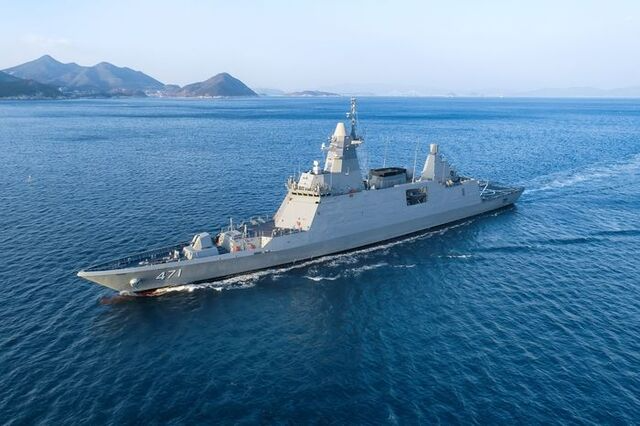
Hanwha Ocean, by contrast, already has a track record in Thailand. Its predecessor, Daewoo Shipbuilding & Marine Engineering, delivered the 3,700-ton-class frigate HTMS Bhumibol Adulyadej to Thailand in 2018, and the vessel entered active service in 2019. It currently serves as a core asset of the Royal Thai Navy. Building on this experience, Hanwha Ocean has proposed the OCEAN-40F, a 4,000-ton-class frigate incorporating a new design based on Korea's next-generation destroyer (KDDX). The company is also said to have pledged additional support, including continuity of vessel operations, follow-on logistics support, and crew training.
For this reason, some in the industry say rumors are circulating that Hanwha Ocean is being evaluated more favorably than its rivals in the Thai bidding war. For Hanwha Ocean, the project represents both an additional order and an opportunity to strengthen its partnership with Thailand.
HD Hyundai Heavy Industries, on the other hand, has never actually delivered a vessel to the Royal Thai Navy, making this its first attempt to enter the Thai market.
이미지 확대보기HTMS Bhumibol Adulyadej, previously delivered to the Royal Thai Navy by Hanwha Ocean. /Photo: Hanwha Ocean
Countries ordering naval vessels, including Thailand, increasingly demand a 'package' deal
The outcome in Thailand matters beyond this project alone — it matters for what comes next. Hanwha Ocean and HD Hyundai Heavy Industries worked together as a "one team" in pursuit of Canada's KRW 60 trillion submarine program (CPSP), but recently lost out.
Korea's shipbuilding industry has already turned its attention to the next battlegrounds. Peru's submarine program and naval vessel markets in Greece and Saudi Arabia are reportedly among those under consideration.
Most naval vessel markets today demand not just performance but a "package" that includes local production, technology transfer, and long-term maintenance, repair and overhaul (MRO) systems. While requirements vary by country, a cooperation model proven in Thailand could be leveraged in future bidding wars.
This trend is tied to countries' efforts to strengthen the competitiveness of their own domestic naval vessel industries.
An industry official explained that countries ordering naval vessels increasingly see such projects as opportunities to gain more than just the vessels themselves, and that shipbuilders are correspondingly focused on building good relationships with these countries to leave open the possibility of further market entry down the road.
(주)한국금융신문은 뉴스레터 구독(이메일 전송) 서비스와 당사 주관 또는 제휴·후원 행사 및 교육에 대한 안내를 위해 이메일주소를 수집합니다.
구독 서비스 신청자는 개인정보 수집·이용에 동의를 거부할 권리가 있습니다. 단, 거부 시 뉴스레터를 이메일로 수신할 수 없습니다.
뉴스레터 수신동의 해제는 뉴스레터 하단의 ‘수신거부’를 통해 해제할 수 있습니다.







 이미지 확대보기
 이미지 확대보기
 이미지 확대보기