





 이미지 확대보기
While Kolmar Korea secured solid fundamentals with overwhelming margins and growth momentum, Cosmax held the upper hand in revenue and profit scale, creating a tightly contested, head-to-head showdown.
According to disclosures filed with the Financial Supervisory Service on the 31st, Cosmax posted first-quarter consolidated revenue of KRW 682 billion and operating profit of KRW 53 billion. Revenue rose 15.9% and operating profit 3.3% year-on-year, respectively.
In overall earnings, Kolmar Korea outpaced Cosmax, but the picture changes when looking at the core cosmetics business alone.
That is because Kolmar Korea's results include "HK inno.N." In the first quarter, HK inno.N recorded revenue of KRW 258.7 billion and operating profit of KRW 33.2 billion. Centered on K-CAB, a treatment for gastroesophageal reflux disease, HK inno.N has continued to grow both at home and abroad, surpassing KRW 1 trillion in revenue last year.
관련기사
Kolmar Korea closes in with smaller revenue
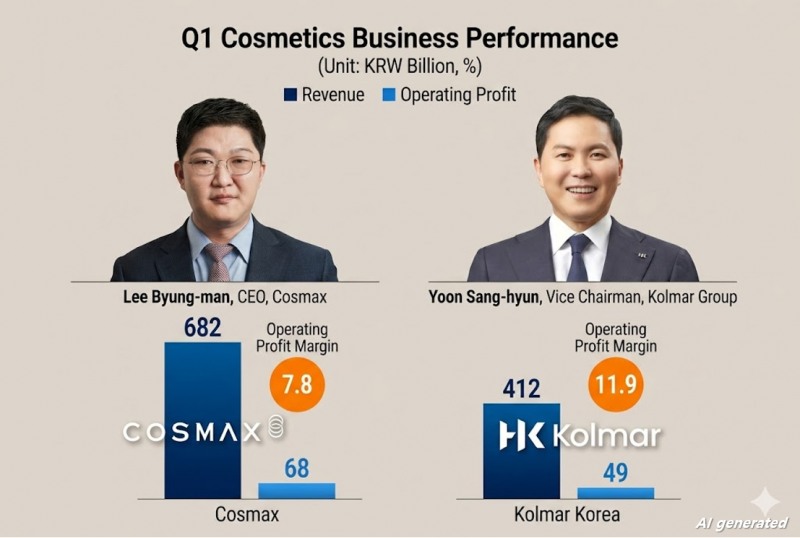
Stripping out subsidiary results, Kolmar Korea's original design manufacturing (ODM) division posted total first-quarter cosmetics revenue (combining domestic and overseas operations) of KRW 412.1 billion and operating profit of KRW 49 billion. With cosmetics revenue of KRW 682 billion and operating profit of KRW 53 billion over the same period, Cosmax is thus defending its firm No. 1 position in terms of revenue and profit scale.Looking solely at the core cosmetics division, Cosmax leads in size and operating profit, but on margin rate (operating profit margin) and growth metrics—which gauge a company's capital-utilization efficiency and the pace of fundamental improvement—Kolmar Korea is ahead of Cosmax.
Despite cosmetics revenue that was KRW 270 billion smaller than Cosmax's, Kolmar Korea demonstrated the ability to narrow the gap in total operating profit to just KRW 4 billion. Behind this lies a "high-profit margin" structure. Kolmar Korea's first-quarter cosmetics operating profit margin reached 11.9%. By contrast, over the same period, Cosmax's cosmetics operating profit margin stood at 7.8%.
In the first quarter, Kolmar Korea's cosmetics revenue grew 19.0% year-on-year while operating profit rose 31.7%.
By contrast, over the same period, Cosmax saw revenue increase 15.9% while operating profit edged up just 3.3%. Cosmax was the one that expanded its top line, but Kolmar Korea was the one that achieved growth while generating returns relative to inputs.
Contrasting fortunes in the U.S. and Chinese markets
The fundamental cause of the gap in scale and profitability between the two companies lies in the U.S. and Chinese markets. In China (combining Shanghai and Guangzhou), Cosmax successfully diversified its clients and product categories, posting first-quarter revenue of KRW 194.7 billion—a record-high performance representing 19.6% growth from the same period last year.Its performance in the U.S. was no less impressive than in China. Riding the boom among local indie beauty brands, Cosmax's U.S. subsidiary recorded revenue of KRW 42 billion, up 46.5% year-on-year, while narrowing its net loss to KRW 7.8 billion, a reduction of KRW 3.9 billion.
By contrast, the slump at Kolmar Korea's U.S. subsidiary became the main factor dragging down its overall earnings total. Hit by reduced orders from its top local large client, the U.S. subsidiary saw first-quarter revenue fall 38.4% year-on-year to KRW 13.4 billion, and on top of that posted an operating loss of KRW 3.7 billion, swinging into the red.
Even the Canadian subsidiary recorded an operating loss of KRW 1.7 billion, turning on warning lights for profitability across the entire Americas region.
In contrast, the Chinese subsidiary posted revenue of KRW 47.3 billion and operating profit of KRW 3.2 billion, up 13.7% and 3.0% year-on-year, respectively.
Despite losses in the U.S. market, Kolmar Korea—buoyed by simultaneous export growth in the domestic "skin care" and "sun care (UV protection)" categories—lifted its first-quarter cosmetics operating profit by more than 30% year-on-year, recording a double-digit margin rate.
Of Cosmax's entire product lineup, skin care accounts for 64%.
By contrast, Kolmar Korea, building on skin care (55%), prepared the high-margin sun care category (26%) as its differentiating weapon. According to Kolmar Korea, this year an early heat wave brought on the sun care peak season sooner than usual, and as the domestic indie brands it had previously worked with scaled up into major global brands, export volumes increased in both skin care and sun care.
On top of this, with the addition of ODM orders for a flagship skin care line from a top global luxury brand, Kolmar Korea achieved first-quarter separate-basis operating profit of KRW 51.2 billion in its domestic business—up 51.2% year-on-year—for an operating profit margin of 14.9%. Strong domestic skin care and sun care performance effectively offset the slump at overseas subsidiaries.
Conversely, Cosmax's Korean subsidiary, even after achieving an overwhelming top line of KRW 423.2 billion in the first quarter, was left with operating profit of KRW 38 billion and an operating profit margin of 8.98%.
This was because, in the process of bulking up, KRW 2.3 billion in bad-debt amortization expenses arose, and the burden of selling, general and administrative (SG&A) expenses—including vendor (export agency) payment fees amounting to KRW 18.5 billion—surged sharply.
Even though Cosmax achieved top-line growth, its profitability took a hit due to chronic cost burdens.
Both companies have climbed onto a growth trajectory riding the favorable winds of the K-beauty export boom, but the core challenges they must overcome to seize supremacy in the global beauty market in the second half are sharply divergent.
Cosmax must prove a systematic "cost control" capability commensurate with its top-line growth in order to lift its profit margin. Kolmar Korea, relatively, must restore the sales capability of its local subsidiaries in order to extend the growth momentum of its high-margin items into North America, including the U.S. and Canada.
A Cosmax official said, "In the case of the U.S. subsidiary, the effects of diversifying local clients are materializing, and high revenue growth is continuing into the second quarter as well," adding, "As the improvement of our fundamentals proceeds smoothly, we expect to be able to achieve a complete turnaround to a quarterly operating profit as early as within this second quarter."
A Kolmar Korea official said, "The profitability of the North American subsidiaries is expected to improve gradually from the second half of this year, once the second U.S. plant stabilizes and the inflow of new clients expands," adding, "In step with the trend of major global brands viewing ODM companies as strategic partners, we will continue to launch products reflecting local trends, centered on our North American production base, and pursue portfolio diversification."
Yang Hyunwoo (yhw@fntimes.com)
데일리 금융경제뉴스 Copyright ⓒ 한국금융신문 & FNTIMES.com
저작권법에 의거 상업적 목적의 무단 전재, 복사, 배포 금지

가장 핫한 경제 소식! 한국금융신문의 ‘추천뉴스’를 받아보세요~