





 이미지 확대보기
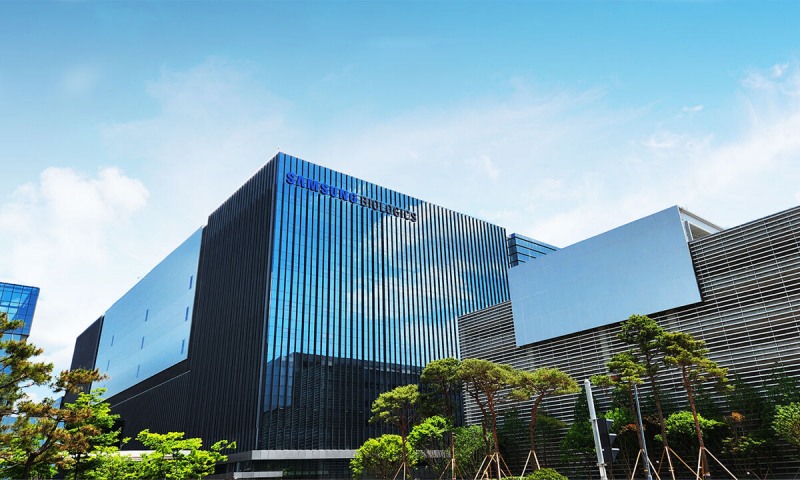
Samsung Biologics posted record-high earnings in the first quarter of this year. Notably, contributions from its newly acquired Rockville, Maryland plant have yet to be reflected in these results, leaving additional growth drivers still in store. However, despite its robust profitability and financial stability, the company is facing turbulence as a labor dispute over wage and collective bargaining negotiations escalates toward a potential strike. Some observers warn that if a strike materializes, it could destabilize supply chain reliability and weigh on the company's financial performance.
Revenue and Operating Profit Both Surge to Double-Digit Growth
According to industry sources, Samsung Biologics disclosed on April 22 that it recorded revenue of KRW 1.2571 trillion and operating profit of KRW 580.8 billion in the first quarter of this year. This represents year-on-year increases of 25.8% and 35.0%, respectively — both all-time highs on a first-quarter basis.Samsung Biologics attributed the earnings growth to the sustained full operation of Plants 1 through 4 at its Songdo campus and the ongoing capacity ramp-up of Plant 5. Plant 5, which commenced operations in September last year, is expected to further boost revenue once it reaches full utilization. A company official stated, "We maintained our annual revenue growth target of 15–20% for this year, taking into account full operation of Plants 1 through 4 and the ramp-up of Plant 5."
Further upside is also anticipated from the acquisition of the Rockville facility in the United States, whose revenue contribution has yet to be reflected in the current figures. Samsung Biologics completed the acquisition of a biopharmaceutical manufacturing facility located in Rockville, Maryland, in March. The facility was formerly owned by global pharmaceutical company GlaxoSmithKline (GSK). The acquisition price was USD 280 million (equivalent to over KRW 400 billion), with Samsung Biologics America — a U.S. subsidiary of Samsung Biologics — serving as the acquiring entity.
The Rockville facility consists of two manufacturing buildings with a combined capacity of 60,000 liters and is capable of producing antibody-based medicines across a range of scales from clinical to commercial production. With this acquisition, Samsung Biologics' total production capacity has expanded to 845,000 liters.
관련기사
 이미지 확대보기
Liabilities Down, Retained Earnings Up — Financial Structure Remains Solid
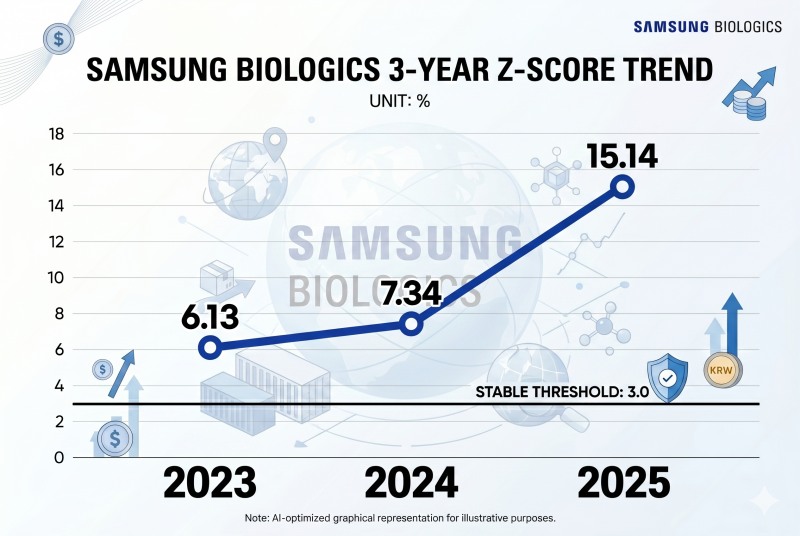
Alongside expanding scale and improving profitability, financial soundness has also reached an all-time high. As of the end of last year, Samsung Biologics' current liabilities stood at KRW 2.5329 trillion, down 34.3% from KRW 3.8532 trillion the previous year, while total liabilities fell 43.9% to KRW 3.6096 trillion from KRW 6.4316 trillion. Retained earnings, meanwhile, rose 35.1% to KRW 6.8710 trillion from KRW 5.0866 trillion a year earlier.Underpinned by this financial strength, Samsung Biologics' Altman Z-Score has climbed steadily — from 6.13 in 2023, to 7.34 in 2024, and to 15.14 in 2025. The Altman Z-Score is a widely used metric by investors and financial institutions to assess a company's credit risk and inform investment or lending decisions. A score above 3 is generally considered safe, while a score below 1.8 indicates a high likelihood of financial distress.
Investment efficiency has also improved markedly. Samsung Biologics' Return on Invested Capital (ROIC) more than doubled from 7.5% in 2023 to 18.6% last year. ROIC is calculated by dividing Net Operating Profit After Tax (NOPAT) by Invested Capital (IC). For last year, Samsung Biologics recorded NOPAT of KRW 1.5767 trillion against invested capital of KRW 8.4764 trillion.
Strike Threat Casts a Shadow; Global Supply Chain at Risk
Despite the dual tailwinds of record earnings and demonstrated financial stability, market reaction has been muted. In fact, the company's share price failed to rebound following the announcement of all-time first-quarter results, instead declining 1.7% from the previous day's close.Analysts point to "strike risk" as the underlying factor suppressing the stock's upward momentum. On the very day of the earnings announcement, the Samsung Biologics Cooperative Labor Union held its first large-scale demonstration in the company's history. The company and union had conducted 13 rounds of wage and collective bargaining negotiations and gone through a conciliation process at the Labor Relations Commission, but ultimately reached an impasse.
The union is demanding an average wage increase of approximately 14%, a KRW 30 million per-employee incentive payment, and company stock grants over three years. It has also called for prior labor-management agreement on all personnel matters, including hiring and promotions, as well as on management decision-making. The union has warned that it will proceed with a strike on May 1 if the company does not accept these demands.
Samsung Biologics has countered with a wage increase proposal of 6.2%, and stated that it cannot accept demands related to prior consent on HR and management matters. Regarding the strike notice, a court ruling on the company's application for an injunction to prohibit industrial action is expected to be issued around April 24.
Market participants are watching the strike risk closely. Jung Yi-su, an analyst at IBK Securities, noted, "Uncertainty stemming from the union's strike warning is weighing on the stock in the short term." She added, "If this issue is resolved, we expect expectations around the Plant 6 expansion momentum and diversification into new treatment modalities to be priced in."
Should a strike materialize, concerns are mounting that supply chain stability could be compromised, dealing a blow to the company's standing in the global market. Last month, the union timed the release of an English-language press statement to coincide with Samsung Biologics' participation in DCAT Week (Drug, Chemical & Associated Technologies Week), a major global pharmaceutical and biotech industry event. The release was reportedly distributed overseas and contained language suggesting that a strike could trigger global supply chain risks.
An industry official commented, "At a time when raw material supply chain management is more critical than ever due to geopolitical risks such as the Iran situation, the company is now contending with an internal headwind in the form of a potential strike — a double threat from within and without." The official added, "Pharmaceutical manufacturing in particular requires round-the-clock monitoring by key personnel. The very fact that labor-management tensions are being reported in overseas media can amplify anxiety among foreign clients and lead to a potentially fatal erosion of trust."
Yang Hyunwoo (yhw@fntimes.com)
데일리 금융경제뉴스 Copyright ⓒ 한국금융신문 & FNTIMES.com
저작권법에 의거 상업적 목적의 무단 전재, 복사, 배포 금지

가장 핫한 경제 소식! 한국금융신문의 ‘추천뉴스’를 받아보세요~