





 이미지 확대보기
Dunamu Merger Derailed by 'Policy Obstacles'
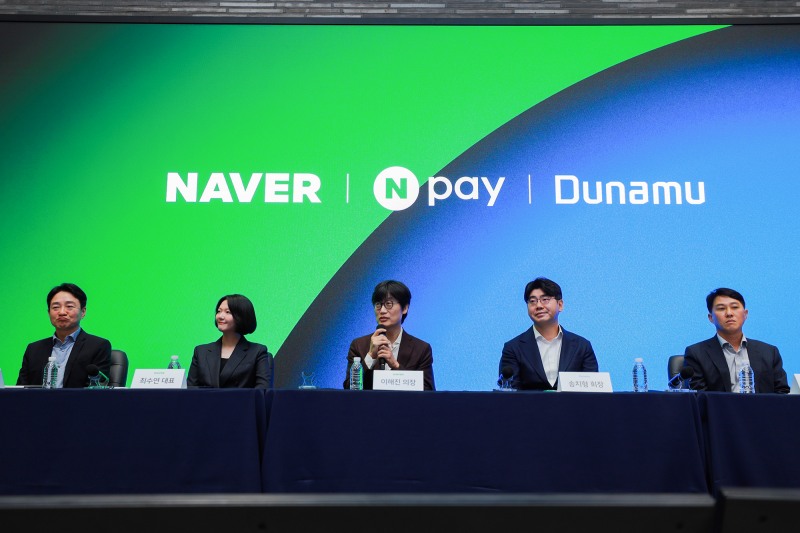
According to Naver on the 15th, the schedule for its comprehensive share exchange with Dunamu has been postponed. The shareholder meeting has been pushed back from May 22 to August 18, and the closing date has been delayed from June 30 to September 30.Naver stated that the schedule was adjusted "to reflect the status of relevant licensing procedures and legislative developments, and to ensure a stable closing of the transaction."
 이미지 확대보기
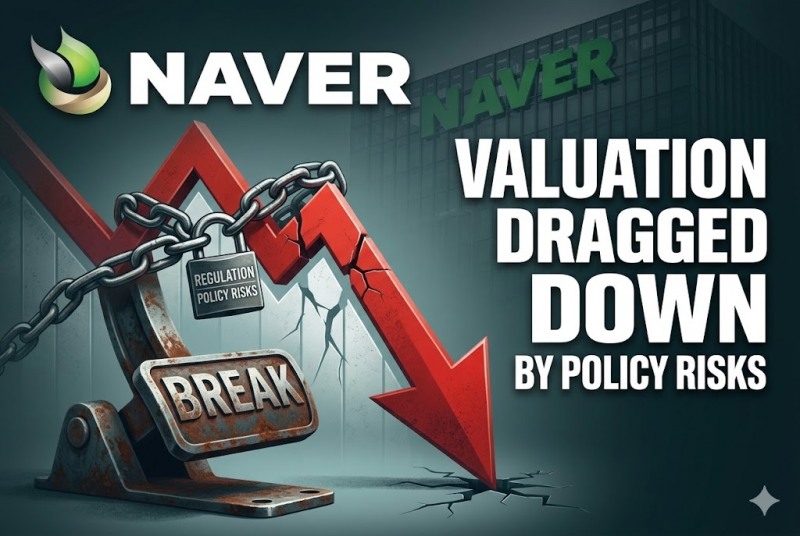
Industry observers, however, say the delay is the cumulative result of regulatory barriers and sweeping political and legislative uncertainty. Naver is specifically cited as the most extreme example among large-scale platform, Web3, and fintech companies with clear growth potential of how severely policy and regulatory risks can manifest.
The comprehensive share exchange Naver is pursuing with Dunamu is viewed not merely as a blockchain technology partnership, but as the opening salvo of a structural business transformation.
The combination of Naver Financial and Dunamu is designed to integrate payments, finance, and digital assets into a single axis, and is expected to serve as the core foundation for building a financial Web3 ecosystem — one that would leverage Naver's existing capabilities in artificial intelligence (AI), search, and e-commerce.
관련기사
Naver hits KRW 10 trillion revenue but premium valuation in doubt [KFT Topic]Naver Grows Steadily While Coupang Smiles Quietly: Why?Koo Kwang-mo's Vision for AI and Robotics Drives LG Group's Transformation [KFT Topic]Kakao CEO Chung Shina Rebuilds C-Level Leadership for AI OS Transformation [KFT Topic]
Under the original plan, the deal was to have been finalized within the first half of this year. However, extended licensing procedures by financial authorities, combined with the effective indefinite postponement of discussions on the Digital Asset Basic Act — citing the recent situation in the Middle East — have disrupted the transaction timeline.
Technology Ready, But Policy Holds Business Back
This situation highlights an emerging reality: even when technology development and business design are sufficiently complete, the pace of legislation and institutional policymaking determines both the progress of business and the value of the company.Naver has internally designed various application models including stablecoins, on-chain payments, and real-world asset (RWA) tokenization. However, without a completed legal and regulatory framework, actual commercialization is simply not possible.
Despite having already secured the technology and user base, delays in actual market entry due to an inadequate regulatory environment are exposing a structure in which Naver's growth trajectory is heavily reliant on policy variables.
 이미지 확대보기
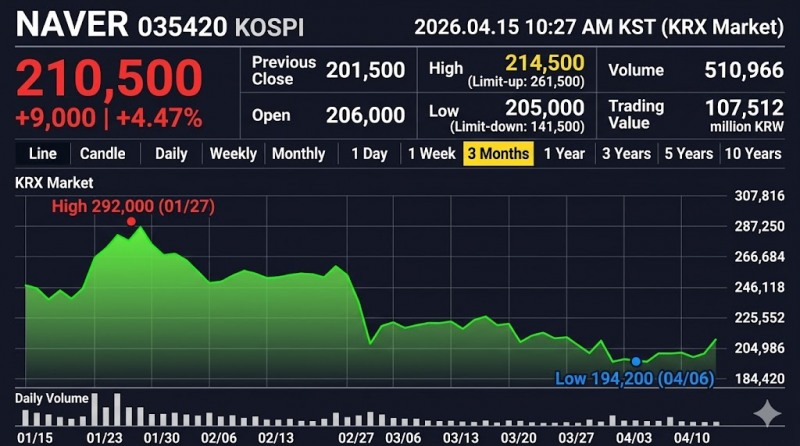
This dynamic is clearly reflected in Naver's share price performance. Looking at stock trends over the past three months, Naver's share price rose to KRW 292,000 around January 27, driven by heightened expectations for the legalization of digital assets and stablecoins.
However, as discussions on the Naver Financial-Dunamu merger stalled and regulatory risks from the government, the Korea Fair Trade Commission (KFTC), and financial authorities converged, the stock retreated from its January peak and has since been trading sideways near the KRW 210,000 level.
This pattern demonstrates that Naver's share price operates under a "risk premium" structure — reacting more sensitively to policy and regulatory risks than to short-term earnings results and AI momentum.
Policy and Regulatory Risks Embedded Across New Businesses
Policy and regulatory risks that govern Naver's business timeline are manifesting consistently across the full breadth of its new business initiatives.As growth areas expand, the forms of regulatory and policy risk multiply — with the common thread that the institutional environment continues to determine growth rates and business velocity.
The digital twin business is equally subject to external variables. Naver has established a joint venture with the Saudi Arabian government and is pursuing large-scale digital transformation projects including digital twin, smart city, and sovereign AI development.
 이미지 확대보기
Most of these ventures are structured as government joint ventures, making them acutely vulnerable to shifts in policy priorities or changes in geopolitical conditions. In particular, as the ripple effects of the ongoing Middle East conflict have extended toward Saudi Arabia, uncertainty surrounding these businesses is intensifying.
The healthcare business faces a structurally similar institutional risk. Naver has acquired healthcare technology companies including InBody and Cenacle, but advancement of AI-based analytical models has been effectively limited.
According to an audit report on the "Status of AI Preparedness in the Health and Medical Sector," released by the Board of Audit and Inspection of Korea on the 24th of last month, only 17 cases of public healthcare data were provided by three public institutions — the National Health Insurance Service (NHIS), the Health Insurance Review and Assessment Service (HIRA), and the National Cancer Center (NCC) — to AI companies between 2021 and March 2025. The total number of medical public data provision cases to all companies during the same period amounted to only 141.
While data exists in abundance, standardization, export, and remote access remain constrained, creating a structure that makes utilization by private companies extremely difficult. It is consistently assessed that without a legal and institutional basis for data access, business expansion will inevitably be delayed regardless of technological advancement.
Cautious Market Approach — Consecutive Target Price Cuts
Even Naver's existing mapping business is tied to institutional variables. The government's conditional approval allowing Google to export high-precision map data has altered the competitive landscape of the domestic mapping market. The AI-based integrated ecosystem of maps, search, and payments that Naver has developed is once again in direct competition with global platforms.Given these circumstances, analysts conclude that Naver's key new businesses are locked in a structure where variance in the policy and regulatory environment — rather than technological capability — governs growth rates and business speed.
 이미지 확대보기
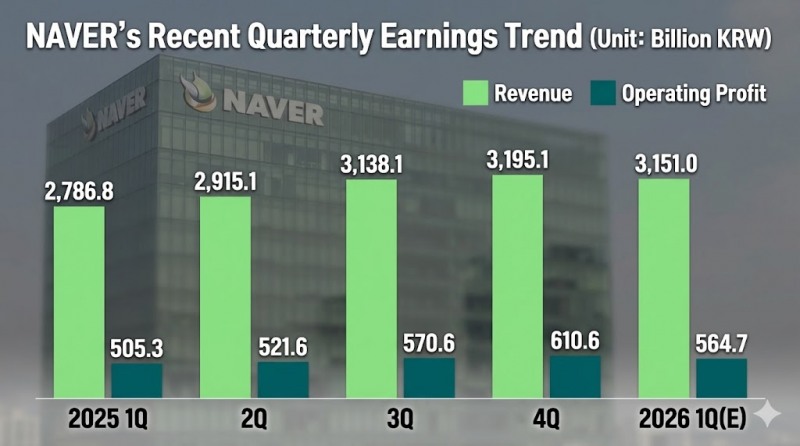
From the investor perspective, this structure is increasingly being treated as a risk premium, with growing demand for conservative valuations that factor in not only technological and market growth potential, but also institutional, political, and geopolitical risks.
In particular, since many of Naver's new businesses — including finance, healthcare, mapping, and public data — intersect directly with government domains, the market is taking a conservative stance even in the face of solid short-term earnings.
Securities firms have been cutting their target prices for Naver in rapid succession. On the 14th, DS Investment Securities lowered its target price for Naver from KRW 400,000 to KRW 300,000.
DS Investment Securities analyst Choi Seung-ho projected that "considering the pace of AI technology development and the ascent of global AI platforms, the 'AI de-rating' of Naver is likely to deepen further."
Shinhan Investment Corp also lowered its target price from KRW 270,000 to KRW 240,000, noting that "expectations for growth related to AI and virtual assets have declined substantially." Daol Investment Securities additionally cut its target price from KRW 360,000 to KRW 300,000. In total, 9 out of 11 securities firms covering Naver have lowered their price targets this month.
Jeong Chaeyun (chaeyun@fntimes.com)
데일리 금융경제뉴스 Copyright ⓒ 한국금융신문 & FNTIMES.com
저작권법에 의거 상업적 목적의 무단 전재, 복사, 배포 금지
가장 핫한 경제 소식! 한국금융신문의 ‘추천뉴스’를 받아보세요~