





Overcoming a 0.2x PBR and Hopes for an Earnings Rebound
According to the Korea Exchange, Hyundai Steel's price-to-book ratio (PBR) stood at just 0.2x, meaning its shares trade at roughly one-fifth of the company's net asset value.PBR is a gauge of how a company's share price compares to its assets. A reading below 1x indicates the stock is trading below its book value.
 이미지 확대보기
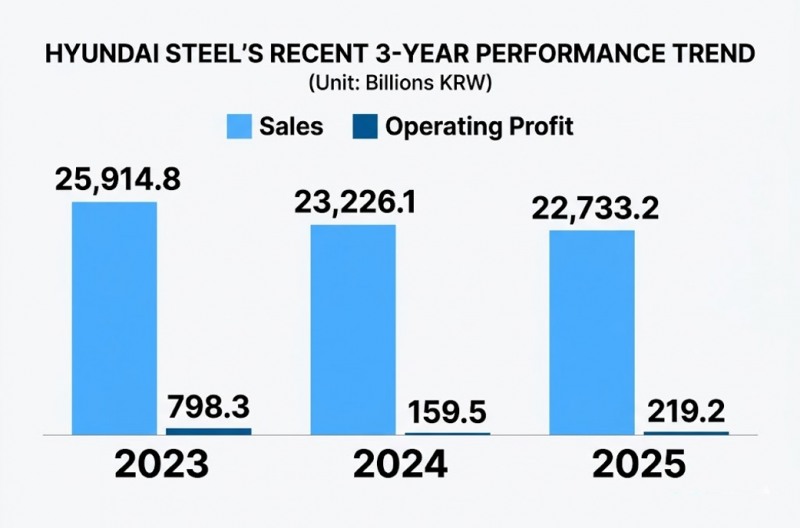
Securities analysts forecast that Hyundai Steel's operating profit for 2026 will grow at a rate ranging from the high double digits to near triple digits compared to 2025.
Kim Yun-sang, a researcher at iM Securities, said: "First-quarter consolidated operating profit is expected to reach KRW 116 billion, a 166.8% increase from the previous quarter. Cost burdens will persist, but the elimination of one-off costs at subsidiaries should lead to an overall improvement in results."
관련기사
POSCO Holdings Completes 6% Share Cancellation Pledge — But Core Profit Recovery Remains the Missing PieceLG Corp. Taps Asset Sale Proceeds to Defend Dividend Amid Subsidiary SlumpSamsung Electronics and SK Hynix Engage in High-Stakes AI Chip War [KFT Topic]Hanwha to Split into Defense-Energy and Tech-Lifestyle Entities [KFT Topic]
Against this backdrop, discussion around treasury share cancellation has gained considerable attention. Canceling treasury shares reduces the total number of issued shares, thereby improving earnings per share (EPS). Shareholder expectations around the timing of a potential cancellation have also grown following the passage of the third amendment to the Commercial Act — the centerpiece of which is the mandatory cancellation of treasury shares — through the National Assembly's plenary session.
As of the third quarter of last year, Hyundai Steel held 1,900,046 treasury shares out of a total of 133,450,000 issued shares, representing a stake of approximately 1.42%.
Market analysts suggest that canceling the entire holding would lift EPS by 1–2%, and that if earnings improvement accompanies the company's currently undervalued state, a re-rating of the stock is possible. In a low-PBR environment, shareholder return measures such as treasury share cancellation tend to serve as catalysts for revaluation.
Governance Card or Shareholder Return?
Hyundai Steel's last treasury share-related transaction was in 2020, in connection with its merger with Hyundai Hysco. There have been no further purchases or cancellations since.The reasons are not straightforward. Hyundai Steel sits at the center of the Hyundai Motor Group's governance structure. The company holds stakes in affiliates including Hyundai Motor and Kia, and has repeatedly been cited as a pivotal player — for share swaps and mergers — whenever discussions of a holding company conversion or the unwinding of circular shareholding structures have arisen.
Hyundai Motor Group's ownership structure takes the form of a circular shareholding chain: Hyundai Mobis holds a 21.9% stake in Hyundai Motor → Hyundai Motor holds a 34.5% stake in Kia → Kia holds a 17.7% stake in Hyundai Mobis → back to Hyundai Mobis. Because a disruption to any one link in the chain can undermine the overall stability of control, financial regulators and markets have consistently called for restructuring in the name of transparency.
Within these governance discussions, Hyundai Steel has served as a focal point for a potential holding company conversion or merger, and there is a persistent view that its treasury shares and affiliate stakes could function as friendly shares in any future restructuring scenario.
 이미지 확대보기
This means the longer the treasury shares are accumulated, the stronger their value as a governance tool — but the larger the untradeable block becomes, raising growing concerns about liquidity and shareholder returns.
The third amendment to the Commercial Act, however, is poised to break this deadlock. The amendment restricts long-term treasury share holdings, requiring companies to confirm at an AGM a plan to either cancel or dispose of newly acquired treasury shares within one year, and existing holdings within one year and six months of the law's enactment.
As a result, the longstanding practice of holding treasury shares indefinitely as de facto "locked-away stakes" is coming under regulatory pressure. The consensus is that Hyundai Steel now faces growing pressure to strike a new balance between deploying its treasury shares for shareholder returns and preserving them as a governance instrument, rather than holding them as a wild card indefinitely.
Shifting Capital Strategies in Steel — What Will Hyundai Steel Choose?
Amid the global economic slowdown, steelmakers are stepping up shareholder returns through a range of capital strategies, including treasury share cancellations, capital reductions, and investment expansion.POSCO Holdings, for instance, carried out a treasury share cancellation equivalent to 2% of its issued shares, worth KRW 635.1 billion. This was in line with its previously announced plan to cancel 6% over three years, and when combined with the current year, the company is on track to return approximately KRW 1.7176 trillion over a three-year period.
Dongkuk Steel cancelled its entire treasury share holding of 2.2% and linked the move to a 2-for-1 capital reduction without consideration and a 5-for-1 stock split. The rationale is that reducing paid-in capital through the reduction increases distributable earnings, thereby expanding dividend capacity. The company deferred one dividend payment and raised its minimum dividend floor from KRW 300 to KRW 400 per share (KRW 80 post-split), signaling its commitment to shareholder returns.
By contrast, Hyundai Steel, facing deteriorating profitability, has cut its dividend per share for three consecutive years — from KRW 1,000 to KRW 750, then to KRW 500, since 2023. At the same time, it has been accelerating investment in an electric arc furnace steelworks in Louisiana, United States, focusing on securing long-term competitiveness centered on 2.7 million tons of automotive steel sheet capacity and eco-friendly electric arc furnace operations.
President Lee Bo-ryong's open-market purchase of 1,500 treasury shares in February — just one month after taking office — has also been interpreted as a show of commitment to responsible management.
An industry official commented: "In the context of the ongoing Commercial Act amendment discussions, the direction Hyundai Steel takes on its treasury shares is drawing significant attention. The key question is what choice the company will present at its March AGM — caught between the pressure to cancel shares and escape the low-PBR trap, and the imperatives of the group's governance strategy."
Jeong Chaeyun (chaeyun@fntimes.com)
데일리 금융경제뉴스 Copyright ⓒ 한국금융신문 & FNTIMES.com
저작권법에 의거 상업적 목적의 무단 전재, 복사, 배포 금지

가장 핫한 경제 소식! 한국금융신문의 ‘추천뉴스’를 받아보세요~