





 이미지 확대보기
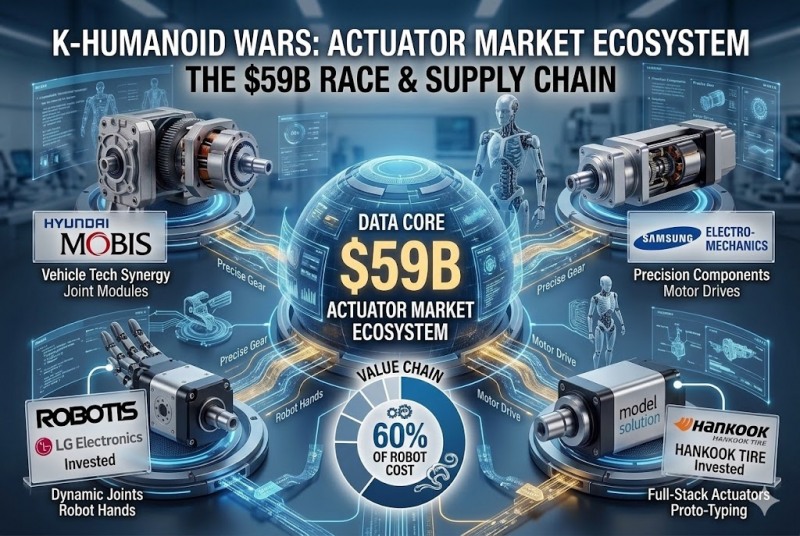
The spotlight on components makers stems from actuators — the joints and muscles of humanoid robots. Accounting for roughly 60% of a robot's total production cost, actuators convert software commands into physical motion and determine a robot's precision and balance. Each humanoid unit requires between 30 and 50 actuators, and as robots grow more sophisticated, that number is expected to rise. The humanoid market's expansion virtually guarantees a parallel surge in actuator demand.
According to market research firm Valuates Reports, the global actuator market for humanoid robots was valued at USD 150 million (approximately KRW 220 billion) in 2024 and is projected to grow at a compound annual growth rate (CAGR) of approximately 80%, reaching USD 9.864 billion (approximately KRW 14.5 trillion) by 2031.
Against this backdrop, both automotive parts makers and electronics components companies are positioning actuators as a core future business — and racing to establish themselves as leading suppliers in the coming era of robotics.
Hyundai Mobis and Samsung Electro-Mechanics: The Power of a Built-In Customer
For components makers, securing early customers is just as critical as technical capability. In this regard, both Hyundai Mobis and Samsung Electro-Mechanics hold a distinctive advantage: their parent conglomerates are directly developing and manufacturing humanoid robots.
관련기사
'From Heavy Industry to Humanoids' — Doosan Robotics Charts a New Future in Physical AI [K-Humanoid Wars, Part 3]'Samsung's Bet on the Future' — Rainbow Robotics, Korea's Humanoid Pioneer [K-Humanoid Wars, Part 2]Tesla's Humanoid Rival Has Arrived — Boston Dynamics Eyes $70 Billion Valuation [K-Humanoid Wars, Part 1]
Hyundai Mobis' share price climbed approximately 47% in the three months following the announcement of its collaboration with Boston Dynamics, as the market began to price in its value not merely as an automotive and electronics parts supplier, but as a future robotics components maker.
The company envisions the Atlas partnership as a springboard — simultaneously creating a new market for robotics components and positioning itself as an industry leader.
"In the short term, the robot components business will support Hyundai Motor Group's humanoid mass production," a Hyundai Mobis official said. "Over the long term, we will expand into hand grippers, sensors, controllers, and battery packs, leveraging cost and quality competitiveness to secure external customers as well."
Samsung Electro-Mechanics is similarly well-positioned. The company is widely expected to secure Rainbow Robotics — Samsung Group's humanoid affiliate — as a primary customer. Rainbow Robotics' share price surged approximately 91% in the three months following Atlas' debut, while Samsung Electro-Mechanics itself rose approximately 56% over the same period. Rainbow Robotics has announced plans to commercialize its humanoid robot by 2028.
Samsung Electro-Mechanics has long supplied components including camera modules for Samsung Electronics smartphones, MLCCs (Multi-Layer Ceramic Capacitors), and electronic substrates. This year, the company formally declared its expansion into the robot actuator business, signaling ambitions to become a major robotics components supplier.
To that end, Samsung Electro-Mechanics has invested in Alpha Industries, a Norwegian micro-motor specialist, to strengthen its actuator capabilities. The company is also seen as a potential supplier to Tesla for its Optimus humanoid robot — a relationship that could be facilitated by its existing role as a supplier of autonomous driving camera modules and MLCCs to the U.S. EV maker.
"Cameras, sensors, MLCCs, and substrates — the key elements that drive humanoids — are areas where Samsung Electro-Mechanics has excelled," said Samsung Electro-Mechanics President Jang Deok-hyeon (장덕현) at CES in January. "Beyond our investment in Alpha Industries, we are examining entry into the actuator market and are in discussions with global humanoid companies regarding component supply."
ROBOTIS and Model Solution: Backed by LG Electronics and Hankook Tire
While Hyundai Mobis and Samsung Electro-Mechanics leverage group ecosystems, ROBOTIS and Model Solution represent a different model — companies in which LG Electronics and Hankook Tire, respectively, have invested to expand their robotics ambitions.ROBOTIS is a dedicated actuator specialist in which LG Electronics became the second-largest shareholder through a rights offering in 2018. Since LG's investment, the company's share price has risen more than 1,000%. More than 98% of ROBOTIS' revenue is generated by robot actuators. Its customer roster is robust, with actuators supplied to Tesla, Google, and China's Unitree Robotics, among others. Last year, the company broadened its business scope by developing its own humanoid robot, the AI Worker.
ROBOTIS is widely regarded as a key supplier for LG Electronics' forthcoming humanoid initiatives. The two companies signed an MOU for "joint research and commercialization of humanoid robots" in June last year. ROBOTIS' foremost strength lies in robotic hands — its actuators were featured in CLOi, LG Electronics' home-service robot unveiled at CES this year. LG Electronics is currently running a joint humanoid development project with investee companies including the LG AI Research Institute, ROBOTIS, Robostar, and Bear Robotics, with ROBOTIS specifically responsible for the arms and hands.
Model Solution, an IT device design specialist acquired by Hankook Tire in 2018, is pursuing a parallel ambition: becoming an "actuator full-stack" provider. The company built its reputation as a prototype design and manufacturing specialist, growing through work for domestic conglomerates — Samsung Electronics' Galaxy smartphones, LG Display, Hyundai Motor, and Kia — as well as global firms including Apple, Amazon, and Tesla.
Model Solution publicly declared its robotics components ambitions at MWC 2025 last year, unveiling an AI robotics vision. Its share price rose approximately 77% in the year following the announcement of its actuator business expansion.
At the "2025 Robo World" expo in November last year, the company made its formal debut as a robotics parts maker, unveiling for the first time an AFPM (Axial Flux Permanent Magnet) ultra-lightweight smart actuator designed for humanoid joints. Going forward, Model Solution plans to differentiate itself in the actuator market with an "all-in-one" solution integrating motor, reducer, drive, sensor, and communication functions into a single module.
The company's extensive customer network — built through years of prototype manufacturing — also provides a solid foundation for global order expansion. Model Solution is currently reported to be carrying out multiple robotics-related projects in collaboration with existing clients including Samsung Electronics and Hyundai Motor Group. <End of Series>
Kim JaeHun (rlqm93@fntimes.com)
데일리 금융경제뉴스 Copyright ⓒ 한국금융신문 & FNTIMES.com
저작권법에 의거 상업적 목적의 무단 전재, 복사, 배포 금지

가장 핫한 경제 소식! 한국금융신문의 ‘추천뉴스’를 받아보세요~