





 이미지 확대보기
Hyundai Motor Group made a striking entrance into 2026 by unveiling the Boston Dynamics humanoid robot "Atlas," sending ripples across the global industry. Atlas has effectively repositioned Hyundai Motor Group's valuation — long seen as a traditional automaker — toward that of a physical AI and robotics company. The dawn of a future society in which real robots and humans coexist is now at hand.
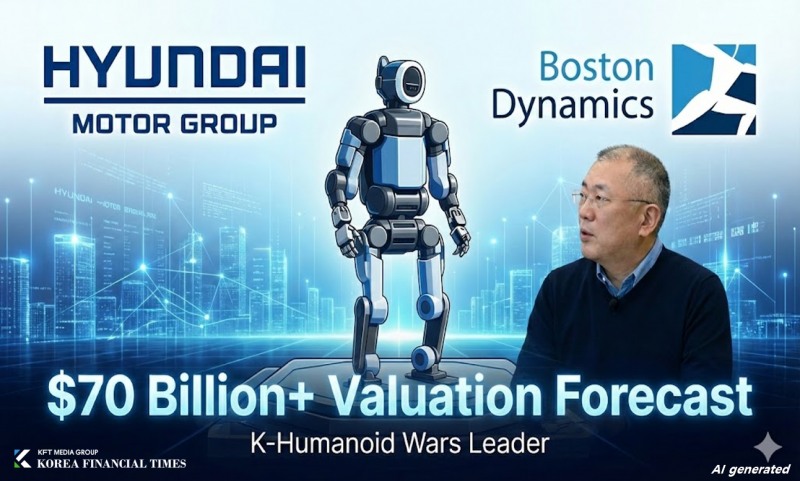
The public debut of Atlas has also vindicated the bold gamble made by Hyundai Motor Group Chairman Chung Eui-sun, who pressed ahead with the Boston Dynamics acquisition despite widespread concern. Analysts are now projecting Boston Dynamics' valuation could exceed KRW 100 trillion (approximately $70 billion), and the company has instantly emerged as a core subsidiary of Hyundai Motor Group.
Atlas Begins Full-Scale Operational Training
On the 7th, Boston Dynamics released a video on its YouTube channel showing humanoid robot Atlas performing a side aerial and back tuck in succession — the first Atlas footage released since CES 2026 in early last month.In addition to the tumbling sequences, Boston Dynamics also unveiled footage of Atlas walking on an icy surface without falling. Even as its feet slipped, the robot maintained balance and continued forward, demonstrating its advanced judgment and control logic.
The continuous aerial sequence is significant not so much for the difficulty of the individual moves, but because it confirmed that Atlas has reached a stable stage in "whole-body control" — the seamless execution of the full sequence from takeoff, to mid-air posture control, to landing impact absorption, and finally to posture recovery.
관련기사
Hyundai Mobis Posts Record Results, Pivots to Robotics and Electrification [KFT Topic]Koo Kwang-mo's Vision for AI and Robotics Drives LG Group's Transformation [KFT Topic]'Chung Eui-sun Declares Robot Management Era'... Hyundai Motor Group to Lead Robotics Age with 'Physical AI' [KFT Topic]'Beyond Mobile to Robotics': LG Innotek Continues Portfolio Expansion [KFT Topic]'We Can't Fall Behind in Robotics'... Hyundai Motor Group's Humanoid 'Atlas' Takes the Stage
This is the result of combining reinforcement learning-based control techniques accumulated through large-scale repetitive training with whole-body control algorithms, suggesting that Atlas is steadily acquiring the full-body mobility needed for continuous execution and repeated verification.
A Boston Dynamics spokesperson explained, "As the Atlas enterprise platform goes into operation, performance testing of the research version will be concluded," adding, "Researchers, with assistance from the lab, conducted final tests to push the limits of whole-body control and mobility."
This signals that Atlas is moving beyond laboratory research settings and into actual industrial environments. Boston Dynamics plans to systematically train Atlas within Hyundai Motor Group's manufacturing operations.
At CES, Hyundai Motor Group announced plans to deploy next-generation electric Atlas development models at production sites including the Hyundai Motor Group Metaplant America (HMGMA), with a phased expansion of Atlas to be verified process by process.
Starting in 2028, Atlas will enter the commercialization phase at HMGMA, first applied to processes where safety and quality benefits are clearly verifiable — such as sequencing work for parts sorting. By 2030, the scope of operations is planned to expand further to include parts assembly.
Why Did Chung Eui-sun Buy What Google and SoftBank Walked Away From?
Although Boston Dynamics is now acclaimed as the future of Hyundai Motor Group through Atlas, the circumstances at the time of the original acquisition were far less favorable.Boston Dynamics was founded in 1992 by MIT professors including Marc Raibert. It began not as an industrial robotics firm, but as a military robot developer supported by DARPA (Defense Advanced Research Projects Agency) under the U.S. Department of Defense. However, deployment plans collapsed due to the noise generated by its robots and various technical limitations, leaving the company at a crossroads.
It was Google that acquired the struggling Boston Dynamics in 2013, as it pursued entry into the robotics business. Google moved aggressively, appointing Android architect Andy Rubin to lead Boston Dynamics, but sexual misconduct allegations against Rubin and worsening profitability due to massive R&D costs led Google to sell the company to Japan's SoftBank in 2017.
SoftBank transformed Boston Dynamics from a military robot developer into an industrial robotics company. This pivot led to the successful 2019 commercial launch of the four-legged robot Spot, but mounting deficits from heavy R&D spending and persistently low profitability prompted SoftBank to decide on a sale in 2020.
That is when Chairman Chung Eui-sun's Hyundai Motor Group stepped in. At the time, Chung declared a transformation toward a future mobility company, with electric vehicles, autonomous driving, robotics, and AI at the forefront, placing strong emphasis on internalizing key technologies. It was during this same period that Hyundai Motor Group acquired and established 42dot and Motional, which now lead the group's autonomous driving efforts.
Hyundai Motor Group placed its bet on the 30 years of accumulated know-how in robotics perception, control, and related technologies that Boston Dynamics had built up, treating them as a critical piece of the future robotics puzzle. Before completing the acquisition, Chairman Chung stated at a town hall meeting, "Robotics will account for 20% of Hyundai Motor Group's future business," underscoring his commitment to advancing the group's robotics capabilities.
When Hyundai Motor Group acquired Boston Dynamics in 2021, the total investment amounted to approximately USD 1.1 billion (approximately KRW 1 trillion 618.6 billion). The ownership structure at the time was Hyundai Motor at 30%, Hyundai Mobis at 20%, and Hyundai Glovis at 10%, with Chairman Chung himself investing approximately KRW 240 billion of personal funds to secure a roughly 20% stake — a clear declaration of his intent to develop Boston Dynamics into the group's core future asset.
At the time, however, there was no shortage of critics within the industry. A wave of objections arose over the decision to pour significant capital into a company that even larger-funded entities like Google and SoftBank had given up on. Some argued that the funds would have been better deployed toward expanding the domestic robotics ecosystem.
Indeed, Boston Dynamics continued to operate at a loss even after joining Hyundai Motor Group. According to Hyundai Motor Group, Boston Dynamics' net losses grew each year: KRW 110 billion in 2021, KRW 254 billion in 2022, KRW 336 billion in 2023, and KRW 441 billion in 2024. It is understood that the net loss for last year also exceeded approximately KRW 400 billion.
The once-unwanted Boston Dynamics has now fully transformed into a swan with this year's Atlas unveiling. Atlas won the "Best Robot" award in the "Best of CES 2026" selection by global tech media outlet CNET, validating the competitive edge it has steadily built.
International media were also effusive in their praise of Atlas's natural movement. British daily The Guardian assessed that "after years of testing, Atlas will mark a turning point this year as it evolves into a refined product."
A $700 Million Bet, Eyeing a $70 Billion Return
As Atlas garners acclaim in global markets, interest is growing in a potential IPO (Initial Public Offering) of Boston Dynamics by Hyundai Motor Group.It is understood that following the Atlas reveal at CES 2026, Hyundai Motor Group has already activated an internal task force led by Vice Chairman Jang Jae-hoon to pursue a Boston Dynamics listing. At CES 2026, Vice Chairman Jang commented regarding a Boston Dynamics IPO, "We are keeping all possibilities open."
Analysts in the securities industry forecast that Boston Dynamics' valuation would surpass KRW 100 trillion (approximately $70 billion) should it proceed with an IPO. Global media outlets have also recognized Atlas as a formidable rival to Tesla's humanoid robot Optimus, projecting that Hyundai Motor Group will emerge as a leading player in the future robotics market.
KB Securities recently projected in a report that the global humanoid robot market will grow to an annual volume of 9,603,000 units by 2035. Of this, Boston Dynamics is forecast to capture a 15.6% market share in the 2035 humanoid market, equivalent to approximately 1.5 million units annually. KB Securities analyst Kang Sung-jin stated, "Boston Dynamics' revenue in 2035 is expected to reach USD 288.3 billion (approximately KRW 404 trillion), with operating profit reaching USD 44.3 billion (approximately KRW 62 trillion)," adding, "Based on these figures, the theoretical enterprise value of Boston Dynamics is estimated at approximately KRW 128 trillion (approximately $89 billion)."
Hanwha Investment & Securities analyst Kim Sung-rae also commented, "Boston Dynamics holds an advantage in mass-production speed in terms of design, engineering, and specifications, and is also favorably positioned in terms of robotics infrastructure." He added, "Applying a 64.5% discount to Hyundai Motor Group relative to Tesla's humanoid business value of USD 280 billion, we forecast Boston Dynamics' market value at USD 99.3 billion (approximately KRW 146 trillion)."
Kim JaeHun (rlqm93@fntimes.com)
데일리 금융경제뉴스 Copyright ⓒ 한국금융신문 & FNTIMES.com
저작권법에 의거 상업적 목적의 무단 전재, 복사, 배포 금지

가장 핫한 경제 소식! 한국금융신문의 ‘추천뉴스’를 받아보세요~