





 이미지 확대보기
Chairman Chung's AI robotics vision was revealed at this year's first global electronics show, 'CES 2026.' Hyundai Motor Group plans to lead the AI robotics era by consolidating group capabilities and establishing global partnerships with companies like Nvidia and Google.
On January 6 (Korean time), Hyundai Motor Group held a Media Day at the Mandalay Bay Convention Center in Las Vegas, Nevada, during the 'International Consumer Electronics Show CES 2026' under the theme 'AI Robotics, Beyond the Lab into Life: Partnering Human Progress.'
At CES 2026, Hyundai Motor Group declared a transition from hardware and mobility-centered robotics to human-centered AI robotics utilizing advanced AI technology. This represents a progressive goal beyond the CES 2022 theme 'Expanding Human Reach,' connecting more closely with human life to support and collaborate with humanity.
Chairman Chung previously announced the full-scale launch of Physical AI-based robot management this year. To this end, he revealed plans to make the largest investment in company history, totaling KRW 125.2 trillion domestically over five years from this year to 2030.
관련기사
'We Can't Fall Behind in Robotics'... Hyundai Motor Group's Humanoid 'Atlas' Takes the StageSoaring Hyundai Mobis Stock Raises Succession Costs for Chung Eui-sunHyundai Motor Group 'Chung Eui-sun era' 5 years ②: 'Bold strategist' Chung Eui-sun to break through with KRW 112 trillion investment over next 5 yearsHyundai Motor Group 'Chung Eui-sun era' 5 years ①: 'Disruptive innovation leadership' powers global Big3
 이미지 확대보기
This investment is expected to focus on the robotics sector based on AI technology advancement, aiming to secure the group's future growth engines and establish a domestic robotics innovation ecosystem.
At the 2026 New Year address held the previous day (January 5), Chairman Chung stated, "Looking at the automotive market alone, we've entered an era where a product's core competitiveness is determined by AI capabilities," while acknowledging, "However, looking at reality objectively, global leading companies have already secured advantages in this area with investments in the hundreds of trillions of won, whereas our secured capabilities are not yet sufficient."
However, he expressed confidence in Hyundai Motor Group's competitiveness in Physical AI, saying, "We have world-class capabilities in the design and manufacturing of physical products," and "If we look at a bigger future and expand our ecosystem through bold cooperation with various partners, we can provide better value to customers."
Chairman Chung further emphasized, "As the focus shifts to Physical AI, the value of 'moving entities' like automobiles and robots and 'manufacturing process' data that Hyundai Motor Group possesses will become increasingly scarce," adding, "This is our powerful weapon that big tech companies cannot easily replicate. For Hyundai Motor Group, which has data, capital, and manufacturing capabilities, AI is a game we can definitely win."
One day after Chairman Chung's declaration of intent, Hyundai Motor Group announced three major strategies and demonstrated its commitment to expanding AI robotics for humanity: ▲collaboration between humans and robots starting in manufacturing environments ▲AI robotics ecosystem built by consolidating group capabilities ▲partnerships with AI leading companies.
Based on the AI robotics strategy, Hyundai Motor Group plans to emerge as a human-centered Physical AI leading company through its group value chain and broad product portfolio. Physical AI refers to the substance of technology that collects data through hardware in real environments such as robotics, smart factories, and autonomous driving, and makes autonomous decisions.
 이미지 확대보기
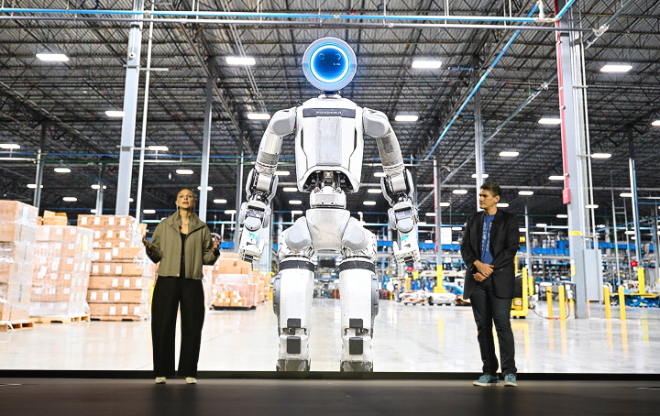
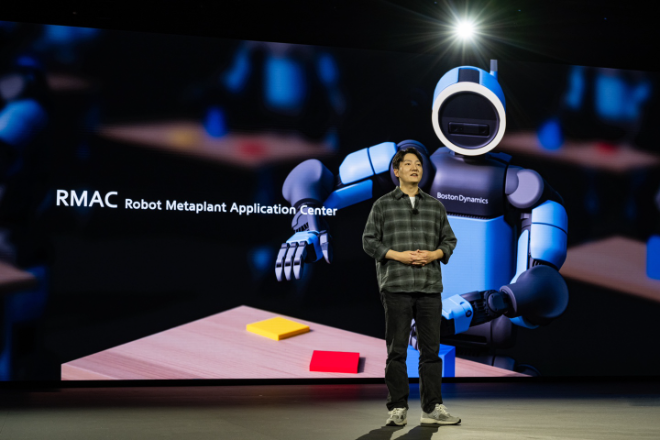
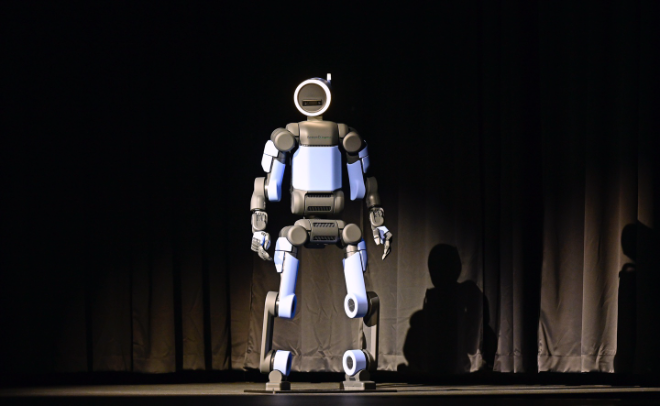
Boston Dynamics, the first to present at the Media Day, unveiled the 'Next-Generation Electric Atlas Research Model' and 'Next-Generation Electric Atlas Development Model' for the first time globally, presenting the core of the AI robotics ecosystem and introducing an ecosystem where Atlas collaborates with humans in the group's manufacturing environment.
Hyundai Motor Group has demonstrated practical results and applicability by deploying various Boston Dynamics robots such as Spot and Stretch in industrial sites, securing safety and increasing logistics efficiency. At this CES presentation, the company showcased its technological prowess with stages utilizing robots like Spot and Stretch.
Jack Koszewski, Vice President and General Manager of Boston Dynamics' Humanoid Robotics Division, confidently stated, "We stand at the threshold of a transformative shift as impactful as the smartphone," adding, "After more than 10 years of humanoid research, rapid advances in AI for commercial viability have occurred, and our moment has finally arrived."
Hyundai Motor Group anticipates that Boston Dynamics and humanoids will form the largest Physical AI market and has set a goal for the next-generation electric Atlas development model to become a mass-production humanoid robot deployed on a large scale in industrial sites.
To achieve this, the group plans to deploy the next-generation electric Atlas development model at production bases including 'Hyundai Motor Group Metaplant America (HMGMA)' and gradually expand Atlas adoption through process-by-process verification.
Starting in 2028, Atlas will be prioritized for processes with clearly verified safety and quality effects, such as sequencing work for parts classification at HMGMA, and from 2030, the work scope will expand to include parts assembly. The policy is to gradually spread throughout the production site as safety and quality are proven in manufacturing, while performing simple repetitive, heavy-weight, and high-risk tasks to ensure safer working environments for factory workers.
 이미지 확대보기
Following the announcement, Boston Dynamics revealed a strategic partnership with Google DeepMind to accelerate future humanoid technology development beyond robots' role in the AI robotics ecosystem. The two companies plan to actively pursue safe and efficient introduction of highly practical humanoids through AI model research for complex robot control.
Vice President Koszewski said, "The convergence of robots and AI is a new innovation that goes beyond simple technological progress to make human life safer and more prosperous," adding, "The consolidation of capabilities through strategic cooperation between Boston Dynamics and Google DeepMind will be an important step in redefining the future industrial paradigm."
Hyundai Motor Group will build an 'AI robotics ecosystem' based on global manufacturing expertise and infrastructure with the highest level of trust and safety accumulated so far, and promote mass production and commercialization of AI robotics.
Hyundai Motor Group's AI robotics ecosystem centers on an End-to-End (E2E) value chain based on automotive production infrastructure and know-how, and various technological capabilities of group affiliates. This is a core strategy for Hyundai Motor Group to lead Physical AI by enabling capability advancement, production acceleration, and service expansion in AI robotics.
To realize these plans, Hyundai Motor Group is strategically cooperating with global leading companies to secure not only physical hubs but also advanced technologies related to Physical AI.
Woo Seung-hyun, Hyundai Motor Group GSO, who introduced the AI robotics ecosystem, explained, "Hyundai Motor Group has established a partnership with Nvidia, which is evolving beyond a GPU company into a company providing an 'AI integrated platform,'" adding, "As the optimal partner to implement the Physical AI vision in the real world, Hyundai Motor Group will accelerate innovation and maximize development efficiency by actively utilizing Nvidia's AI infrastructure, simulation libraries, and frameworks."
Beyond manufacturing sites, Hyundai Motor Group is also pursuing partnerships for Physical AI's entry into other businesses. Currently, Spot and Stretch have already proven their utility at various companies including Intel, Michelin, and DHL, and based on this, they are expected to expand their activities into various fields such as construction, logistics, facility management, and energy.
 이미지 확대보기
Beyond external collaboration, the group plans to lead robot innovation and expand the Physical AI industry by utilizing accumulated manufacturing expertise and expanding parts infrastructure.
By affiliate, Hyundai Motor and Kia provide manufacturing infrastructure, process control, and production data; Hyundai Mobis handles precision actuator development; and Hyundai Glovis focuses on logistics and supply chain optimization.
In particular, Hyundai Mobis is making a full-scale entry into the global robot parts market by partnering with Boston Dynamics to supply actuators to Atlas.
Based on extensive experience in automotive parts design and mass production, Hyundai Mobis is strengthening its high-performance robot parts design capabilities and is expected to play an important role in the AI robotics ecosystem through standardization of core parts within the industry.
Through collaboration with affiliates possessing various capabilities, the group plans to realize the advantages of the group's AI robotics ecosystem and form a robust End-to-End value chain with flexibility, quality, and excellence by combining each affiliate's unique strengths and expertise.
This encompasses the entire robotics value chain including parts, logistics, and software, not only accelerating AI robotics commercialization but also enabling integrated management from development (parts supply, R&D) → learning and verification (AI development and verification) → mass production → service operation (sales, system integration, maintenance).
GSO Woo Seung-hyun stated, "We will build a system capable of producing 30,000 robots annually by 2028 to increase production speed," adding, "We aim to debut Atlas as the first industrial humanoid robot entering mass production and expand into broader industrial and commercial markets."
Kim JaeHun (rlqm93@fntimes.com)
데일리 금융경제뉴스 Copyright ⓒ 한국금융신문 & FNTIMES.com
저작권법에 의거 상업적 목적의 무단 전재, 복사, 배포 금지

가장 핫한 경제 소식! 한국금융신문의 ‘추천뉴스’를 받아보세요~