




 이미지 확대보기
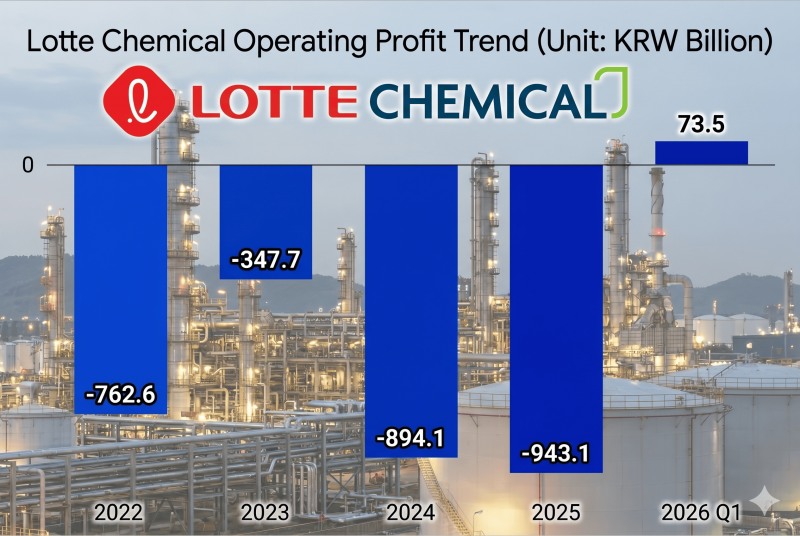
The company posted an operating profit of KRW 73.5 billion in the first quarter, marking its first quarterly profit in 10 quarters—since the third quarter of 2023. The unexpected result was driven by a lagging effect, in which the U.S.-Iran war pushed up international oil and product prices.
From the second quarter onward, there are concerns that earnings could shrink due to a reverse-lagging effect, as the company will have to sell products made from expensive raw materials (naphtha) at lower prices. Still, Lotte Chemical is expected to stay in the black on a full-year basis, as international oil prices are unlikely to suddenly fall below their pre-war levels. At its first-quarter earnings briefing, the company likewise stated that "if raw material and product prices follow a gradual trend through the end of the year, the (negative lagging) impact could be limited."
However, the structural factors weighing on profitability have not been resolved. The domestic petrochemical industry is now in its fifth year of a downturn driven by oversupply originating from China.
On top of this, the financial burden that has long dragged on Lotte Chemical remains. It stems from the company's investment in the "Line Project," a large-scale petrochemical complex in Indonesia, which began at a time that coincided with the industry slump. With the related investment wrapped up at the end of last year, the company's first-quarter capital expenditure (CAPEX) fell to KRW 165.1 billion, less than half the previous quarter's level. However, as temporary funding needs arose to improve its financial structure, the company's negative free cash flow (FCF) widened roughly twofold to KRW 789.8 billion.
관련기사
Lotte Chemical Snaps 10-Quarter Deficit Streak... How Long Will War-Driven Windfall Last?Lotte Chemical's Losses Mount for 4th Year as Basic Chemical Unit Struggles, Plans Growth Push in Advanced Materials[Petrochemicals: A Shifting Landscape] Korea's Petrochemical Restructuring Accelerates as Middle East Crisis BitesLotte-HD Hyundai Daesan Merger Signals Full-Scale Petrochemical Restructuring in Korea
On the 12th, Korea Investors Service lowered the outlook on Lotte Chemical's unsecured corporate bond credit rating from "AA- (stable)" to "AA- (negative)." It noted that, despite the first-quarter earnings rebound, the actual reduction in financial burden is limited owing to a delayed mid-to-long-term industry recovery, an annual interest burden of around KRW 400 billion, and KRW 600 billion in capital contributions to the integrated Daesan entity.
Lotte Chemical has faced downgrades to its credit rating or rating outlook almost every year since 2022. Since 2024, the company has been raising liquidity through price return swaps (PRS)—which carry a lighter initial burden as they are not recorded as financial debt—while steadily proceeding with the sale of "non-core" assets.
 이미지 확대보기
The market, too, maintains a conservative view of Lotte Chemical.
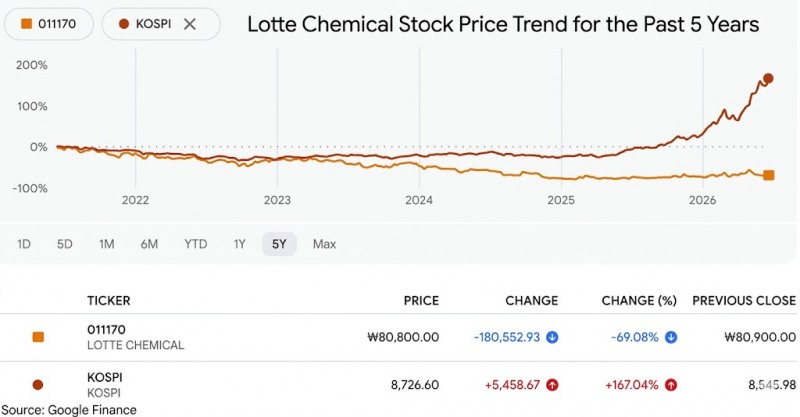
The company's stock has risen 19% this year, underperforming the KOSPI index's 102% gain. Even that increase was concentrated in a roughly 10% surge that began on the 11th, when expectations grew that the Middle East war would come to an end.
According to "THE COMPASS," the proprietary AI data platform developed by the Korea Financial Times, Lotte Chemical's price-to-book ratio (PBR) stood at 0.19 as of the first quarter. This reflects an extreme undervaluation in which the market recognizes only 19% of the asset value recorded on the company's books—effectively a forecast that the current earnings recovery will not be sustained.
A re-rating of Lotte Chemical's corporate value is expected to occur once the effects of its business restructuring become visible. The new businesses being pursued by President Lee Young-jun have stalled, pushed down the priority list for now by the broader restructuring of Korea's petrochemical sector. In his New Year's address this year, Lee emphasized that the company "aims for a fundamental transformation in which functional compounds, semiconductor process materials, green materials, functional copper foil, and eco-friendly energy materials such as hydrogen and ammonia account for more than 60% of its portfolio."
Gwak Horyung (horr@fntimes.com)
데일리 금융경제뉴스 Copyright ⓒ 한국금융신문 & FNTIMES.com
저작권법에 의거 상업적 목적의 무단 전재, 복사, 배포 금지

가장 핫한 경제 소식! 한국금융신문의 ‘추천뉴스’를 받아보세요~