






 이미지 확대보기
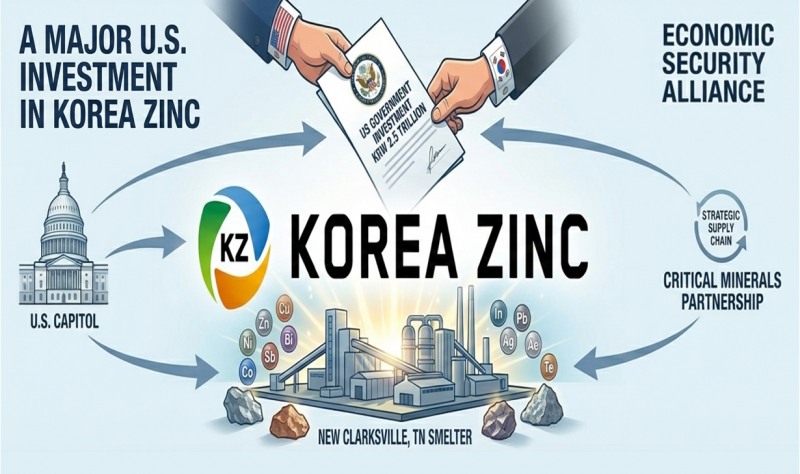
Korea Zinc will invest a total of KRW 11 trillion to build a 'U.S. Smelter' in Clarksville, Tennessee. This is a mega project with approximately KRW 10 trillion (USD 6.6 billion) invested in facility investment (Capex) alone.
The key to this investment is that it combines equity investment beyond simple subsidies. From the U.S. perspective, which must actively utilize economically allied companies to build comprehensive supply chains, Korea Zinc is analyzed to have been selected as the optimal partner.
U.S. Commerce Secretary Howard Lutnick highly evaluated the strategic value of this investment. He emphasized, "Korea Zinc's U.S. investment is a transformational deal that will change the critical minerals landscape," and "Through this, the U.S. can produce 13 types of critical strategic minerals on a large scale that are essential for national security, including aerospace, defense, semiconductors, and automobiles."
Over the past six months, the U.S. government has invested over USD 10 billion (approximately KRW 14.7 trillion) to secure equity and warrants in companies in critical minerals, IT, and energy sectors, including U.S. Steel, Intel, MP Materials, Trilogy Metals, and Westinghouse.
This is a preemptive response to the increasingly severe 'resource weaponization' risk. Currently, the U.S. import dependency for zinc reaches 73%, and self-sufficiency in major critical minerals such as antimony (85%), bismuth (89%), and gallium (100%) is also vulnerable.
The reason the U.S. chose Korea Zinc is clear. Not only does Korea Zinc possess world-class smelting technology and production capabilities, but it is already producing 12 of the 60 critical minerals selected by the U.S. (antimony, bismuth, cobalt, copper, indium, lead, nickel, silver, tellurium, zinc). When gallium and germanium are added by 2028, a total of 14 types can be supplied.
The industry views this investment as an opportunity for Korea-U.S. economic partnership to become even stronger. An industry official evaluated it as "a representative exemplary case symbolizing the economic security alliance between Korea and the U.S. beyond private company investment."
Shin Haeju (hjs0509@fntimes.com)
[관련기사]
가장 핫한 경제 소식! 한국금융신문의 ‘추천뉴스’를 받아보세요~
데일리 금융경제뉴스 Copyright ⓒ 한국금융신문 & FNTIMES.com
저작권법에 의거 상업적 목적의 무단 전재, 복사, 배포 금지




!['Chung Eui-sun Declares Robot Management Era'... Hyundai Motor Group to Lead Robotics Age with 'Physical AI' [KFT Topic]](https://cfnimage.commutil.kr/phpwas/restmb_setimgmake.php?pp=006&w=284&h=214&m=5&simg=20260106111449071567492587736121125197123.jpg&nmt=18)
![Lee Jae-yong and Chey Tae-won, Korea's 'Semiconductor Duo,' Head to China... What's the Status of Local Operations? [KFT Topic]](https://cfnimage.commutil.kr/phpwas/restmb_setimgmake.php?pp=006&w=284&h=214&m=5&simg=2026010608232205705141825007d12411124362.jpg&nmt=18)
!['Beyond Mobile to Robotics': LG Innotek Continues Portfolio Expansion [KFT Topic]](https://cfnimage.commutil.kr/phpwas/restmb_setimgmake.php?pp=006&w=284&h=214&m=5&simg=2026010508201109906141825007d12411124362.jpg&nmt=18)
![Doosan Enerbility Eyes Return to 'A' Credit Rating After 9 Years on Nuclear Power and Gas Turbine Boom [KFT Topic]](https://cfnimage.commutil.kr/phpwas/restmb_setimgmake.php?pp=006&w=284&h=214&m=5&simg=2026010208511504157141825007d12411124362.jpg&nmt=18)


![One Year In: CEO Hyun Shin-kyun Transforms LG CNS into KRW 6 Trillion AI Powerhouse [KFT Topic]](https://cfnimage.commutil.kr/phpwas/restmb_setimgmake.php?pp=006&w=110&h=79&m=5&simg=2026012807381208149141825007d12411124362.jpg&nmt=18)
![Samsung's 'Last Chance': Lee Jae-yong Pushes HBM4 as Make-or-Break Moment [KFT Topic]](https://cfnimage.commutil.kr/phpwas/restmb_setimgmake.php?pp=006&w=110&h=79&m=5&simg=2026012623242806011141825007d122461258.jpg&nmt=18)
![Hyundai Mobis Posts Record Results, Pivots to Robotics and Electrification [KFT Topic]](https://cfnimage.commutil.kr/phpwas/restmb_setimgmake.php?pp=006&w=110&h=79&m=5&simg=2026012911595100522141825007d12411124362.jpg&nmt=18)
